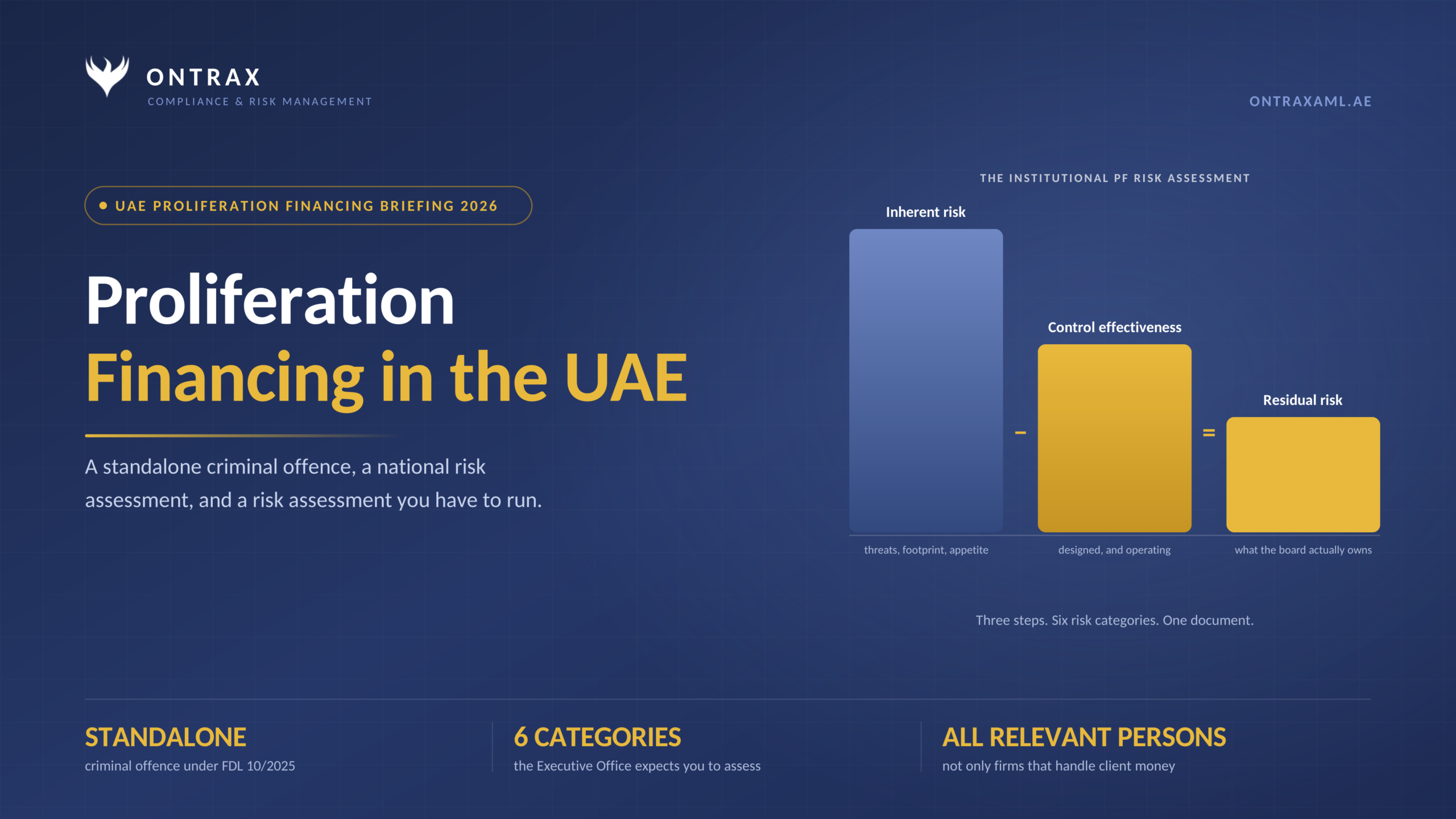

In short: Proliferation financing became a standalone criminal offence in the UAE under Federal Decree-Law No. 10 of 2025, alongside targeted financial sanctions obligations under Cabinet Decision No. 74 of 2020. The National Committee published an updated proliferation financing national risk assessment in 2026, issued pursuant to Decision No. 13 of 2026, identifying vulnerabilities in trade finance, shipping and complex corporate structures. The Executive Office for Control and Non-Proliferation expects financial institutions, DNFBPs and VASPs to run an institutional proliferation financing risk assessment in three steps — inherent risk, control effectiveness, residual risk — across six risk categories, one of which is cyber threats. It is a separate assessment from your AML risk assessment, not a paragraph inside it.
Proliferation financing is the obligation most UAE firms have formally acknowledged and practically ignored. The policy mentions it. The risk assessment has a paragraph. The training deck has a slide. And if a supervisor asked how the firm would recognise a payment for a dual-use component routed through three jurisdictions, nobody could answer.
That is no longer a survivable position. Proliferation financing is now a standalone criminal offence in the UAE, not merely a predicate or an add-on to the sanctions regime. The National Committee has published an updated national risk assessment specifically on proliferation financing. The CBUAE’s 2026 guidance requires licensed financial institutions to assess proliferation financing risk. The FSRA has told firms that business risk assessments should cover terrorist financing and proliferation financing, not money laundering alone. And the DFSA is examining proliferation financing controls in its thematic work.
This briefing sets out what proliferation financing is and how it differs from money laundering, what the national risk assessment expects firms to do, how the institutional proliferation financing risk assessment works, the six risk categories and the indicators that sit inside them, and which sectors carry real exposure. If your underlying sanctions controls need work first, our guide to sanctions screening in the UAE is the companion piece.
1. What proliferation financing is, and why your AML controls will not see it
Proliferation financing is the provision of funds or financial services used for the manufacture, acquisition, possession, development, export, transhipment, brokering, transport, transfer, stockpiling or use of nuclear, chemical or biological weapons and their means of delivery — or the evasion of sanctions imposed to prevent it.
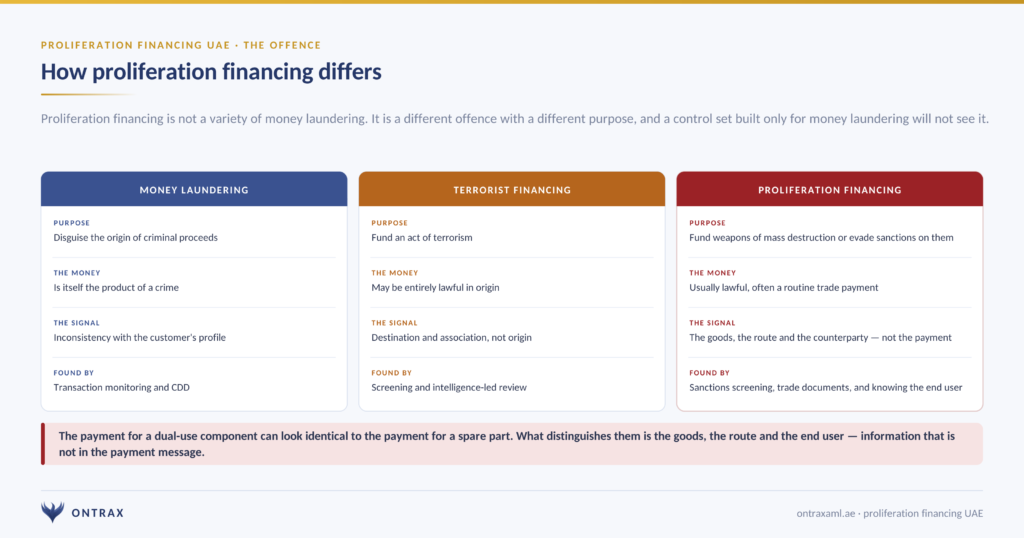
The distinction that matters operationally is this. Money laundering starts with criminal proceeds and tries to disguise their origin, so a control set built to detect inconsistency with a customer profile works. Proliferation financing usually starts with lawful money moving through a routine trade payment. There is nothing inconsistent about it. What makes it proliferation financing is the goods, the route and the end user — and none of that information is in the payment message.
The core problem: A payment for a dual-use component can look identical to a payment for a spare part. Transaction monitoring reading payment data alone will not distinguish them. Proliferation financing is detected through sanctions screening, trade documentation and knowing who the end user actually is.
Under Federal Decree-Law No. 10 of 2025, which came into force on 14 October 2025, proliferation financing is a standalone criminal offence. The same framework made terrorist financing, proliferation financing and tax evasion predicate offences for money laundering, and allows knowledge of illicit funds to be inferred from objective circumstances rather than requiring proof of actual knowledge. Legal persons face fines from AED 5 million to AED 100 million or more, and senior management can face personal criminal liability where they knew of and participated in or facilitated a predicate offence. Our guide to AML compliance for financial institutions in the UAE covers the wider framework these sit within.
Targeted financial sanctions under Cabinet Decision No. 74 of 2020 sit alongside the criminal provisions. Where a match arises, funds must be frozen and the match reported without delay — in practice within 24 hours of the listing decision, which is why firms must receive list updates directly from the Executive Office rather than relying on a vendor’s refresh cycle.
2. The national risk assessment, and what it actually requires
The National Anti-Money Laundering and Combatting the Financing of Terrorism and Financing of Illegal Organisations Committee published an updated proliferation financing national risk assessment in 2026, issued pursuant to Decision No. 13 of 2026. It identifies vulnerabilities in trade finance, shipping and complex corporate structures.
The national risk assessment does not change the underlying legal framework. It changes what supervisors expect firms to have considered — which is a more demanding test, because it cannot be met by pointing at a policy.
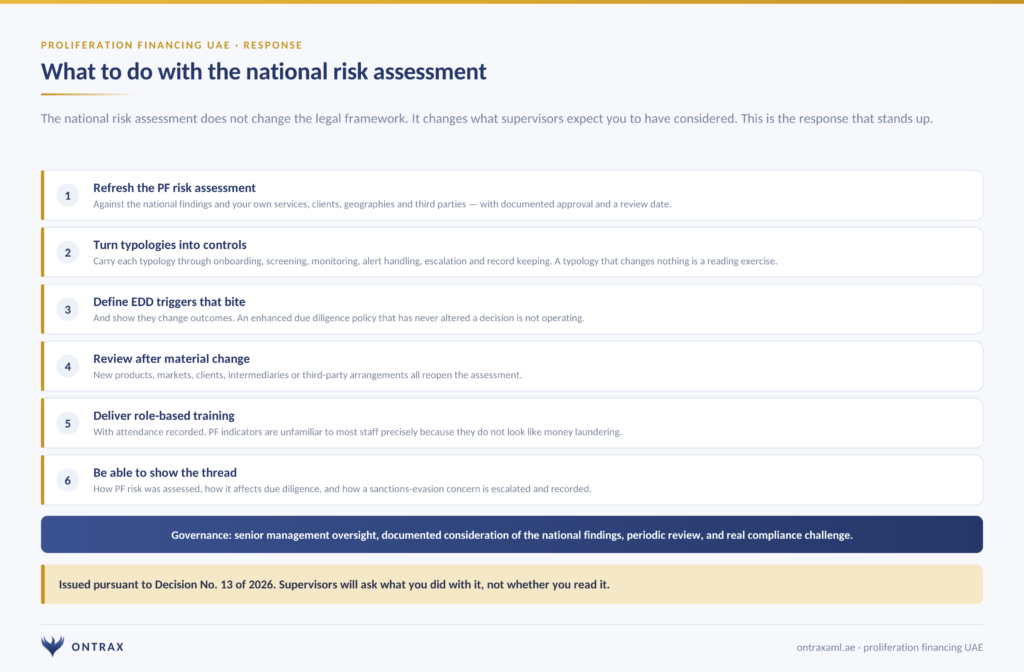
The expected response has six parts. Refresh the business-level proliferation financing risk assessment against the national findings and the firm’s own services, clients, geographies and third parties, with documented approval and a review date. Turn typologies into controls across onboarding, screening, monitoring, alert handling, escalation and record keeping. Define enhanced due diligence triggers and demonstrate that they change outcomes. Review controls after material change. Provide role-based AML and CPF training with attendance recorded. And be able to show how proliferation financing risk was assessed, how it affects due diligence, and how a sanctions-evasion concern is escalated and recorded.
Note who this reaches. Proliferation financing risk applies to all Relevant Persons, not only to firms that handle customer funds. Asset managers, advisers, virtual asset service providers and DNFBPs are explicitly in scope through their investors, their geographies, their cross-border activity and their reliance on custodians and third parties.
3. The institutional proliferation financing risk assessment
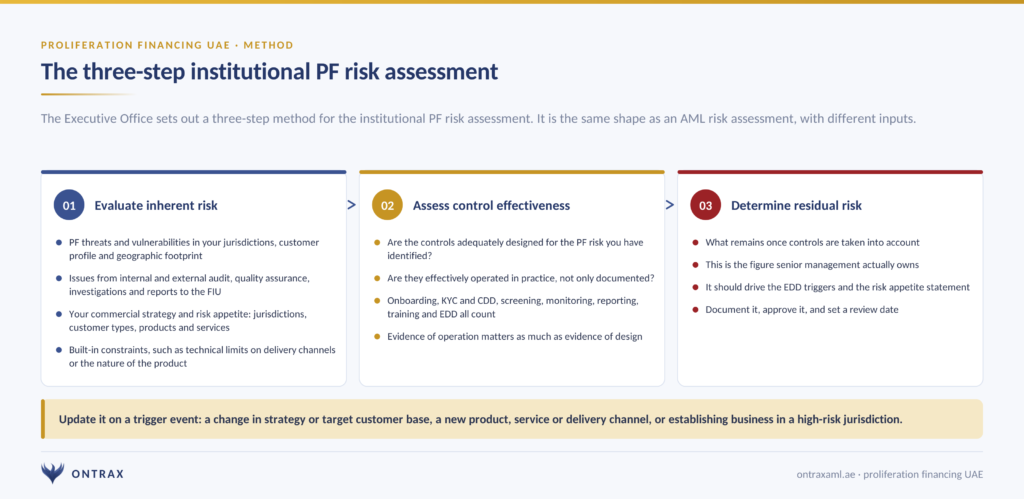
The Executive Office for Control and Non-Proliferation has published guidance on the institutional proliferation financing risk assessment, addressed to financial institutions, DNFBPs and virtual asset service providers. It sets out a three-step method.
Step one: evaluate inherent risk
Inherent proliferation financing risk is driven by the threats and vulnerabilities facing the institution’s jurisdictions, customer profile and geographic footprint; issues identified through internal and external audit, quality assurance, investigations and reports made to the Financial Intelligence Unit; the firm’s own commercial strategy and risk appetite in terms of jurisdictions, customer types, products and services; and built-in constraints such as technical limits on delivery channels or the nature of the products themselves. If your AML risk assessment already captures some of this, reuse it — but do not assume it covers proliferation financing, because the threat inputs are different.
Step two: assess control effectiveness
Controls are tested on two questions: are they adequately designed for the proliferation financing risk identified, and are they effectively operated in practice. Onboarding, KYC and customer due diligence, sanctions and adverse media screening, ongoing and transaction monitoring, suspicious activity reporting, employee training and screening, and enhanced due diligence all count toward the control score. Evidence of operation matters as much as evidence of design.
Step three: determine residual risk
Residual risk is what remains once controls are taken into account. This is the figure senior management actually owns, and it should drive the enhanced due diligence triggers and the risk appetite statement rather than sitting in an appendix. Document it, have it approved, and set a review date.
When to update it: On a trigger event rather than only on an annual cycle. A change in business strategy or target customer base, a new product, service or delivery channel, or establishing business in a high-risk jurisdiction each reopen the proliferation financing risk assessment.
4. The six risk categories — including the one nobody includes
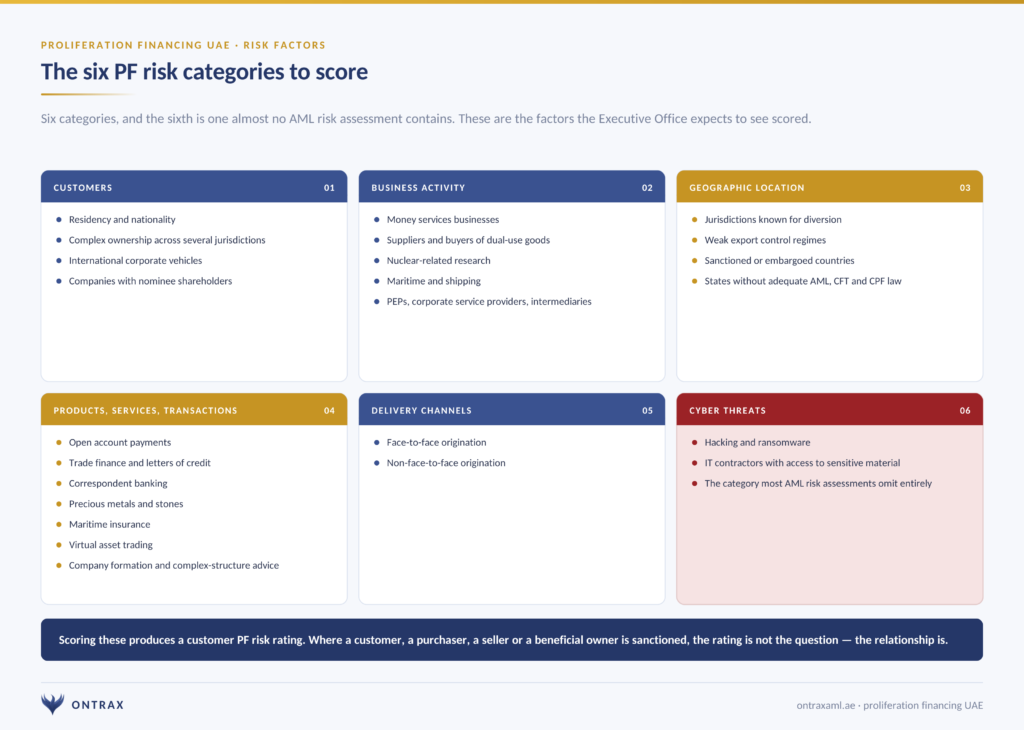
The Executive Office identifies six categories to assess. Five will look familiar. The sixth appears in almost no UAE AML risk assessment.
Customers
Residency and nationality; complex ownership spanning several jurisdictions and entity types; international corporate vehicles; and companies with nominee shareholders.
Business activity
Money services businesses; suppliers, buyers and trading partners in dual-use goods; nuclear-related research; the maritime and shipping industry; politically exposed persons; and corporate service providers and intermediaries.
Geographic location
Jurisdictions known for diversion; jurisdictions with weak export control laws; and countries subject to sanctions or embargoes or lacking adequate AML, CFT and CPF legislation. Diversion risk is the distinctive one here: a jurisdiction can be unremarkable for money laundering purposes and material for proliferation financing because of what passes through it.
Products, services and transactions
Open account payments; trade finance and letters of credit; correspondent banking; trading in precious metals and stones; maritime insurance; virtual asset trading; and company formation and legal advice on complex ownership structures. Our guide to crypto AML compliance in the UAE covers the VASP dimension in more depth.
Delivery channels
Face-to-face and non-face-to-face origination, assessed for what each permits an applicant to conceal.
Cyber threats
Hacking, ransomware, and IT contractors with access to sensitive material. This is the category that distinguishes a proliferation financing risk assessment from an AML one, and the reason the two cannot simply be merged. Proliferation networks acquire technical information as well as goods, and the route in is frequently the firm’s own systems or the people who maintain them.
If you are tempted to add a proliferation financing paragraph to your existing AML risk assessment rather than running a separate exercise, the cyber category is the test. An AML risk assessment has no natural home for it, which is a reasonable indication that the two assessments are answering different questions.
5. What a proliferation financing indicator looks like
The indicators that matter are not the ones a money laundering programme is tuned for.
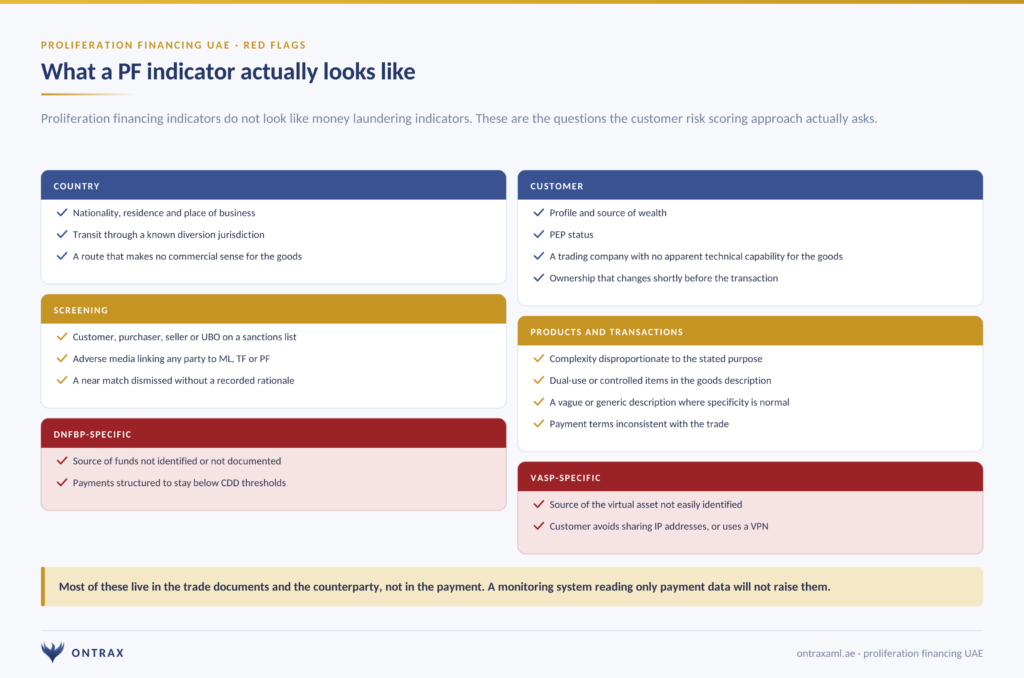
On country: nationality, residence and place of business; transit through a known diversion jurisdiction; a route that makes no commercial sense for the goods being shipped.
On the customer: profile and source of wealth; politically exposed person status; a trading company with no apparent technical capability for the goods it is purchasing; ownership that changes shortly before a transaction.
On screening: whether the customer, the purchaser, the seller or any ultimate beneficial owner appears on a sanctions list; adverse media linking any party to money laundering, terrorist financing or proliferation financing; and a near match dismissed without a recorded rationale. That last one is a documentation failure rather than a detection failure, and it is the most common. Our sanctions screening guide sets out which lists bind UAE firms and the clock that applies to a match.
On products and transactions: complexity disproportionate to the stated purpose; dual-use or controlled items in the goods description; a vague or generic description where specificity would be normal; payment terms inconsistent with the trade.
For DNFBPs specifically: whether the source of funds is identified and documented, and whether payments are structured to stay below customer due diligence thresholds. For virtual asset service providers: whether the source of the virtual asset is easily identified, and whether the customer avoids sharing IP addresses or uses a VPN.
Where these indicators live: Almost all of them sit in the trade documents and the counterparty, not in the payment. A transaction monitoring system reading only payment data will not raise them, which is why proliferation financing detection depends on trade document review, screening breadth and staff who know what to look for.
6. Where the exposure actually sits
Firms frequently conclude that proliferation financing is somebody else’s problem — a trade finance bank’s, or a shipping line’s. The national assessment points more widely than that.
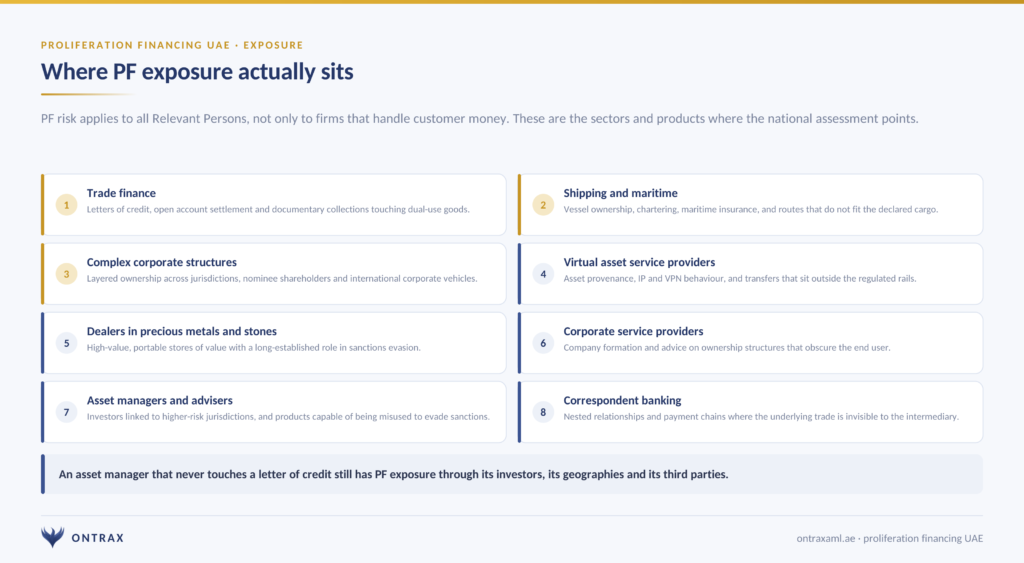
Trade finance carries it through letters of credit, open account settlement and documentary collections touching dual-use goods. Shipping and maritime through vessel ownership, chartering, maritime insurance and routes that do not fit the declared cargo. Complex corporate structures through layered ownership, nominee shareholders and international corporate vehicles.
Virtual asset service providers carry it through asset provenance and transfers sitting outside regulated rails. Dealers in precious metals and stones through high-value portable stores of value. Corporate service providers through company formation and structuring advice that obscures the end user. Asset managers and advisers through investors linked to higher-risk jurisdictions and products capable of being misused to evade sanctions. Correspondent banking through nested relationships where the underlying trade is invisible to the intermediary — as our guide to the UAE AML inspection notes, that invisibility is exactly what a supervisor probes.
An asset manager that never touches a letter of credit still has proliferation financing exposure through its investors, its geographies and its third parties. “We do not do trade finance” is not a risk assessment conclusion.
7. Building proliferation financing controls that work
Most UAE firms need to add a small number of specific capabilities rather than rebuild the programme.
Screen more than the customer
Screening the account holder is not enough. The purchaser, the seller, the ultimate beneficial owner, the vessel, the shipping agent and the end user should all be in scope where the firm has visibility of them. Where it does not have visibility, that absence is itself a risk factor to record.
Read the trade documents
Where the firm sees invoices, bills of lading or letters of credit, the goods description, the route and the end user are the richest source of proliferation financing indicators available. A generic goods description where specificity would be normal is a question, not a formatting preference.
Set enhanced due diligence triggers that change outcomes
Dual-use goods, diversion jurisdictions, maritime and shipping counterparties, nuclear-related research and complex structures should each trigger enhanced due diligence. As the national assessment response makes clear, the triggers have to demonstrably change what happens — an EDD policy that has never altered a decision is not operating. Our AML Policy Development service writes these triggers into the policy framework, and our guide to what a UAE AML policy must contain sets out where they belong.
Train people on indicators they have never seen
Proliferation financing indicators are unfamiliar precisely because they do not resemble money laundering. Role-based training for relationship managers, trade operations and screening analysts is the control with the best return here, and the national response expects it with attendance recorded.
Document the thread
The final expectation is evidential: be able to show how proliferation financing risk was assessed, how that assessment affects due diligence, and how a sanctions-evasion concern is escalated and recorded. An Independent AML Audit or an AML Audit & Compliance Review will test exactly that thread.
8. How Ontrax helps
Ontrax Compliance & Risk Management Ltd builds proliferation financing capability for UAE financial institutions, DNFBPs and virtual asset service providers. Our AML Risk Assessment service runs the institutional proliferation financing risk assessment as a separate, documented exercise across all six categories, with inherent risk, control effectiveness and residual risk evidenced and taken to senior management for approval.
Alongside it, our Transaction Monitoring & Screening service extends screening beyond the account holder to the counterparties that carry the risk; our AML Training & Awareness Programs build the indicator training this topic specifically requires; and our AML Compliance for Financial Institutions service covers the CBUAE expectation end to end. For firms in the financial free zones, our MLRO Services for DIFC & ADGM address the DFSA and FSRA overlay described in our DIFC AML compliance guide. Where the compliance function lacks capacity, our Virtual Compliance Officer and Outsourced AML Function services supply it.
If you take one action: Open your current risk assessment and look for the cyber threat category, the dual-use goods factor and the diversion jurisdiction factor. If none of the three is present, you do not have a proliferation financing risk assessment — you have an AML risk assessment with the words added, and that is the gap a supervisor will find first. Speak to Ontrax about running the assessment properly.
Frequently asked questions
What is proliferation financing?
The provision of funds or financial services used for the manufacture, acquisition, possession, development, export, transhipment, brokering, transport, transfer, stockpiling or use of nuclear, chemical or biological weapons and their means of delivery, or the evasion of sanctions imposed to prevent it. In the UAE it is a standalone criminal offence under Federal Decree-Law No. 10 of 2025.
How is proliferation financing different from money laundering?
Money laundering starts with criminal proceeds and tries to disguise their origin. Proliferation financing usually involves lawful money moving through a routine trade payment. What makes it an offence is the goods, the route and the end user — none of which appears in the payment message. Controls tuned to detect inconsistency with a customer profile will not see it.
Do I need a separate proliferation financing risk assessment?
Yes. The UAE Executive Office for Control and Non-Proliferation has published guidance on the institutional proliferation financing risk assessment for financial institutions, DNFBPs and VASPs. It uses six risk categories, one of which — cyber threats — has no natural home in an AML risk assessment, which is a practical indication that the two exercises answer different questions.
What are the three steps of a PF risk assessment?
Evaluate inherent risk, assess control effectiveness, then determine residual risk. Inherent risk draws on jurisdictional threats, customer profile, geographic footprint, audit and investigation findings, commercial strategy and risk appetite. Controls are tested on whether they are adequately designed and effectively operated. Residual risk is what remains and is the figure senior management owns.
What are the six proliferation financing risk categories?
Customers; business activity; geographic location; products, services and transactions; delivery channels; and cyber threats. The sixth covers hacking, ransomware and IT contractors with access to sensitive material, reflecting that proliferation networks acquire technical information as well as goods.
Who does proliferation financing risk apply to in the UAE?
All Relevant Persons — financial institutions, DNFBPs and virtual asset service providers — not only firms that handle customer funds. Asset managers, advisers, corporate service providers and dealers in precious metals and stones all carry exposure through investors, geographies, cross-border activity and reliance on third parties.
What is the UAE proliferation financing national risk assessment?
An assessment published by the National Anti-Money Laundering and Combatting the Financing of Terrorism and Financing of Illegal Organisations Committee in 2026, issued pursuant to Decision No. 13 of 2026. It identifies vulnerabilities in trade finance, shipping and complex corporate structures. It does not change the legal framework but sets expectations for how firms assess and mitigate proliferation financing risk.
What should a firm do in response to the national risk assessment?
Refresh the business-level PF risk assessment against the national findings with documented approval and a review date; turn typologies into controls across onboarding, screening, monitoring, alert handling, escalation and record keeping; define EDD triggers that demonstrably change outcomes; review after material change; deliver role-based training with attendance recorded; and be able to show how PF risk affects due diligence and how concerns are escalated.
What are dual-use goods?
Items with both civilian and military or weapons applications — components, materials, software and technology that are lawful to trade in most contexts but controlled when destined for a weapons programme. Suppliers, buyers and trading partners in dual-use goods are a named business activity risk factor in the UAE guidance.
How quickly must a sanctions match be acted on?
Without delay, which is treated in practice as within 24 hours of the listing decision. Funds must be frozen and the match reported. Firms should be registered with the Executive Office to receive list updates as they are issued rather than relying on a third-party vendor’s refresh cycle.
What are the penalties for proliferation financing in the UAE?
Under Federal Decree-Law No. 10 of 2025, legal persons face fines from AED 5 million to AED 100 million or more. Senior management can face personal criminal liability where they knew of and participated in or facilitated a predicate offence. Knowledge of illicit funds may be inferred from objective circumstances rather than requiring proof of actual knowledge.
Does transaction monitoring detect proliferation financing?
Not on its own. Most proliferation financing indicators sit in the trade documents and the counterparty rather than the payment. Detection depends on screening breadth — covering the purchaser, seller, beneficial owner, vessel and end user, not only the account holder — together with trade document review and trained staff.
How often should the PF risk assessment be updated?
On trigger events as well as periodically. Triggers include a change in business strategy or target customer base, a new product, service or delivery channel, or establishing business in a high-risk jurisdiction. The guidance says the assessment should be regularly updated based on emerging risks or trigger events.
Do DIFC and ADGM firms have proliferation financing obligations?
Yes. The federal framework applies in the financial free zones, and both regulators have reinforced it. The FSRA has told firms that business risk assessments should address terrorist financing and proliferation financing rather than money laundering alone, and the DFSA examines proliferation financing controls in its thematic reviews.
Sources and further reading
· UAE Executive Office — Targeted Financial Sanctions: Proliferation & Terrorism Financing
· Freshfields — Keeping pace with the UAE’s evolving AML, CTF and CPF framework
· CBUAE — Anti-Money Laundering resources
This briefing is general information on proliferation financing in the UAE and is not legal advice. Guidance and sanctions lists change constantly; verify the current position with the Executive Office for Control and Non-Proliferation and your supervisory authority before acting. Ontrax Compliance & Risk Management Ltd, Dubai International Financial Centre.