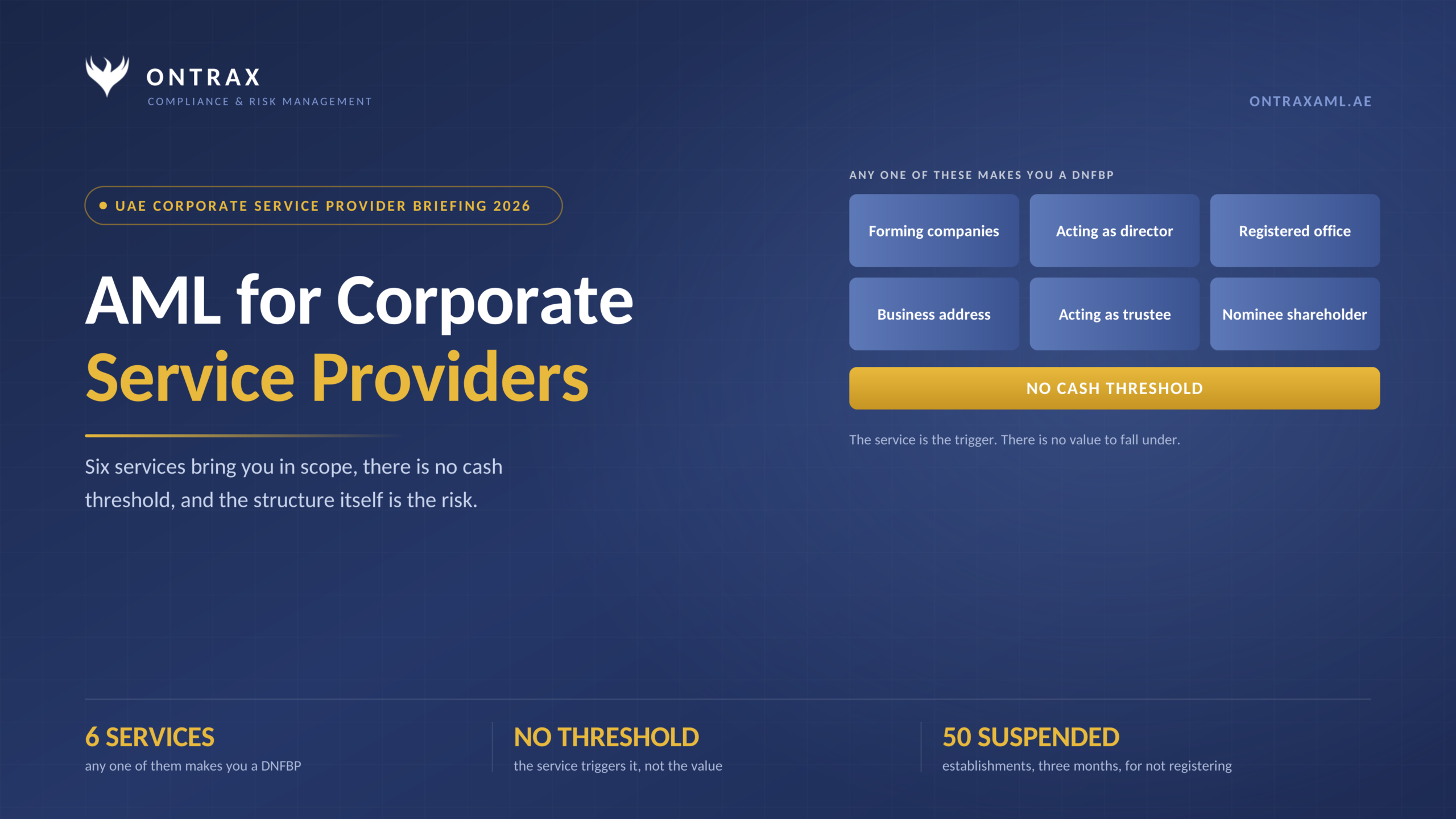

In short: A corporate service provider is a DNFBP under Cabinet Resolution No. 134 of 2025 when it performs any of six specified services: acting as a formation agent, acting as or arranging a director, secretary or partner, providing a registered office, providing a business, correspondence, residence or administrative address, acting as or arranging a trustee, or providing nominee shareholder services. There is no cash threshold — the service is the trigger. Obligations include customer due diligence focused on ownership, control and the purpose of the structure, a business risk assessment, an appointed compliance officer, goAML registration regardless of whether a report has ever been filed, record keeping and staff training. Fifty establishments were suspended for three months in 2023 for failing to register, and corporate service providers and auditors together recorded 95 violations and over AED 4 million in fines in the first half of 2025.
Corporate service providers occupy an unusual position in the UAE’s AML framework. They are not handling large cash payments like a jeweller, and they are not closing property deals like a broker. What they do is more consequential: they build the structures that everybody else then has to see through.
That is why the sector is regulated, and why its obligations are framed differently. There is no transaction value to assess, because the service is the trigger. Every engagement is in scope from the moment it is accepted, and the question the file has to answer is not where the money came from but what this structure is for.
This briefing sets out what AML for corporate service providers actually requires in the UAE: the six services that bring a firm into scope, why having no threshold changes how the programme is built, the four questions a client file must answer, where the risk genuinely sits, the two services that carry the most of it, and what the Ministry of Economy and Tourism asks for. For the ownership-tracing side of the same work, our guides to the UAE UBO register and KYC and CDD requirements go further into the mechanics.
1. The six services that bring you in scope
Cabinet Resolution No. 134 of 2025 defines a company or trust service provider by what it does for customers. Performing any one of six specified services is enough.
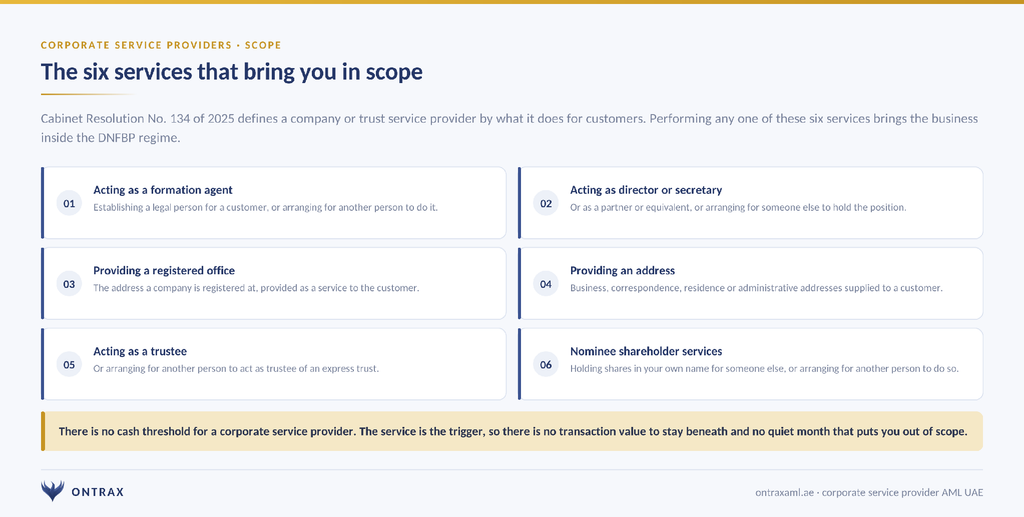
The six services that make a business a corporate service provider DNFBP in the UAE.
Acting as an agent to establish a legal person for a customer, or arranging for another person to do it. Acting as, or arranging for someone else to act as, a director, company secretary, partner or equivalent. Providing a registered office. Providing business, correspondence, residence or administrative addresses. Acting as, or arranging for someone to act as, a trustee. And providing or arranging nominee shareholder services.
The phrase to notice: “Or arranging for another person to.” A firm that does not itself act as director, but introduces clients to somebody who will, is performing the service. Referral is not a way out of the definition, and firms that have built their model on introductions rather than direct provision frequently assume otherwise.
Business setup consultancies, company formation agents, corporate secretarial firms and trust providers are all likely to fall inside. So are law firms and accountancy practices that provide these services alongside their main work — the obligation attaches to the activity, not to the professional label on the door. Where a firm also handles property transactions or deals in precious metals, the real estate and precious metals obligations apply on top rather than instead.
2. No cash threshold, and why that changes everything
Most DNFBP categories have a number attached to them. Corporate service providers do not, and that single difference reshapes the programme.
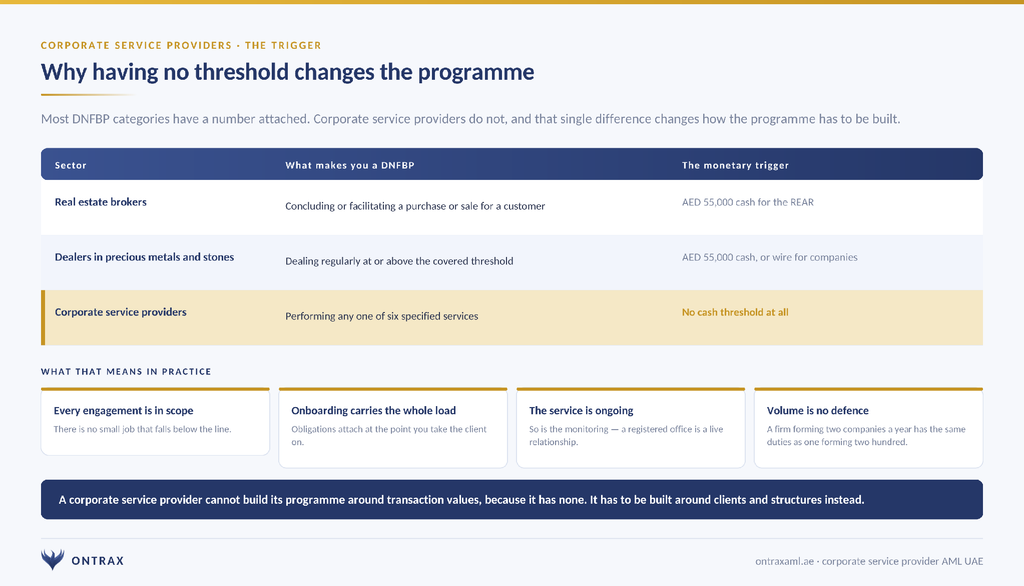
How the corporate service provider trigger differs from real estate and precious metals thresholds.
A real estate broker becomes a DNFBP by concluding or facilitating purchases and sales, with AED 55,000 attaching to the separate reporting obligation. A dealer in precious metals and stones is caught by dealing at or above the covered threshold. A corporate service provider is caught by performing a service, at any value, including for free.
Four consequences
- Every engagement is in scope. There is no small job that falls below the line, and no way to scope a cheap incorporation out of the programme.
- Onboarding carries the whole load. The obligations attach at the point the client is taken on, which means the client acceptance process is the control rather than a later transaction review.
- The service is ongoing, so the monitoring is too. A registered office or a directorship is a live relationship that continues for years, not a transaction that completes.
- Volume is no defence. A firm forming two companies a year carries the same obligations as one forming two hundred. What scales is the size of the programme, not whether one is required.
A corporate service provider cannot build its risk assessment around transaction values, because it has none. It has to be built around clients, structures and jurisdictions instead — which is a genuinely different exercise from the template most AML risk assessments start from.
3. The four questions a client file must answer
Due diligence for a corporate service provider answers a different question from due diligence at a bank.
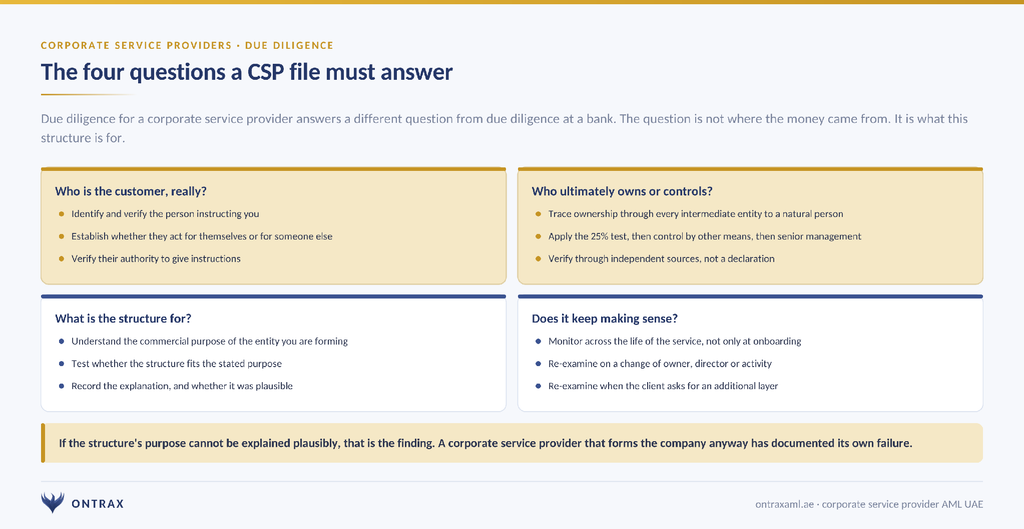
The four questions a corporate service provider’s client file has to answer.
Who is the customer, really?
Identify and verify the person instructing you, establish whether they act for themselves or for somebody else, and verify their authority to give instructions. An intermediary instructing on behalf of an unnamed principal is a starting point for enquiry, not a completed identification.
Who ultimately owns or controls?
Trace ownership through every intermediate entity until a natural person is reached, applying the 25% test, then control by other means, then the senior management official. Verify through independent sources rather than a declaration. This is the same cascade that governs your clients’ own UBO registers, and our AML Know Your Customer (KYC) service builds the verification process around it.
What is the structure for?
Understand the commercial purpose of the entity being formed, test whether the structure proposed actually fits that purpose, and record both the explanation and your assessment of whether it was plausible. This is the question unique to this sector and the one most files skip.
Does it keep making sense?
Monitor across the life of the service rather than only at onboarding. Re-examine on a change of owner, director or activity, and re-examine when a client asks for an additional layer to be added to an existing structure.
The test that matters: If the purpose of a structure cannot be explained plausibly, that is the finding. A corporate service provider that forms the company anyway, with a file recording an explanation it did not believe, has documented its own failure rather than discharged its duty.
4. Where the risk actually sits
Risk for a corporate service provider is structural rather than transactional.
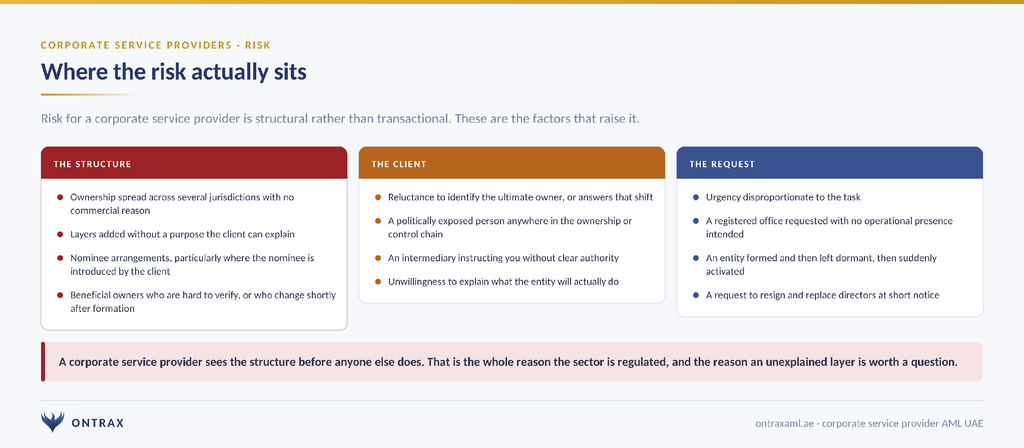
The structural, client and request risk factors for UAE corporate service providers.
In the structure: ownership spread across several jurisdictions with no commercial reason, layers added without a purpose the client can explain, nominee arrangements — particularly where the nominee is introduced by the client — and beneficial owners who are hard to verify or who change shortly after formation.
In the client: reluctance to identify the ultimate owner or answers that shift between conversations, a politically exposed person anywhere in the ownership or control chain, an intermediary instructing without clear authority, and unwillingness to explain what the entity will actually do.
In the request: urgency disproportionate to the task, a registered office requested with no operational presence intended, an entity formed and left dormant then suddenly activated, and a request to resign and replace directors at short notice.
A corporate service provider sees the structure before anyone else does — before the bank, before the auditor, before any counterparty. That is the whole reason the sector is regulated, and the reason an unexplained layer is worth a question at formation rather than a note in the file. Role-specific AML training for the people who take client instructions is what makes those questions happen.
5. The two services that carry the most risk
Both are entirely legitimate and widely used. Both can also put distance between a company and the person behind it, which is exactly what a laundering structure needs.
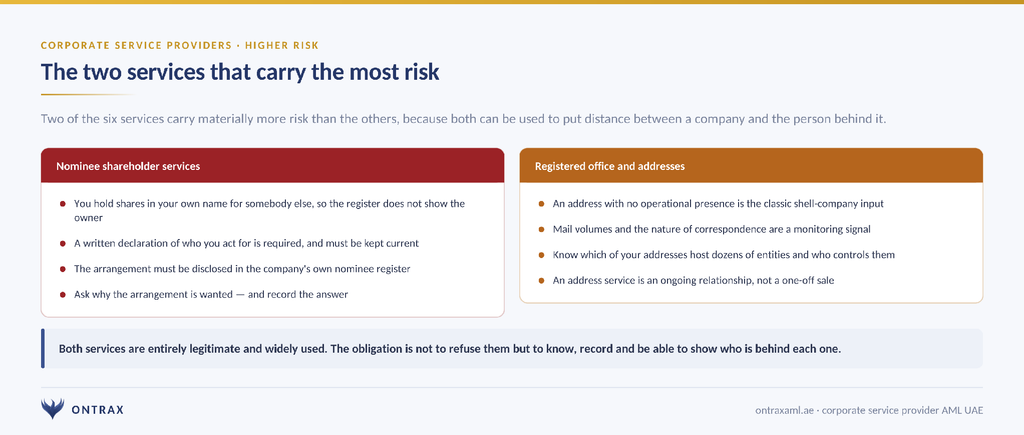
Nominee shareholder services and registered office provision: the two highest-risk corporate service provider services.
Nominee shareholder services
You hold shares in your own name for somebody else, so the share register does not show the real owner. A written declaration of who you act for is required and must be kept current, the arrangement must be reflected in the company’s own nominee register, and the question of why the arrangement is wanted should be asked and the answer recorded. Our guide to the UAE UBO register sets out the nominee declaration requirement from the company’s side.
Registered office and address services
An address with no operational presence is the classic shell-company input. Mail volume and the nature of correspondence are a monitoring signal that costs nothing to observe. Know which of your addresses host dozens of entities and who controls them. And treat an address service as the ongoing relationship it is, rather than a one-off sale with an annual renewal invoice.
The obligation is not to refuse: Neither service is prohibited and neither should be. The obligation is to know who is behind each arrangement, to record it, and to be able to show it on request. A firm that provides nominee services and can produce a current declaration for every one of them is in a strong position. A firm that cannot is not.
6. The enforcement record, and what is asked for
Corporate service providers are supervised by the Ministry of Economy and Tourism, and the published record shows the sector is actively examined.
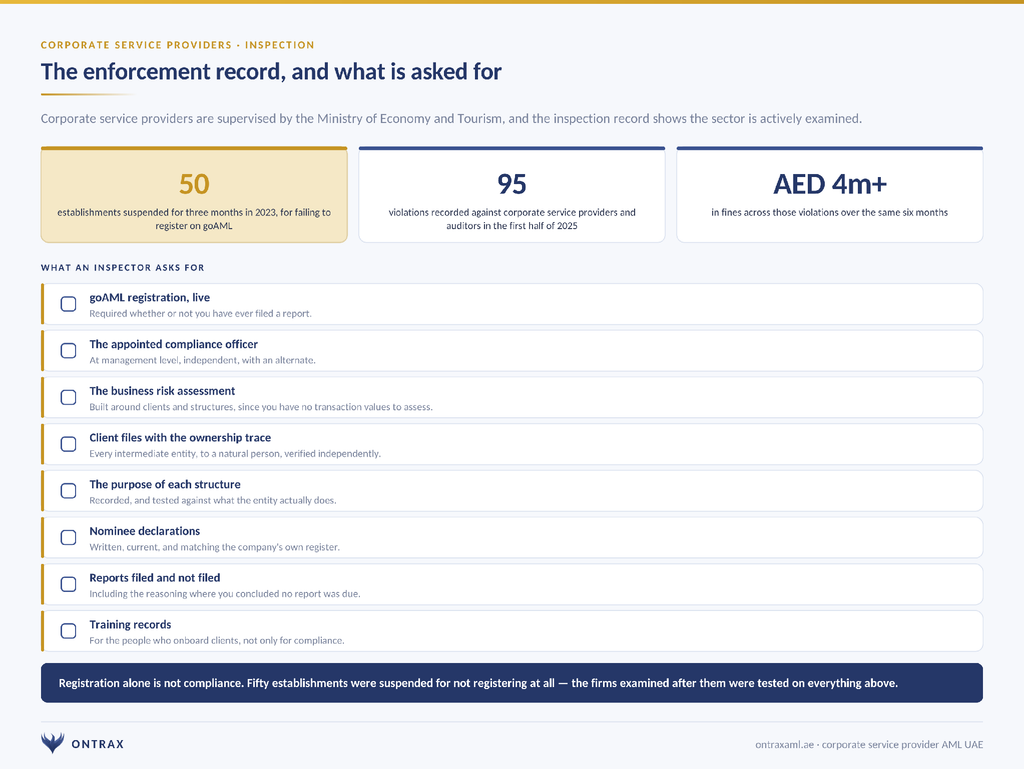
Enforcement against UAE corporate service providers and what a MoET inspector asks for.
Fifty establishments were suspended for three months in 2023 for failing to register on goAML. In the first half of 2025, corporate service providers and auditors together recorded 95 violations and over AED 4 million in fines. Registration is the baseline, and our guide to goAML registration covers the process including the SACM step that catches firms out — registration is required whether or not you have ever filed a report.
What an inspection requests
Live goAML registration. An appointed compliance officer at management level, independent of client-facing work, with an alternate. A business risk assessment built around clients and structures rather than transaction values. Client files showing the ownership trace through every intermediate entity to a natural person, verified independently. The recorded purpose of each structure, tested against what the entity actually does. Written, current nominee declarations matching the company’s own register. Reports filed and, critically, the reasoning recorded where you concluded no report was due. And training records for the people who onboard clients, not only for the compliance function — the standard is set out in our guide to AML training in the UAE.
Our guide to the UAE AML inspection describes how that request arrives and how quickly each item has to be produced.
7. When you have to decline, and how
Corporate service providers face the refusal question more often than most DNFBPs, because the warning signs appear at onboarding rather than mid-relationship. Handling it badly creates more exposure than the engagement would have.
Where beneficial ownership cannot reasonably be verified, or the purpose of a structure cannot be explained plausibly, the correct outcome is to decline the engagement or exit the relationship. Proceeding with a file that records your own doubts is the worst of both positions: you have the exposure and you have documented that you saw it coming.
Declining is not the end of the obligation. If the circumstances gave rise to a suspicion, that suspicion is reportable whether or not the engagement proceeded — the duty attaches to attempted and abandoned business as much as to completed business. Our guide to goAML registration and reporting sets out which report type applies and the fact that there is no value threshold on a suspicion.
And tipping off remains an offence. You may tell a prospective client that you are unable to act. You may not tell them that a report has been made, is being considered, or that their file has been escalated. Train the people who deliver that conversation, because it is usually a client-facing colleague rather than the compliance officer who has it.
Write the script before you need it: Agree in advance the exact wording used to decline an engagement on compliance grounds, and make sure every client-facing person uses it. An improvised explanation from somebody trying to be helpful is how tipping off actually happens in this sector.
8. Building a programme that fits a CSP
The programme a corporate service provider needs is not large, but it is shaped differently from a standard template.
The minimum viable programme
- goAML registration, live, with named users and current contacts.
- An appointed compliance officer at management level, independent of client-facing work, with an alternate.
- A documented scope assessment recording which of the six services you provide, including those you arrange rather than perform.
- A business risk assessment built around client types, jurisdictions, structures and the services you offer.
- Policies written for a corporate service provider, with client acceptance as the central control.
- A client acceptance standard that requires the ownership trace and the structure’s purpose before the engagement is accepted.
- A nominee register with current written declarations for every arrangement.
- Ongoing review triggered by changes of owner, director, activity or structure.
- Role-specific training for the people who take client instructions.
- Records held at least five years and organised so a client relationship can be reconstructed.
Where the capacity comes from
Most corporate service providers are small firms where the person responsible for compliance also sells the service — which is precisely the independence problem the rules are concerned with. Our Virtual Compliance Officer service places a qualified, UAE-resident officer into the role, independent of the client-facing side, and our Outsourced AML Function supplies the file work and reporting capacity behind them. Our guide to what can and cannot be outsourced sets out exactly where that line falls, because it is a question corporate service providers are often asked by their own clients.
To test the programme before a supervisor does, our AML Audit & Compliance Review works through the inspection list above, and our Independent AML Audit provides independent assurance for larger firms and groups.
9. How Ontrax helps
Ontrax Compliance & Risk Management Ltd works with company formation agents, corporate service providers, trust providers and business setup firms across the UAE. AML for corporate service providers is shaped by structures rather than transactions, and we build the programme that way.
We supply the officer through Virtual Compliance Officer, the capacity through Outsourced AML Function, the documents through AML Risk Assessment and AML Policy Development, the client acceptance process through AML Know Your Customer (KYC), screening through Transaction Monitoring & Screening, deputy cover through MLRO Provision, and the capability of your client-facing team through AML Training & Awareness Programs.
If you take one action: Pick three clients you incorporated in the last year and ask, for each, who the ultimate natural person owner is and what the structure was for. If the file cannot answer both questions from documents rather than memory, that is the gap an inspection will find, and it will find it in every file rather than in one. Speak to Ontrax about building the programme properly.
Frequently asked questions
Are corporate service providers DNFBPs in the UAE?
Yes. Under Cabinet Resolution No. 134 of 2025, a company or trust service provider is a designated non-financial business and profession when it performs any of six specified services for customers. They are supervised by the Ministry of Economy and Tourism.
Which services make a firm a corporate service provider?
Acting as a formation agent for a legal person; acting as or arranging for someone to act as a director, company secretary, partner or equivalent; providing a registered office; providing business, correspondence, residence or administrative addresses; acting as or arranging a trustee; and providing or arranging nominee shareholder services.
Is there a cash threshold for corporate service providers?
No. Unlike real estate brokers and dealers in precious metals and stones, there is no monetary threshold. The service itself is the trigger, so every engagement is in scope at any value, including services provided at no charge.
Does arranging for someone else to act count?
Yes. The definition expressly covers arranging for another person to act as director, secretary, partner, trustee or nominee shareholder. A firm that introduces clients to a third party who performs the service is performing the service for these purposes.
Do business setup consultancies have AML obligations?
Where they act as formation agents, provide registered offices or addresses, or arrange directors, secretaries, trustees or nominee shareholders, yes. The obligation attaches to the activity rather than to how the firm describes itself, so a business setup consultancy performing those services is in scope.
Do law firms and accountants fall within this category?
They can. A law firm or accountancy practice that provides company formation, registered office, directorship or trustee services alongside its main work is performing the specified services. Independent legal professionals are supervised by the Ministry of Justice rather than MoET, but the underlying obligation is the same.
What does customer due diligence look like for a CSP?
Four questions: who is the customer and do they have authority to instruct; who ultimately owns or controls, traced through every intermediate entity to a natural person and verified independently; what the structure is for and whether it fits that purpose; and whether it continues to make sense across the life of the service.
Do corporate service providers need to register on goAML?
Yes, and registration is required whether or not a report has ever been filed. Fifty establishments were suspended for three months in 2023 for failing to register. Registration is free, and the process begins with SACM pre-registration rather than on the goAML portal itself.
What are the risks in nominee shareholder services?
The share register does not show the real owner, which is the point of the arrangement and also its risk. A written declaration of who the nominee acts for is required and must be kept current, the arrangement must be reflected in the company’s nominee register, and the reason for it should be asked and recorded.
Is providing a registered office a regulated activity?
Yes, it is one of the six specified services. An address provided with no operational presence behind it is a recognised shell-company input, so mail volumes and correspondence patterns are worth monitoring, and the firm should know which of its addresses host large numbers of entities.
What penalties have corporate service providers faced?
Fifty establishments were suspended for three months in 2023 for failing to register on goAML. In the first half of 2025, corporate service providers and auditors together recorded 95 violations and over AED 4 million in fines. Supervisory powers derive from Federal Decree-Law No. 10 of 2025 and Cabinet Resolution No. 134 of 2025.
Does a small CSP have the same obligations as a large one?
Yes. There is no volume exemption. A firm forming two companies a year has the same obligations as one forming two hundred. What scales with size is the proportionality of the programme, not whether a programme is required.
How long must a CSP keep records?
At least five years under the federal framework, organised so that a client relationship and the services provided can be reconstructed, and available to the supervisory authority on request.
Can a corporate service provider outsource its compliance function?
Specific tasks can be outsourced with a Letter of No Objection from the supervisory authority, but the role of the compliance officer and the compliance function as a whole cannot be outsourced. Where a firm cannot appoint a suitable officer internally, a third-party or virtual compliance officer route exists under conditions set by the Ministry of Economy and Tourism, with prior written approval.
Sources and further reading
· Cabinet Resolution No. 134 of 2025 — Executive Regulations to Federal Decree-Law No. 10 of 2025
· UAE Ministry of Economy & Tourism — AML for DNFBPs
· DNFBP AML obligations compared: real estate, precious metals and corporate service providers
· UAE Financial Intelligence Unit — goAML reporting platform
· AML regulations for DNFBPs in the UAE — sector guide
This briefing is general information on AML for corporate service providers in the UAE and is not legal advice. Rules and guidance change; verify the current position with the Ministry of Economy and Tourism before acting. Ontrax Compliance & Risk Management Ltd, Dubai International Financial Centre.