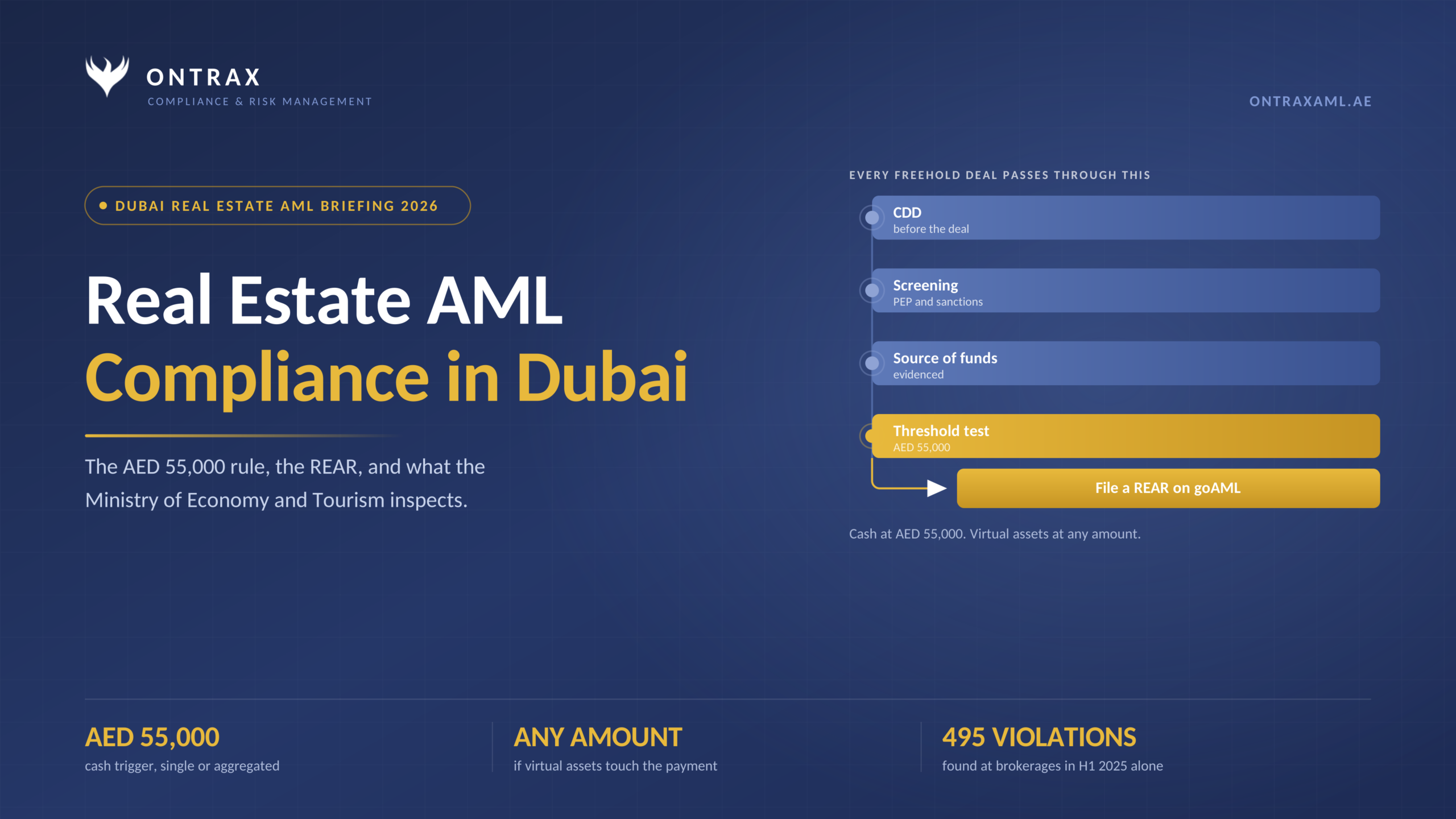

In short: Real estate agents and brokers are DNFBPs supervised by the Ministry of Economy and Tourism. A Real Estate Activity Report must be filed on goAML for any freehold purchase or sale where cash payments reach AED 55,000 in total — one payment or several — or where virtual assets form any part of the payment, at any amount. The REAR is not a suspicion report; it is filed whether or not anything looks wrong. Customer due diligence must be completed before the transaction is executed, source of funds must be evidenced rather than asserted, and records kept at least five years. In the first half of 2025 alone, MoET recorded 495 violations at real estate brokerages, with penalties of roughly AED 18.5 million.
Dubai sells more property, to more nationalities, with more cash and more structures in the chain, than almost any market on earth. That is the opportunity, and it is also the reason real estate AML compliance has become the most heavily inspected corner of the UAE’s non-financial sector.
The numbers make the point better than any argument. In the first six months of 2025, the Ministry of Economy and Tourism’s inspection programme found 1,063 violations across all designated non-financial businesses and professions, with fines exceeding AED 42 million. Real estate brokerages accounted for 495 of those violations and around AED 18.5 million of those penalties. Nearly one in two findings came from this sector.
Most of those findings are not sophisticated. They are missing files, unfiled reports, untrained sales staff and a policy document with another firm’s name still in it. This briefing sets out what real estate AML compliance actually requires in Dubai and across the UAE: who is in scope, exactly when a Real Estate Activity Report is triggered, how due diligence has to be sequenced around a deal, what source of funds evidence stands up, and what an inspector asks for. Our broader guide to KYC and CDD requirements in the UAE covers the underlying customer due diligence framework in more depth.
1. Who real estate AML compliance actually reaches
Real estate AML compliance follows the activity, not the licence category or the size of the firm. A brokerage that concludes or facilitates transactions on behalf of its customers in relation to the purchase or sale of real estate is a DNFBP, and it is in scope anywhere in the UAE — mainland and free zones alike.
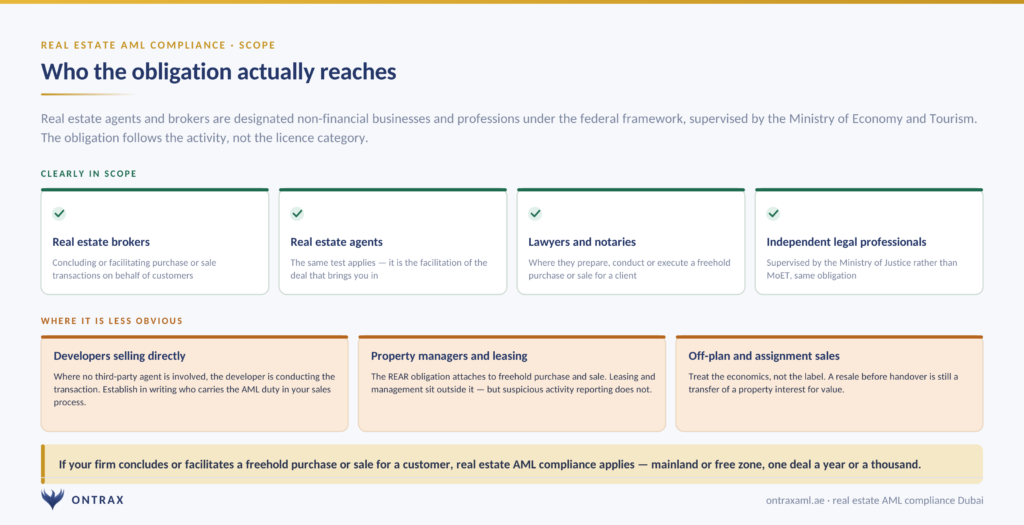
In Dubai and across the UAE, real estate brokers and agents are supervised by the Ministry of Economy and Tourism. Lawyers, notaries and other independent legal professionals carry the same reporting obligation when they prepare, conduct or execute a freehold purchase or sale for a client, but are supervised by the Ministry of Justice. The duty is identical; the supervisor differs.
Three places firms misread the perimeter
The first is a developer selling directly. Where no third-party agent is involved, the developer is the party conducting the transaction, and the question of who carries the AML duty in that sales process should be settled in writing rather than assumed. Developers working through external agents should be equally clear about where the obligation sits.
The second is leasing and property management. The REAR obligation attaches to freehold purchase and sale, so routine leasing falls outside that specific trigger. Suspicious transaction reporting does not fall outside anything — if activity in a leasing relationship looks like laundering, it is reportable.
The third is off-plan and assignment sales. The safe approach to real estate AML compliance here is to treat the economics rather than the label: a resale before handover is still a transfer of a property interest for value, and the due diligence and reporting logic should follow it.
There is no small-firm exemption in UAE real estate AML compliance. A two-broker office doing a handful of deals a year carries the same registration, reporting and record-keeping obligations as a national chain. What changes is the scale of the programme, not whether one is required.
2. The Real Estate Activity Report: exactly when it is triggered
The REAR is the real estate AML compliance obligation most specific to this sector, and the one most often misunderstood. It is not a suspicion report. It is triggered by the shape of the payment, and it is filed whether or not anything about the deal looks wrong.
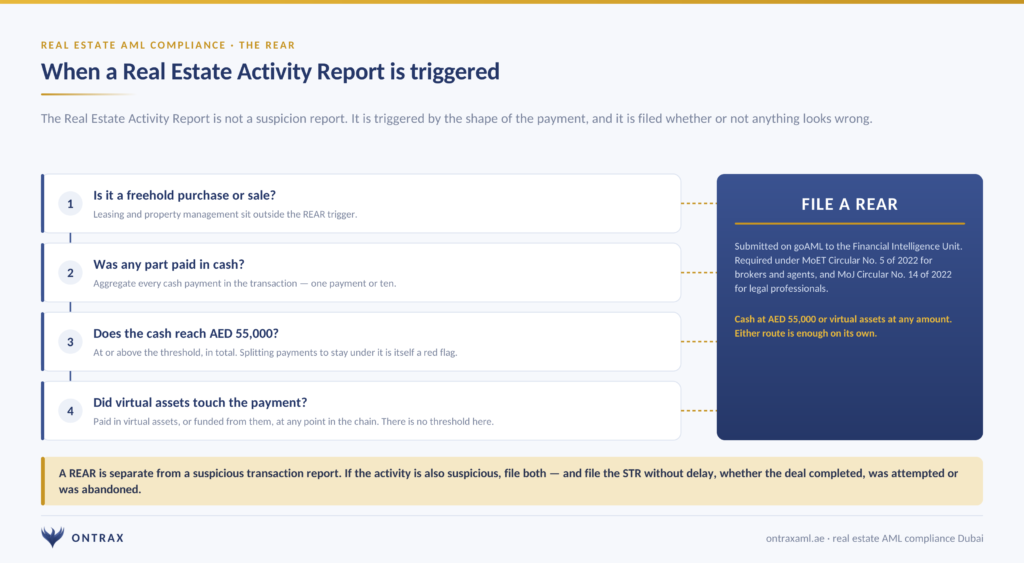
The requirement comes from Ministry of Economy Circular No. 5 of 2022 for brokers and agents, and Ministry of Justice Circular No. 14 of 2022 for lawyers and other legal professionals. It applies to freehold purchase and sale transactions, and the report is filed with the Financial Intelligence Unit through goAML.
The cash route: AED 55,000, in aggregate
A REAR is required where cash payments in the transaction reach AED 55,000 or more. The threshold applies in aggregate, not per payment: a single cash payment at or above the figure triggers it, and so do several smaller payments that add up to it.
The aggregation point: Four cash payments of AED 14,000 each total AED 56,000 and trigger a REAR, exactly as one payment of AED 56,000 would. A buyer who proposes to split payments to stay below the threshold has handed you a red flag, not a solution — structuring to evade a reporting threshold is itself an indicator of deliberate evasion and should be considered for a suspicious transaction report.
The virtual asset route: no threshold at all
A REAR is also required, regardless of amount, where all or part of the payment is made in virtual assets, or where funds were converted from or to virtual assets at any point in the funding chain. There is no de minimis. A single dirham of crypto-derived value in the payment chain brings the obligation. Where a virtual asset service provider is involved, confirm its licensing position — our guide to crypto AML compliance in the UAE covers the VASP side of that relationship.
REARs and STRs are different obligations
In real estate AML compliance, filing a REAR does not discharge the suspicious transaction reporting duty, and filing an STR does not discharge the REAR. Where a transaction is both over threshold and suspicious, both are filed. And the reporting duty applies whether the transaction completed, was attempted, or was discontinued — abandoned deals are among the most under-reported items in this sector, because the file is closed and nobody goes back to it.
3. Due diligence has to come before the deal
Sequencing matters more in real estate AML compliance than in most sectors, because the commercial pressure in a Dubai brokerage runs the other way. Customer due diligence must be completed before the business relationship begins and before any transaction is executed — not assembled at closing to satisfy a file review.
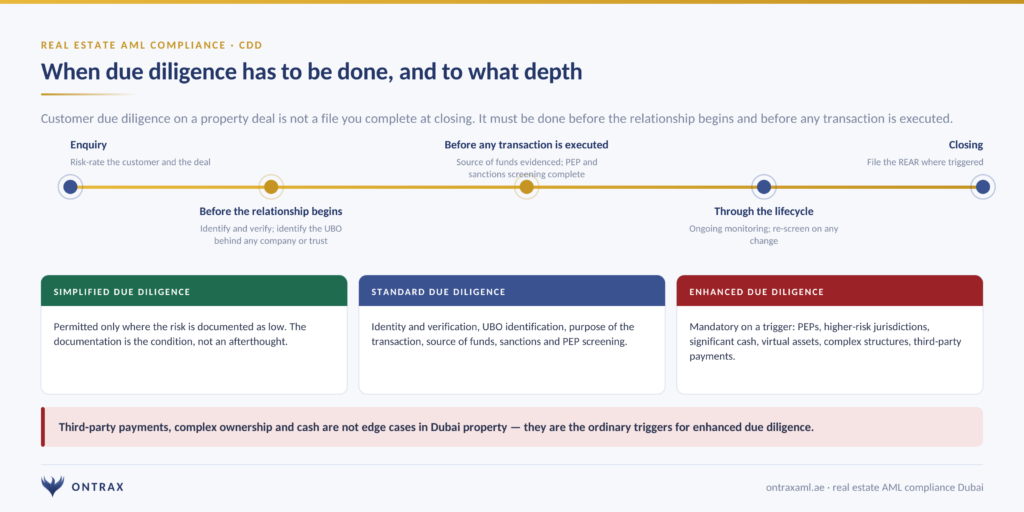
Standard due diligence covers identification and verification of the customer, identification of the ultimate beneficial owner behind any corporate or trust buyer, an understanding of the purpose of the transaction, verification of source of funds, and sanctions and politically exposed person screening. Our AML Know Your Customer (KYC) service builds this process for brokerages that are starting from a blank page, and our sanctions screening guide sets out which lists bind you and how quickly you have to act on a match.
In real estate AML compliance, simplified due diligence is permitted only where the risk has been documented as low — and the documentation is the condition, not a formality to add later. Enhanced due diligence is mandatory on a trigger, and the triggers are unusually common in Dubai property: politically exposed persons, higher-risk jurisdictions, significant cash, virtual assets, complex ownership structures and third-party payments.
Read that list again in the context of an actual Dubai pipeline. Complex offshore structures, overseas buyers, third parties settling on behalf of a purchaser and cash components are not exotic in this market — they are ordinary. For many Dubai brokerages, enhanced due diligence is the normal case rather than the exception, and a programme designed around standard CDD will be under-scoped from the start.
Ongoing monitoring applies through the lifecycle of the relationship, which for a repeat investor client means re-screening on change rather than once at onboarding.
4. Source of funds: evidenced, not asserted
This is where real estate AML compliance files most often fail. The buyer must show where the money came from, and a note recording what they said is not evidence of where it came from.
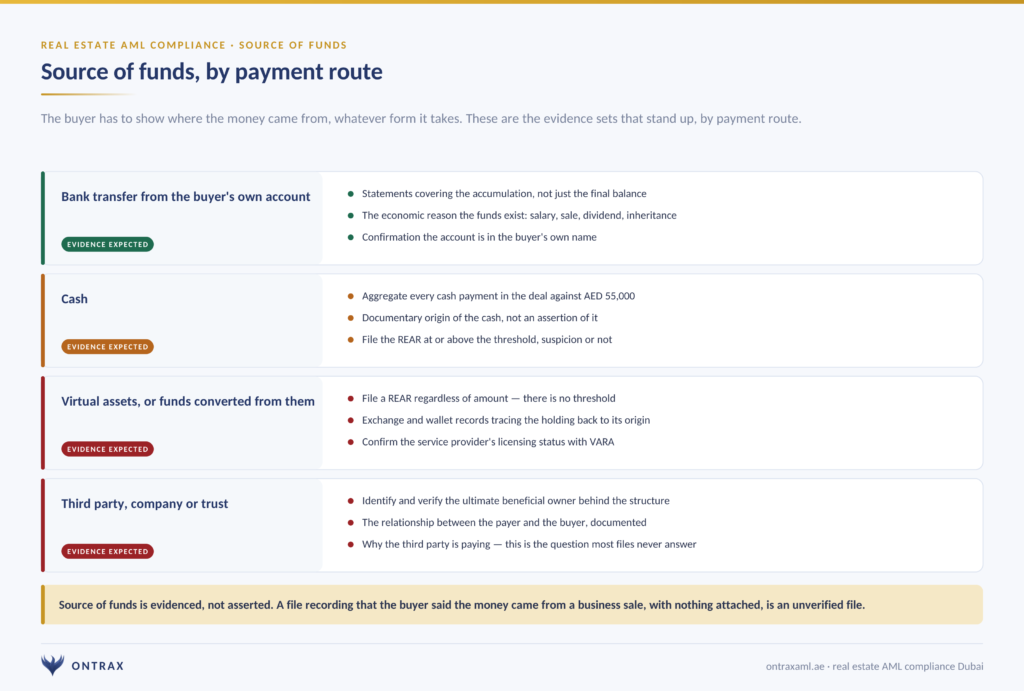
For a bank transfer from the buyer’s own account, the evidence set is statements covering the accumulation of the funds rather than a screenshot of the final balance, a documented economic reason for the funds existing — salary, a business or property sale, a dividend, an inheritance — and confirmation that the paying account is in the buyer’s own name.
For cash, aggregate every payment against the AED 55,000 threshold, obtain documentary evidence of the origin of the cash rather than an assertion of it, and file the REAR at or above the threshold whether or not you are suspicious.
For virtual assets, file the REAR regardless of amount, obtain exchange and wallet records tracing the holding back to its origin, and confirm the licensing status of any service provider in the chain.
For a third party, company or trust, identify and verify the ultimate beneficial owner behind the structure, document the relationship between the payer and the buyer, and record why the third party is paying at all. That last question is the one most files never answer, and it is the first one an inspector asks.
Red flags that recur in Dubai property files
Real estate AML compliance training works better when the indicators are drawn from this market rather than from a generic list. These are the patterns that recur in Dubai transactions.
- A buyer who proposes splitting cash payments, or who asks what the reporting threshold is before structuring the payment.
- A purchase price materially out of line with the market for the unit, in either direction, with no commercial explanation.
- A corporate buyer incorporated weeks before the transaction, with no trading history and no apparent purpose beyond holding the asset.
- An ownership chain that runs through two or more jurisdictions with no connection to the buyer, the funds or the property.
- A third party settling the purchase with no documented relationship to the buyer, or a relationship that changes when questioned.
- Rapid resale shortly after purchase, particularly at a loss, which can indicate layering rather than a commercial decision.
- A buyer indifferent to price, unit or location, where the objective appears to be placing funds rather than acquiring property.
- Reluctance to provide source of funds evidence, or documentation that arrives only after repeated requests and in fragments.
- Payment routed from a jurisdiction with no connection to the buyer’s stated residence or business.
- Instructions to complete unusually quickly, with pressure applied to shorten due diligence.
None of these is conclusive on its own. Each is a prompt to ask a further question and to record both the question and the answer. A file showing that an indicator was noticed, examined and resolved is a strong file; a file that is silent on an obvious indicator is the one that produces a finding.
A test you can apply to any file today: Pick a completed transaction at random. Can you point to a document — not a note of a conversation — that shows where the purchase money came from? If the answer is a file note recording the buyer’s explanation, with nothing attached, the source of funds is unverified and the file will be recorded as a finding.
5. What inspection is actually producing
Real estate AML compliance in the UAE is not a theoretical risk. It is an active supervisory programme with published results.
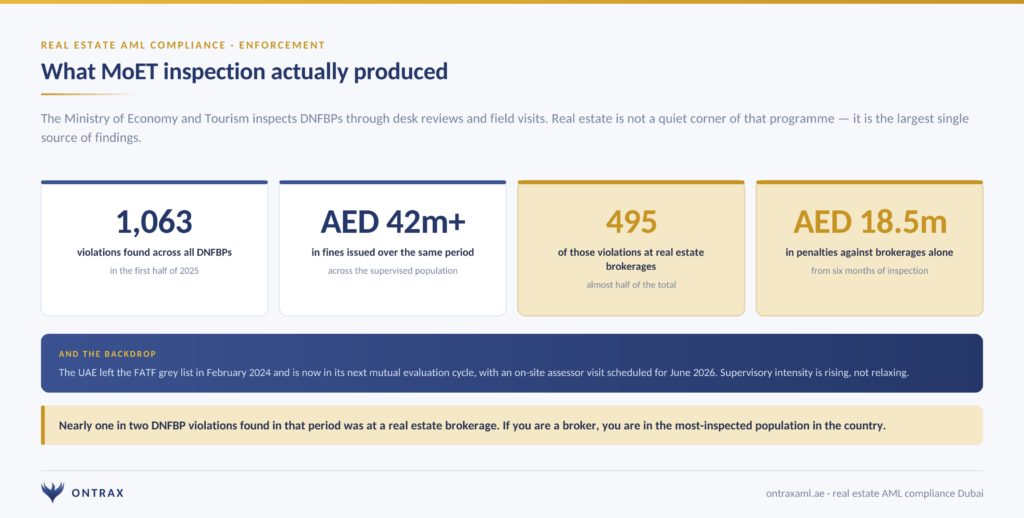
In the first half of 2025, MoET’s desk reviews and field visits found 1,063 violations and issued fines exceeding AED 42 million across the DNFBP population. Real estate brokerages accounted for 495 of those violations and approximately AED 18.5 million in penalties. For context on the wider effort, UAE authorities confiscated assets worth AED 5.4 billion during 2025.
The backdrop to real estate AML compliance in Dubai is tightening rather than relaxing. The UAE was removed from the FATF grey list in February 2024, and is now in its next mutual evaluation cycle with an on-site assessor visit scheduled for June 2026. A mutual evaluation examines effectiveness, not just the existence of rules — which means supervisors have a direct incentive to demonstrate that inspection finds things and that penalties follow.
If you run a brokerage, you are in the most-inspected non-financial population in the country, in the year of a mutual evaluation on-site visit. The question is not whether an inspection is likely but whether the file survives one.
6. What an inspector asks for
A MoET real estate AML compliance inspection is predictable in structure. These are the items requested, in roughly the order they come.
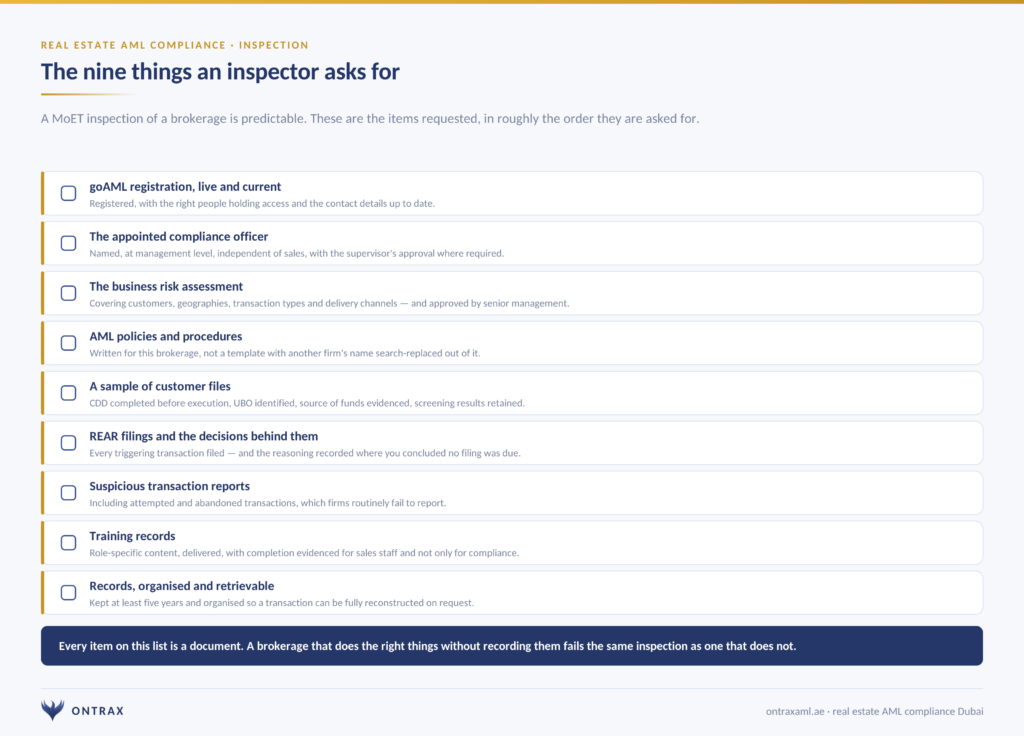
Registration on goAML comes first, and it must be live, with the right people holding access and the contact details current. Then the appointed compliance officer: named, at management level, independent of the sales function, and approved by the supervisory authority where that approval is required. Our guide to outsourced AML compliance explains why a brokerage that cannot appoint a suitable officer internally has a route available to it, and what conditions attach.
Then the documents. The business risk assessment covering customers, geographies, transaction types and delivery channels, approved by senior management. The AML policies and procedures — written for this brokerage, not a template with another firm’s name search-replaced out of it, which inspectors find more often than firms imagine. Our guide to what a UAE AML policy must contain sets out the sections that have to be there.
Then the evidence. A sample of customer files, testing whether CDD was completed before execution, the UBO identified, source of funds evidenced and screening results retained. REAR filings, and critically the reasoning recorded where you concluded no filing was due. Suspicious transaction reports, including for attempted and abandoned transactions. Training records, with role-specific content evidenced as completed by sales staff and not only by the compliance function. And records, kept at least five years and organised so that a transaction can be fully reconstructed on request — the subject of our guide to the UAE AML inspection.
The finding behind most findings
Almost every item on that real estate AML compliance list is a document. Brokerages that handle their customers carefully but record none of it fail inspections at the same rate as brokerages that do nothing. The compliance work and the evidence of the compliance work are, for supervisory purposes, the same obligation.
7. Building a programme that fits a brokerage
Most Dubai brokerages do not need an enterprise compliance function to meet their real estate AML compliance obligations. They need a small number of things to exist, work, and be evidenced.
The minimum viable programme
- goAML registration, live, with named users and current contacts.
- An appointed compliance officer at management level, independent of sales, with a designated alternate.
- A business risk assessment covering your actual customer base, approved and dated by senior management.
- Policies and procedures written for your brokerage, naming your systems and your escalation path.
- A CDD process sequenced to complete before execution, with EDD triggers that reflect your real pipeline.
- A source of funds standard setting out what evidence is acceptable by payment route.
- A REAR decision log capturing every triggering transaction and every reasoned decision not to file.
- Role-specific training for sales staff, with completion recorded.
- A record-keeping arrangement that holds files for at least five years and can reconstruct a transaction.
Where the capacity usually has to come from
The constraint on real estate AML compliance in a brokerage is rarely willingness. It is that the person carrying compliance also runs the business. Ontrax’s Virtual Compliance Officer service places a qualified, UAE-resident officer into the role, independent of your sales function, with the authority and access the position requires — our guide to the MLRO and compliance officer role in the UAE explains why that independence is not negotiable. Where the officer exists but the volume does not fit the hours available, our Outsourced AML Function supplies the file work, screening and reporting capacity behind them.
For brokerages that want to know where they stand before a supervisor tells them, our AML Audit & Compliance Review tests the programme against the inspection list above, and our Independent AML Audit provides the independent assurance that larger firms and franchise networks increasingly require.
8. How Ontrax helps
Ontrax Compliance & Risk Management Ltd works with real estate brokerages, developers and conveyancing practices across Dubai and the wider UAE. Real estate AML compliance is a sector-specific discipline, and we treat it as one: the risk assessment reflects a property book, the EDD triggers reflect an international buyer base, and the REAR decision log is built to be read by an inspector.
We can supply the officer through Virtual Compliance Officer, the capacity behind them through Outsourced AML Function, the underlying documents through AML Risk Assessment and AML Policy Development, the onboarding process through AML Know Your Customer (KYC), the sales-floor capability through AML Training & Awareness Programs, and the assurance through Independent AML Audit.
If you take one action: Pull your last twelve months of freehold transactions and mark every one where cash reached AED 55,000 in aggregate or virtual assets touched the payment. Compare that list against your REAR filings. Any gap is a reportable omission that an inspection will find, and it is better found by you. Speak to Ontrax about reviewing your brokerage’s programme.
Frequently asked questions
Do real estate brokers in Dubai have AML obligations?
Yes. Real estate agents and brokers are designated non-financial businesses and professions under the UAE federal AML framework, supervised by the Ministry of Economy and Tourism. The obligation applies anywhere in the UAE, mainland and free zones, to any firm that concludes or facilitates property purchase or sale transactions for customers. There is no exemption for small brokerages.
What is a Real Estate Activity Report (REAR)?
A REAR is a report filed with the UAE Financial Intelligence Unit through goAML for freehold property purchases or sales that meet defined payment criteria. It comes from Ministry of Economy Circular No. 5 of 2022 for brokers and agents, and Ministry of Justice Circular No. 14 of 2022 for legal professionals. It is not a suspicion report — it is filed whether or not the transaction looks suspicious.
When does the AED 55,000 cash rule apply?
A REAR is required where cash payments in a freehold purchase or sale reach AED 55,000 or more in total. The threshold applies in aggregate: several smaller cash payments that add up to the figure trigger the obligation exactly as one large payment would.
What if a buyer splits payments to stay under AED 55,000?
Aggregate them anyway — the threshold is cumulative, so the REAR is still required. Beyond that, deliberate structuring to avoid a reporting threshold is itself a red flag and should be assessed for a suspicious transaction report. The fact that payments were split is part of what makes the transaction reportable.
Is there a threshold for virtual asset payments?
No. A REAR is required regardless of amount where all or part of the payment is made in virtual assets, or where funds were converted from or to virtual assets at any point in the funding chain. This is a zero-threshold obligation, and it catches transactions that would be unremarkable if settled in dirhams.
Is a REAR the same as a suspicious transaction report?
No, and filing one does not discharge the other. A REAR is triggered by the payment profile. An STR is triggered by suspicion, at any value. Where a transaction is both over threshold and suspicious, file both. STRs must be filed without delay and apply to completed, attempted and discontinued transactions alike.
When must customer due diligence be completed on a property deal?
Before the business relationship begins and before any transaction is executed. Assembling the file at closing, or after it, does not satisfy the requirement. Ongoing monitoring then continues through the lifecycle of the relationship.
When is enhanced due diligence required in real estate?
On a trigger: politically exposed persons, higher-risk jurisdictions, significant cash, virtual assets, complex ownership structures and third-party payments. In the Dubai market these are common rather than exceptional, so many brokerages find EDD is the normal case rather than the exception.
What counts as acceptable source of funds evidence?
Documents, not statements of explanation. Bank statements covering the accumulation of the funds, a documented economic reason for the funds existing, confirmation the paying account belongs to the buyer, and for virtual assets, exchange and wallet records tracing the holding to its origin. A file note recording what the buyer said, with nothing attached, is an unverified file.
What if a third party pays for the property?
Identify and verify the ultimate beneficial owner behind the payer, document the relationship between the payer and the buyer, and record why the third party is paying. Third-party payment is an enhanced due diligence trigger, and the reason for the arrangement is the question inspectors ask first.
Do developers have AML obligations?
Where a developer concludes transactions directly rather than through a third-party agent, it is conducting the transaction and should treat the AML duty as sitting with it. Where an external agent is engaged, the allocation of responsibility should be settled in writing rather than assumed by either party.
Does the REAR apply to leasing or property management?
The REAR obligation attaches to freehold purchase and sale transactions, so routine leasing and management fall outside that specific trigger. Suspicious transaction reporting applies regardless of the type of activity, so suspicious conduct in a leasing relationship remains reportable.
How long must a brokerage keep AML records?
At least five years under the federal framework. Records must be organised so that a transaction can be fully reconstructed and must be available to the supervisory authority on request. That includes customer files, risk assessments, screening results, REAR and STR filings, and the reasoning behind decisions not to file.
What penalties do real estate firms face?
In the first half of 2025, MoET inspections found 1,063 violations across DNFBPs with fines exceeding AED 42 million, of which real estate brokerages accounted for 495 violations and approximately AED 18.5 million in penalties. Supervisory powers derive from Federal Decree-Law No. 10 of 2025 and Cabinet Resolution No. 134 of 2025.
Sources and further reading
· UAE Ministry of Economy & Tourism — AML for DNFBPs
· Cabinet Resolution No. 134 of 2025 — Executive Regulations to Federal Decree-Law No. 10 of 2025
· UAE Financial Intelligence Unit — goAML reporting platform
· Lexis Middle East — AML/CFT: Real Estate Activity Report
· FATF — United Arab Emirates country page
This briefing is general information on real estate AML compliance in the UAE and is not legal advice. Circulars and thresholds change; verify the current position with the Ministry of Economy and Tourism or your supervisory authority before acting. Ontrax Compliance & Risk Management Ltd, Dubai International Financial Centre.