
In short: AML training in the UAE is a statutory obligation, not a best practice. Cabinet Resolution No. 134 of 2025 requires periodic anti-crime programmes and workshops and makes the compliance officer personally responsible for developing, implementing and documenting them. The CBUAE Rulebook requires new joiners to be trained within 30 calendar days and bars them from serving customers independently until they are, with customer-facing staff retrained at least annually and refreshers triggered by any regulatory or internal change. Training must be role-specific across five distinct audiences, must cover fifteen prescribed topics, and must be assessed — employees should not receive credit unless they have mastered the concepts. Penalties under Federal Decree-Law No. 10 of 2025 run from AED 10,000 to AED 5,000,000 per violation.
Ask a UAE compliance officer about AML training and you will usually be shown an attendance report. Ask what the sales team was taught that the board was not, how the material changed after the 2025 federal law came into force, or what happened to the four people who did not complete last year’s module, and the conversation changes.
That gap is the subject of this briefing. AML training in the UAE is one of the most consistently under-built controls in the country, not because firms refuse to train but because they train the wrong way: one enterprise deck, delivered annually, to everyone, with attendance as the only measure. Every element of that sentence is a finding.
What follows sets out what the obligation actually requires: where it comes from in law, the five audiences the CBUAE expects to be separated, the cadence triggers that fire far more often than once a year, the fifteen topics the material must cover, how effectiveness has to be demonstrated, and the seven documents an examiner reads. If your underlying framework needs work first, our guide to what a UAE AML policy must contain is the companion piece, and Ontrax’s AML Training & Awareness Programs service builds the programme described here.
1. Where the AML training obligation comes from
Firms sometimes treat training as a soft obligation because no single article prescribes a number of hours. The absence of an hours figure is not an absence of duty — the obligation is specific about ownership, content and consequence.
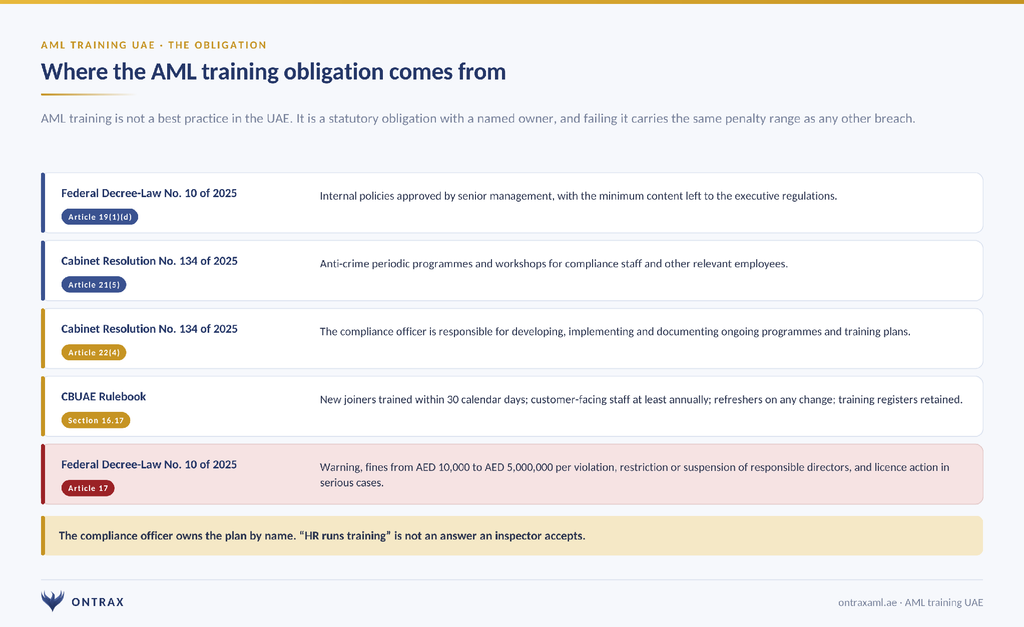
The legal basis for AML training in the UAE, from the federal decree-law through to the CBUAE Rulebook.
Federal Decree-Law No. 10 of 2025, which replaced the 2018 framework, requires at Article 19(1)(d) that regulated entities maintain internal policies approved by senior management, with the minimum content set by the executive regulations. Cabinet Resolution No. 134 of 2025 supplies that content. Article 21(5) requires anti-crime periodic programmes and workshops for compliance staff and other relevant employees.
The ownership point: Article 22(4) of Cabinet Resolution No. 134 of 2025 makes the compliance officer responsible for developing, implementing and documenting ongoing programmes and training plans for employees. AML training is not an HR function that compliance contributes to. It is a compliance function that HR may help deliver, and the named officer carries it.
For licensed financial institutions the CBUAE Rulebook adds operational detail at section 16.17, covering who must be trained, how quickly, how often and on what. DIFC firms are reached by the federal framework directly as well as by the DFSA’s own AML module — our guide to DIFC AML compliance covers that overlay. DNFBPs are supervised by the Ministry of Economy and Tourism or, for legal professionals, the Ministry of Justice.
The consequence sits in Article 17 of the decree-law: a warning, fines from AED 10,000 to AED 5,000,000 per violation, restriction or suspension of responsible directors and managers, and in serious cases suspension or revocation of the licence. Training failures are not treated as a lesser category of breach.
2. Five audiences, not one
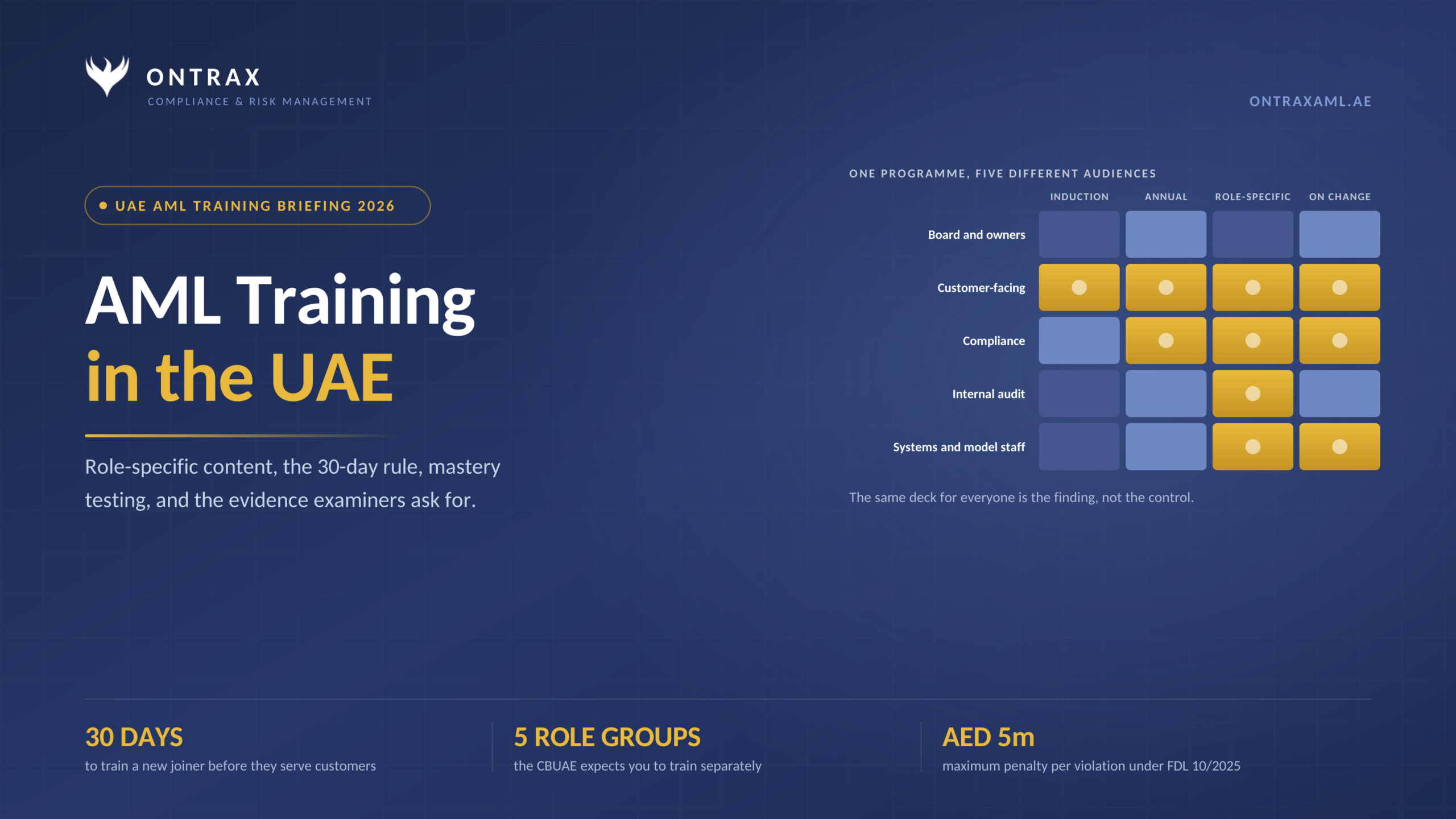
Role-based AML training is the expectation, and the single most common AML training finding in the UAE is an enterprise-wide module delivered identically to everyone. The CBUAE’s expectation is that firms identify distinct role groups and train each to the standard its exposure requires.
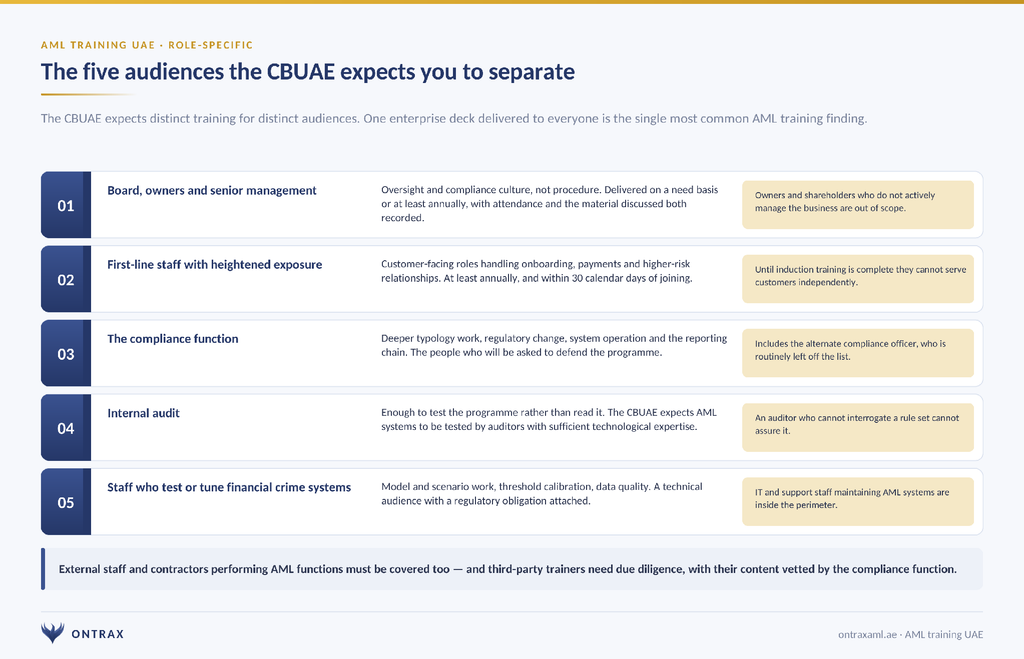
The five role groups the CBUAE expects UAE firms to train separately, and what each one needs.
Board, owners and senior management
Board training should address oversight and compliance culture rather than operational procedure, and should be delivered on a need basis or at least annually. Attendance and the material discussed should both be recorded. Owners, partners and shareholders need training only where they actively manage the institution; passive shareholders are outside the requirement. This is the group most often omitted, and the one whose omission is most visible in a governance review — as our guide to the UAE AML inspection sets out.
First-line staff with heightened exposure
Customer-facing roles handling onboarding, payments and higher-risk relationships need training at least annually, and within 30 calendar days of joining. The content should connect to what they actually do: the red flags in their product set, the escalation path they would use, and the customer due diligence steps they personally perform.
The compliance function
Deeper typology work, regulatory change, system operation and the reporting chain. This is the group that will be asked to defend the programme, and it includes the alternate compliance officer — routinely left off the training list because the role is treated as a formality rather than live cover.
Internal audit
Enough technical depth to test the programme rather than read it. The CBUAE expects financial crime systems to be tested by auditors with sufficient technological expertise, which is a meaningful qualifier: an audit function that can review a policy but cannot interrogate a rule set is not providing assurance. Where that capability does not exist internally it is normally scoped into an independent AML audit.
Staff who test or tune financial crime systems
Model and scenario work, threshold calibration and data quality carry a regulatory obligation even where the people doing them sit in technology rather than compliance. IT and support staff who maintain AML systems are inside the perimeter, as our guide to transaction monitoring in the UAE explains in more detail.
External staff and contractors performing AML functions must be trained too. And where a third-party trainer is used, the firm should perform due diligence on the provider and the compliance function should vet the content — buying a course does not transfer responsibility for whether it covers your obligations.
3. The cadence: far more than once a year
There is no single statutory frequency for AML training in the UAE. There is a set of triggers, and a programme that fires only on the annual cycle will miss most of them.
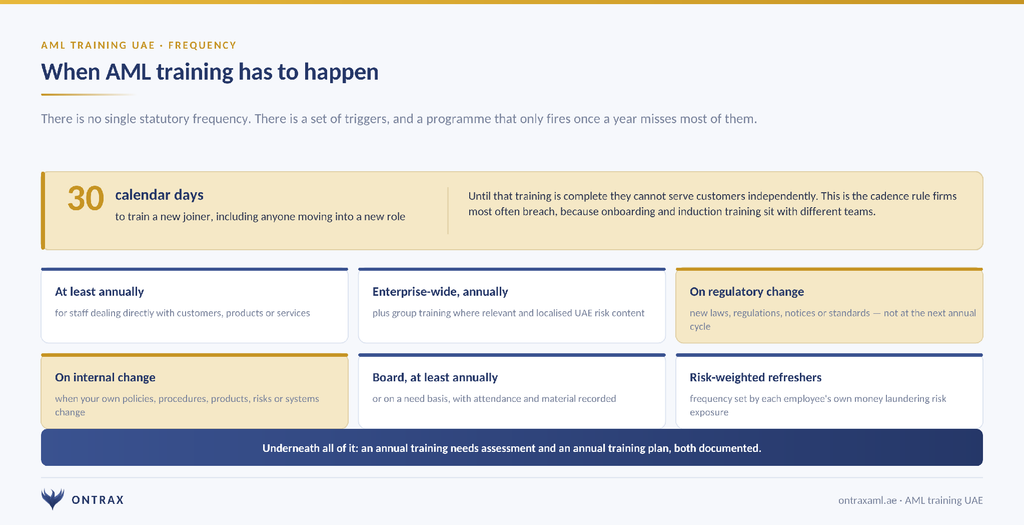
When AML training has to happen in the UAE — the 30-day induction rule and the five other triggers.
The 30-day rule
Under CBUAE Rulebook section 16.17, new joiners must complete AML training within 30 calendar days of joining, and until they do they cannot serve customers independently. The requirement extends to existing staff moving into a new role.
Why firms breach this one: Onboarding sits with HR and AML training sits with compliance, and nobody owns the join between them. A salesperson starts on the first of the month, is on the floor by the fifth, and completes the AML module in the second month because that is when the quarterly session runs. The firm has breached the rule and will usually not realise until an examiner reconciles joining dates against the training register.
The other triggers
- At least annually for staff dealing directly with customers, products or services.
- Enterprise-wide annual training, with group training where relevant and localised content on UAE-specific risks.
- On regulatory change — new laws, regulations, notices or standards, delivered when the change happens rather than at the next annual cycle.
- On internal change — when the firm’s own policies, procedures, products, risks or systems change.
- Board training on a need basis or at least annually, with attendance and material recorded.
- Risk-weighted refreshers, with frequency set by each employee’s own money laundering and terrorist financing risk exposure.
Underneath all of it, the CBUAE expects an annual training needs assessment and an annual training plan, both documented. The needs assessment is what connects training to the business risk assessment: if your risk assessment identifies exposure to a typology, the training plan should show where that typology is taught and to whom.
A practical test of whether your cadence is real: when the federal framework changed in October 2025 and the executive regulations followed in December, how quickly did your material change, and can you evidence who was retrained as a result? If the answer is that it was picked up at the next annual refresh, the on-change trigger is not operating.
4. The fifteen topics the material must cover
The CBUAE sets out a minimum content standard. It is worth running your current deck against it line by line, because most firms find four or five gaps — and they tend to be the same gaps.
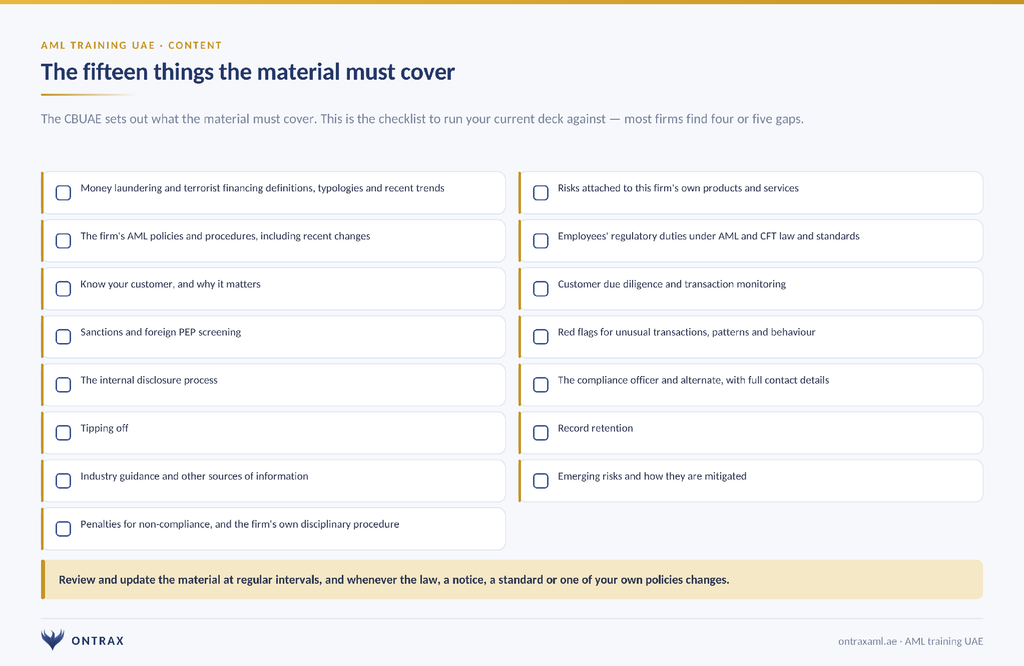
The fifteen topics UAE AML training material must cover, under CBUAE Rulebook section 16.17.
The topics cover definitions, typologies and recent trends; the risks attached to the firm’s own products and services; the firm’s policies and procedures including recent changes; employees’ regulatory duties; know your customer and why it matters; customer due diligence and transaction monitoring; sanctions and foreign PEP screening; red flags for unusual transactions, patterns and behaviour; the internal disclosure process; the compliance officer and alternate with full contact details; tipping off; record retention; industry guidance and other sources of information; emerging risks and their mitigation; and penalties for non-compliance together with the firm’s own disciplinary procedure.
The gaps that recur
Four items are missing from most decks. The compliance officer’s and alternate’s full contact details — firms teach that escalation exists without telling people who to escalate to. The firm’s own disciplinary procedure for AML breaches, which turns an abstract obligation into a personal one. Emerging risks, which require the material to be refreshed rather than reused. And risks attached to the firm’s own products, which is the item that distinguishes a programme from a generic course.
The test that separates real training from a bought course: Open your material and look for the name of your own firm, your own products, your own escalation path and your own compliance officer. A deck that would work unchanged at any other UAE business is not training your staff on your risks — and the CBUAE expects localised content on UAE risks specifically.
Material must be reviewed and updated at regular intervals, and whenever the relevant laws, regulations, notices, standards or internal policies change.
5. Proving it worked: attendance is not evidence
This is where the obligation has moved furthest from common practice. The CBUAE’s position is that participants should not receive credit for AML training unless they have mastered the related concepts.
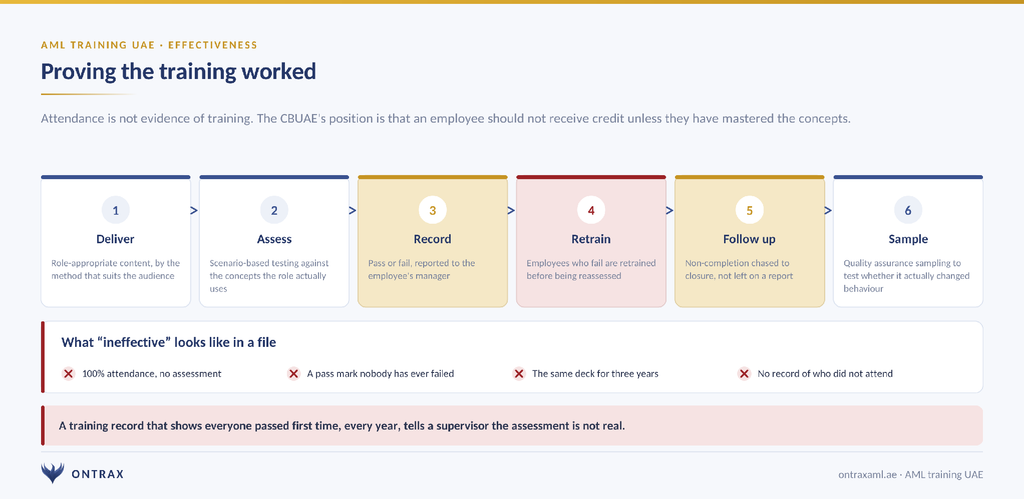
The effectiveness cycle for UAE AML training: deliver, assess, record, retrain, follow up and sample.
In AML training, mastery implies assessment, and assessment implies that failure is possible. Employees who fail should be retrained before being reassessed. Completion and pass or fail results should be reported to the employee’s manager, and non-completion should be followed up rather than recorded and forgotten.
Beyond individual assessment, the CBUAE points to scenario-based testing and quality assurance sampling as evidence that training has changed behaviour rather than simply been delivered. Scenario-based assessment is markedly more useful than multiple choice: asking a relationship manager what they would do when a long-standing client asks to route a payment through a third party tests judgement, which is what the training is for.
A training record showing one hundred per cent attendance, one hundred per cent pass rate and no failures across three consecutive years does not demonstrate effectiveness. To a supervisor it suggests the assessment is not real. A programme with a small, explained failure rate and documented retraining is a stronger file than a perfect one.
What ineffective looks like in practice
- Attendance recorded, with no assessment of whether anything was understood.
- A pass mark nobody has ever failed, because the questions restate the slide immediately preceding them.
- The same deck used for three years, with the date changed on the cover.
- No record of who did not attend, and no evidence of follow-up for those who did not.
- Assessment results held by the trainer and never reported to the employee’s manager.
- No link between the training content and the firm’s own risk assessment.
6. The file an examiner reads
Examiners verify AML training by reading a file. Seven documents make up that file, and in most firms at least two are missing.
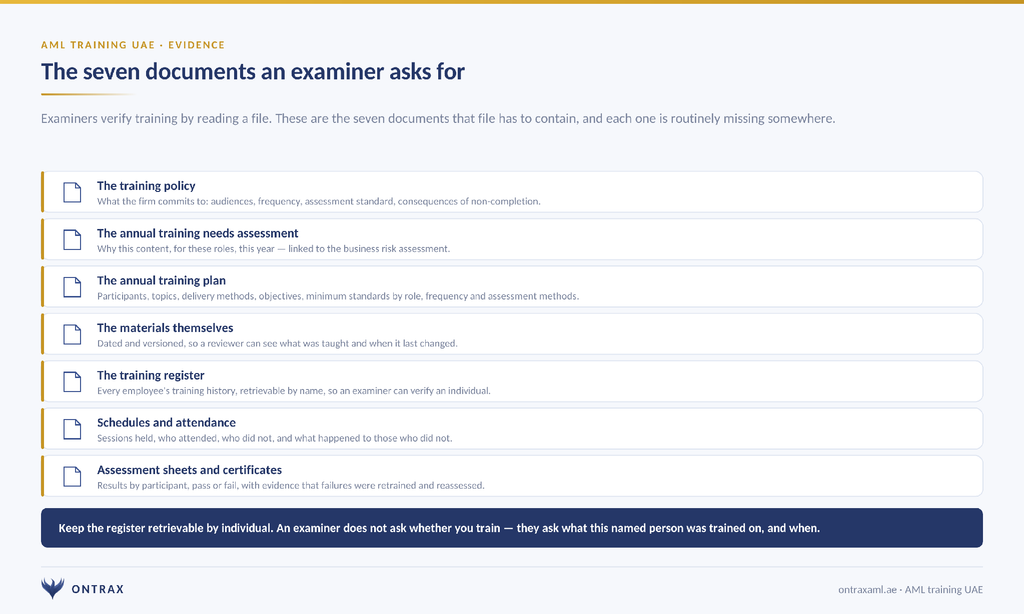
The seven documents a UAE examiner asks for when testing AML training.
The training policy states what the firm commits to: audiences, frequency, assessment standard and the consequences of non-completion. The annual training needs assessment explains why this content, for these roles, this year, and links back to the business risk assessment. The annual training plan sets out participants, topics, delivery methods, objectives, minimum standards by role, frequency and assessment methods — the CBUAE lists those elements specifically.
The materials themselves should be dated and versioned so a reviewer can see what was taught and when it last changed. The training register holds every employee’s training history and must be retrievable by name. Schedules and attendance records show sessions held, who attended, who did not and what happened to them. Assessment sheets and certificates show results by participant, with evidence that failures were retrained and reassessed.
How the question is actually asked: An examiner does not ask whether you deliver AML training. They pick a named employee — often one who joined recently or handles higher-risk customers — and ask what that person was trained on, when, and how you know they understood it. If the register cannot be searched by individual, the answer takes days and the finding writes itself.
Training records should be retained for the period set by UAE record-keeping rules and be available for audit. Firms in the DIFC and ADGM work to at least six years; the federal minimum is five.
7. Building a programme that holds up
For most UAE firms, fixing AML training is a matter of structure rather than spend. The sequence below produces a defensible programme within one cycle.
Step one: map the audiences
Role-based AML training starts here. List every role in the business and assign each to one of the five groups. Include the board, the alternate compliance officer, internal audit, technology staff who maintain AML systems, and any external contractors performing AML functions. The map is the first document in the file.
Step two: run the needs assessment
Take the business risk assessment and ask, typology by typology, who in the business needs to recognise it. That exercise produces the content plan, and it is also the evidence that the training is risk-based rather than generic.
Step three: write role-specific content
Role-based AML training is built as a core module with role-specific layers on top of it, rather than one deck with optional sections. The board layer addresses oversight. The first-line layer addresses red flags and escalation in their product set. The compliance layer addresses regulatory change and the reporting chain. Each layer names your firm, your products, your escalation path and your officer.
Step four: fix the induction join
Agree with HR a process that triggers AML training on the joining date and blocks independent customer contact until it is complete. This single control closes the most commonly breached rule in the framework.
Step five: assess properly
Use scenario-based questions drawn from your own business. Set a pass standard you are willing to see people fail. Report results to line managers. Retrain failures and reassess them. Sample for behaviour change through quality assurance review.
Step six: assemble the file
Policy, needs assessment, plan, materials, register, schedules and attendance, assessment sheets and certificates. Build it as you go rather than reconstructing it when an inspection is announced. An AML Audit & Compliance Review will test exactly this file, which makes it a useful dry run before a supervisor does the same.
8. How Ontrax helps
Ontrax Compliance & Risk Management Ltd builds AML training programmes for UAE financial institutions, DNFBPs and virtual asset service providers. Our AML Training & Awareness Programs service covers the needs assessment, the annual plan, role-specific content written around your own products and typologies, scenario-based assessment, delivery to each audience including the board, and the evidence file an examiner will read.
Where the compliance officer carrying the obligation is stretched, our Virtual Compliance Officer and MLRO Provision services supply the capacity — and as our guide to outsourced AML compliance explains, training is one of the tasks that can legitimately be delegated, with a Letter of No Objection, while the obligation stays with the firm. Where the programme needs testing rather than building, our Independent AML Audit assesses it against the standard above, and for licensed financial institutions our AML Compliance for Financial Institutions service covers training within the wider programme.
If you take one action: Pull the joining dates of everyone who started in the last six months and reconcile them against your training register. Every person who went live with customers more than 30 calendar days before completing AML training is a breach already on the record. It takes an hour and it is the first reconciliation an examiner runs. Speak to Ontrax about building the programme properly.
Frequently asked questions
Is AML training mandatory in the UAE?
Yes. Article 21(5) of Cabinet Resolution No. 134 of 2025 requires periodic anti-crime programmes and workshops for compliance staff and other relevant employees, and Article 22(4) makes the compliance officer responsible for developing, implementing and documenting them. For licensed financial institutions the CBUAE Rulebook adds detailed operational requirements at section 16.17.
How quickly must a new employee complete AML training?
Within 30 calendar days of joining, under CBUAE Rulebook section 16.17. Until the training is complete, the employee cannot serve customers independently. The same requirement applies to existing staff who move into a new role.
How often is AML training required in the UAE?
There is no single statutory frequency. Staff dealing directly with customers, products or services must be trained at least annually. Enterprise-wide training is expected annually. Refreshers are required whenever laws, regulations, notices, standards or the firm’s own policies and procedures change, and refresher frequency can otherwise be set by each employee’s risk exposure.
Who is responsible for AML training — HR or compliance?
The compliance officer. Article 22(4) of Cabinet Resolution No. 134 of 2025 assigns responsibility for developing, implementing and documenting ongoing programmes and training plans to that role. HR may deliver or administer the training, but the obligation and the accountability sit with the named officer.
What must AML training cover?
The CBUAE sets fifteen minimum topics: definitions, typologies and trends; risks in the firm’s own products and services; the firm’s policies and procedures; employees’ regulatory duties; KYC; due diligence and transaction monitoring; sanctions and foreign PEP screening; red flags; the internal disclosure process; the compliance officer and alternate with contact details; tipping off; record retention; industry guidance; emerging risks; and penalties plus the firm’s disciplinary procedure.
Does the board need AML training?
Yes. Board training should be provided on a need basis or at least annually, focused on oversight and compliance culture rather than operational procedure, with attendance and the material discussed both recorded. Owners, partners and shareholders require training where they actively manage the institution; passive shareholders do not.
What is role-based AML training?
Training differentiated by audience rather than delivered identically to everyone. The CBUAE identifies five minimum groups: the board, owners and senior management; first-line staff with heightened exposure; the compliance function; internal audit; and staff who test or tune financial crime systems and models. IT and support staff maintaining AML systems and external contractors performing AML functions are also in scope.
Is attendance enough to evidence AML training?
No. The CBUAE’s position is that participants should not receive credit unless they have mastered the related concepts. That requires assessment, a pass standard capable of being failed, retraining for those who fail, reporting of results to line managers, and follow-up on non-completion.
Can AML training be outsourced to a third-party provider?
Yes, training is one of the tasks that can be delegated — but the firm must perform due diligence on the provider and the compliance function should vet the content. Under the UAE joint supervisory guidance, outsourcing a specific AML task requires a Letter of No Objection from the relevant supervisory authority, and the obligation itself never transfers.
What records of AML training must be kept?
Seven items: the training policy, the annual training needs assessment, the annual training plan, the materials themselves, the training register, schedules and attendance records, and assessment sheets and certificates. The register must be retrievable by individual employee so an examiner can verify a named person’s history.
How long must AML training records be retained?
For the period set by UAE record-keeping rules — at least five years under the federal framework, and at least six years for firms in the DIFC and ADGM. Records must be available for audit and for supervisory inspection.
What are the penalties for inadequate AML training?
Under Article 17 of Federal Decree-Law No. 10 of 2025: a warning, fines from AED 10,000 to AED 5,000,000 per violation, restriction or suspension of responsible directors and managers, and in serious cases suspension or revocation of the licence.
Do DNFBPs have the same AML training obligations?
The federal obligation in Cabinet Resolution No. 134 of 2025 applies to financial institutions, DNFBPs and virtual asset service providers alike. The CBUAE Rulebook detail applies directly to licensed financial institutions, but supervisors of DNFBPs apply equivalent expectations, and the CBUAE standard is the most developed articulation of what good looks like.
What does an examiner actually ask about training?
They pick a named employee, usually a recent joiner or someone handling higher-risk customers, and ask what that person was trained on, when, and how the firm knows they understood it. If the training register cannot be searched by individual, producing the answer takes days and the finding follows.
Sources and further reading
· CBUAE Rulebook — section 16.17, AML Training
· Cabinet Resolution No. 134 of 2025 — Executive Regulations to Federal Decree-Law No. 10 of 2025
· CBUAE — Anti-Money Laundering resources
· UAE AML/CFT training requirements — Knowledge Foundry summary
· DFSA — AML, Counter-Terrorist Financing and Sanctions FAQs
This briefing is general information on AML training in the UAE and is not legal advice. Rules and guidance change; verify the current position with your supervisory authority before acting. Ontrax Compliance & Risk Management Ltd, Dubai International Financial Centre.