
In short: Dealers in precious metals and stones are DNFBPs supervised by the Ministry of Economy and Tourism under Federal Decree-Law No. 10 of 2025 and Cabinet Resolution No. 134 of 2025. A Dealers in Precious Metals and Stones Report must be filed on goAML where an individual pays AED 55,000 or more in cash, or where a company or other entity transacts AED 55,000 or more in cash or by wire transfer. The threshold aggregates across linked dealings and instalments, and trade-ins count as cash. The report is not risk-dependent and is separate from any suspicious transaction report. Due diligence itself is risk-driven and applies below the threshold, and sanctions screening applies to every customer regardless of transaction size. Records are kept at least five years.
Dubai moves a very large share of the world’s gold, and the trade that carries it is built on speed, relationships and, still, a great deal of cash. That combination is why dealers in precious metals and stones sit near the top of every UAE supervisory risk assessment, and why DPMS AML compliance has become an inspection priority rather than a paperwork exercise.
The difficulty with DPMS AML compliance is not unwillingness. It is that the rules are more specific than most dealers realise. The reporting trigger is not one figure — it changes depending on whether the customer is a person or a company, and the second version catches wire transfers that most dealers never think to report. Due diligence does not begin at the reporting threshold. And the obligation reaches a watch, a decorative piece or an inlaid object whenever half its value comes from precious materials.
This briefing sets out what DPMS AML compliance actually requires: who is in scope by purity and by value, exactly when a DPMSR is triggered, why due diligence starts well below AED 55,000, the red flags specific to this trade, the provenance checks the sector owes, and what a MoET inspector asks for. The structure parallels our guide to real estate AML compliance in Dubai, which covers the other large MoET-supervised population.
1. Who is in scope, by purity and by value
DPMS AML compliance reaches you if you deal in precious metals or stones regularly and carry out transactions at or above the covered threshold. The test is the activity, not the licence description, and it applies on the mainland and in commercial free zones alike.
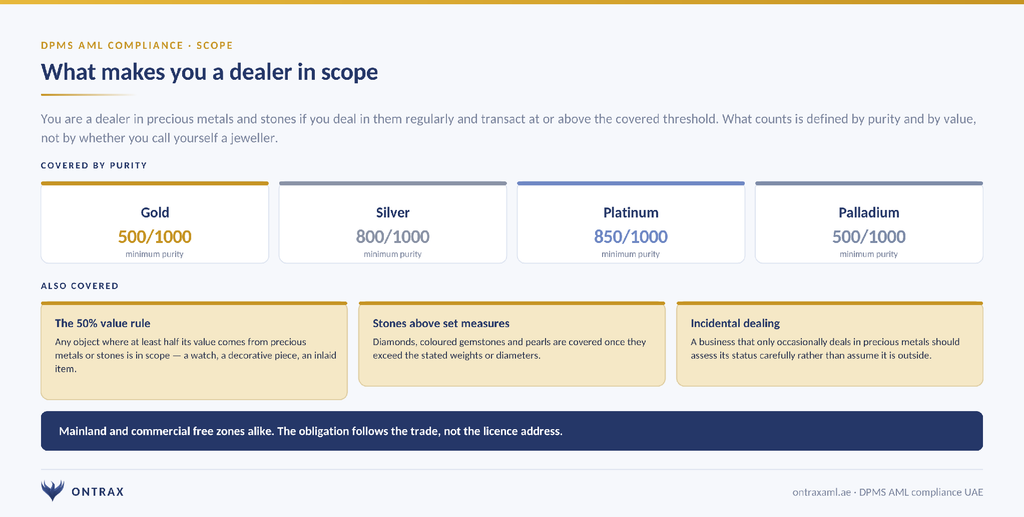
What brings a business into scope for DPMS AML compliance in the UAE: purity thresholds and the 50% value rule.
Four metals bring a business inside DPMS AML compliance above stated purities: gold at 500/1000, silver at 800/1000, platinum at 850/1000 and palladium at 500/1000. Diamonds, coloured gemstones and pearls are covered once they exceed the stated weights or diameters.
The rule most businesses miss: Any object where at least 50% of its value comes from precious metals or stones is covered. That reaches luxury watches, decorative items and inlaid pieces sold by businesses that have never thought of themselves as precious metals dealers. If half the value is in the materials, the obligation applies.
Businesses whose dealings in precious metals are only incidental should assess their status carefully rather than assume they fall outside. The guidance is explicit that a careful assessment is expected, and an assumption recorded nowhere is not an assessment.
A practical consequence: if you sell high-value watches, bullion as an investment sideline, or jewellery alongside another trade, run the 50% test on your actual product mix before concluding you are out of scope. The conclusion should be documented either way.
2. The DPMSR: two triggers, not one
The Dealers in Precious Metals and Stones Report is the obligation most specific to this sector, and the source of the most common DPMS AML compliance failure in it.
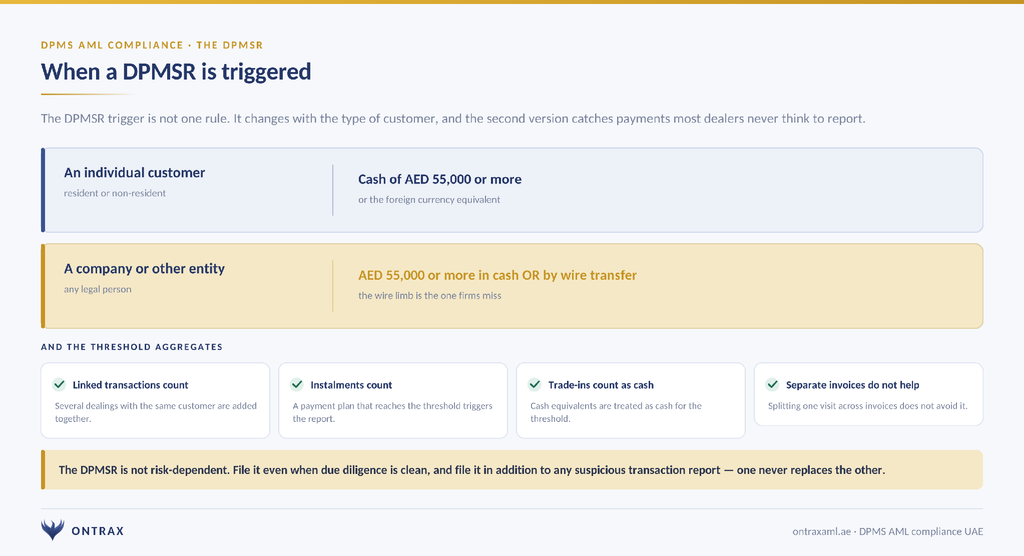
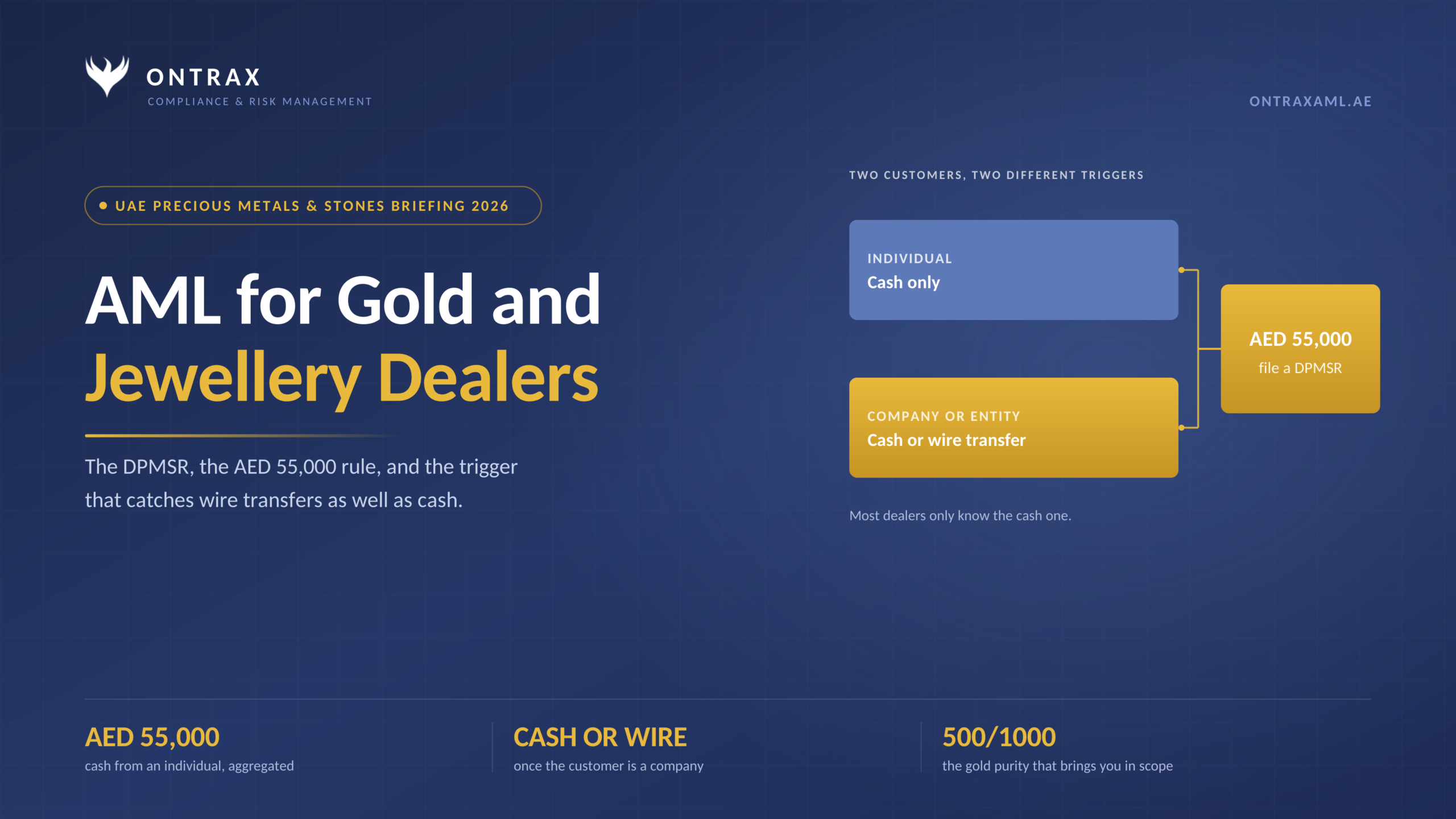
When a DPMSR is triggered in UAE DPMS AML compliance — the individual and company limbs, and the aggregation rules.
Individual customers: cash at AED 55,000
Where the customer is an individual, resident or non-resident, a DPMSR is required for a cash transaction of AED 55,000 or more, or the foreign currency equivalent.
Company customers: cash or wire at AED 55,000
Where the customer is a company or other legal entity, the trigger is a transaction of AED 55,000 or more whether in cash or by wire transfer. This is the limb firms miss. A bank-to-bank payment from a corporate buyer, with no cash anywhere in the transaction, still triggers a report.
Test your own filing history: Pull twelve months of corporate sales settled by wire at or above AED 55,000 and compare the list against your DPMSR filings. Most dealers find the two do not match, because the cash limb is the only one their process was built around. Every gap is an unfiled report.
The threshold aggregates
- Linked or related transactions with the same customer are added together.
- Instalments count toward the threshold, and the report is filed at the time the funds that cross it are received.
- Cash equivalents, including trade-ins, count as cash.
- Separate invoices issued for a single visit do not avoid the threshold.
In DPMS AML compliance, structuring a purchase to stay below the figure is itself a red flag rather than a solution, and should be assessed for a suspicious transaction report in its own right.
The DPMSR is not risk-dependent. It is filed whether or not the customer looks suspicious and whether or not due diligence raised anything. It also does not replace a suspicious transaction report, and an STR does not replace it. Where a transaction is both over threshold and suspicious, both are filed.
3. Due diligence does not start at AED 55,000
This is the structural error that produces most DPMS AML compliance findings. The threshold is a reporting trigger. It is not the point at which compliance begins.
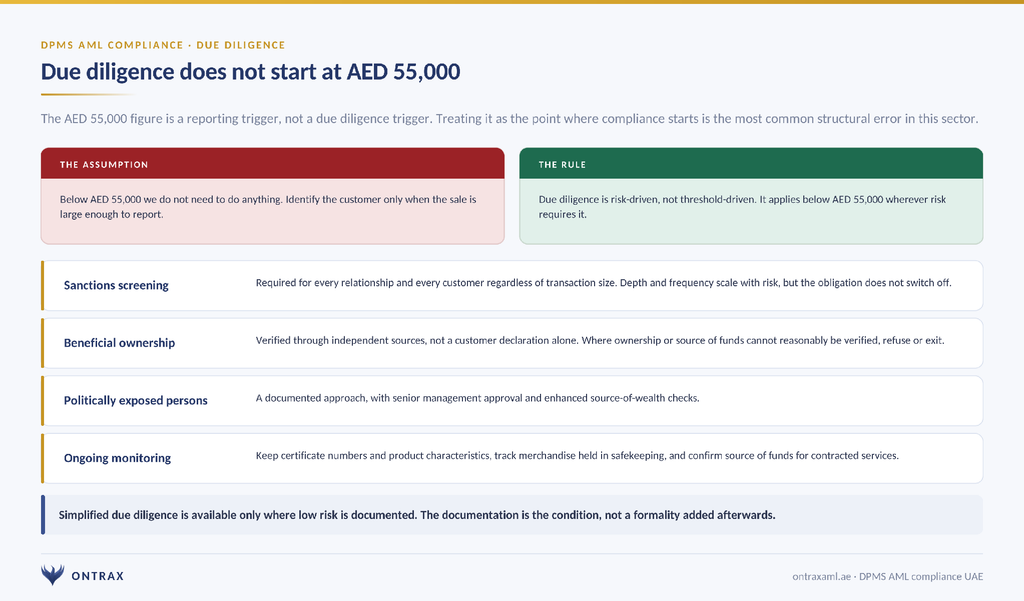
Why DPMS AML compliance due diligence is risk-driven rather than threshold-driven.
Customer due diligence and enhanced due diligence apply on a risk basis, including for transactions below AED 55,000. Our guide to KYC and CDD requirements in the UAE sets out the underlying framework, and our AML Know Your Customer (KYC) service builds the process for dealers starting from nothing.
Sanctions screening applies to everyone
DPMS AML compliance requires screening for all business relationships and all customers regardless of transaction size. The depth and frequency scale with risk; the obligation itself does not switch off for small sales. Our sanctions screening guide sets out which lists bind UAE firms and how quickly a match must be acted on, and our Transaction Monitoring & Screening service operates it.
Beneficial ownership must be verified independently
Where the customer is a company, the beneficial owner must be verified through independent sources rather than a customer declaration alone. Where beneficial ownership or source of funds cannot reasonably be verified, the guidance is to refuse the transaction or exit the relationship — not to proceed with a note on file.
Politically exposed persons
DPMS AML compliance expects a documented approach, including senior management approval for the relationship and enhanced source-of-wealth checks. Foreign PEPs are specifically flagged in the sector guidance.
Ongoing monitoring in a dealer’s business
Monitoring in DPMS AML compliance looks different from a bank’s. Keep certificate numbers and product characteristics, track merchandise held in safekeeping for customers, and confirm the source of funds for contracted services. The record should let you reconstruct what was sold, to whom, and how it was paid for.
On simplified due diligence: It is available only where low risk has been documented. The documentation is the condition, not a formality added later. A file showing simplified due diligence with no recorded risk rationale is treated as due diligence not performed.
4. The red flags specific to this trade
Generic AML indicators are of limited use at a jewellery counter, so DPMS AML compliance training has to be built from sector-specific ones. These are the ones the sector guidance calls out.
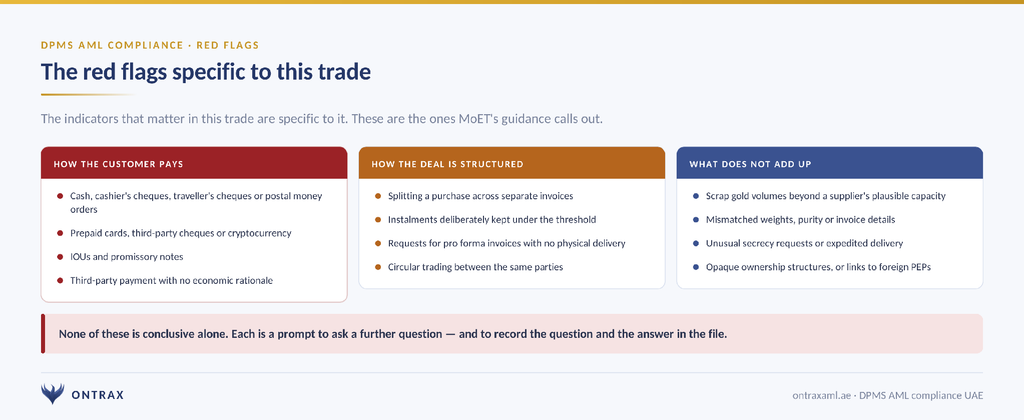
Red flags specific to DPMS AML compliance in the UAE, grouped by payment, structure and inconsistency.
How the customer pays
Cash, cashier’s cheques, traveller’s cheques and postal money orders. Prepaid cards, third-party cheques and cryptocurrency. IOUs and promissory notes. And third-party payment with no economic rationale — the question of why somebody other than the buyer is paying is one the file should answer.
How the deal is structured
Splitting a purchase across separate invoices. Instalments deliberately kept beneath the threshold. Requests for pro forma invoices with no physical delivery. Circular trading between the same parties, where goods and money move without a commercial purpose.
What does not add up
Scrap gold volumes that exceed a supplier’s plausible capacity. Mismatched weights, purity or invoice details. Unusual secrecy requests or pressure to expedite delivery. Opaque ownership structures, and links to politically exposed persons, particularly foreign ones.
None of these is conclusive on its own. Each is a prompt to ask a further question and to record both the question and the answer. A file showing that an indicator was noticed, examined and resolved is a strong file. A file silent on an obvious indicator produces the finding. This is the material that role-specific AML training should be built from — counter staff need these indicators, not a generic deck.
5. Provenance: the obligation that concerns the goods
DPMS AML compliance carries a supply chain obligation that most due diligence frameworks do not cover, because it attaches to the goods rather than to the customer.
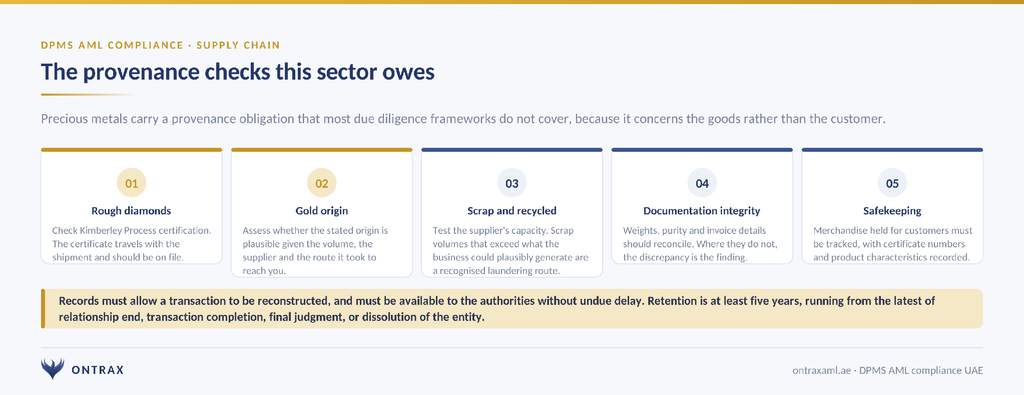
The provenance and supply chain checks expected in UAE DPMS AML compliance.
For rough diamonds, Kimberley Process certification should be checked and the certificate held on file. For gold, the stated origin should be assessed for plausibility given the volume, the supplier and the route the material took to reach you.
Scrap and recycled material deserves particular attention in DPMS AML compliance. Scrap gold volumes that exceed what a supplier’s business could plausibly generate are a recognised laundering route, and testing capacity is a reasonable and documentable check.
Documentation should reconcile. Where weights, purity and invoice details do not match, the discrepancy is itself the finding and should be investigated rather than corrected quietly.
Records
Customer due diligence records, transaction records and correspondence are kept for at least five years. The period runs from the latest of four events: termination of the relationship or closure of the account, completion of an occasional transaction, a final judgment, or the dissolution or termination of the legal person or arrangement. Records must allow a transaction to be reconstructed and must be available to the competent authorities without undue delay — which in practice means organised and retrievable, as our guide to the UAE AML inspection describes.
6. What a MoET inspection asks for
A DPMS AML compliance inspection follows a predictable order. Every item is a document.
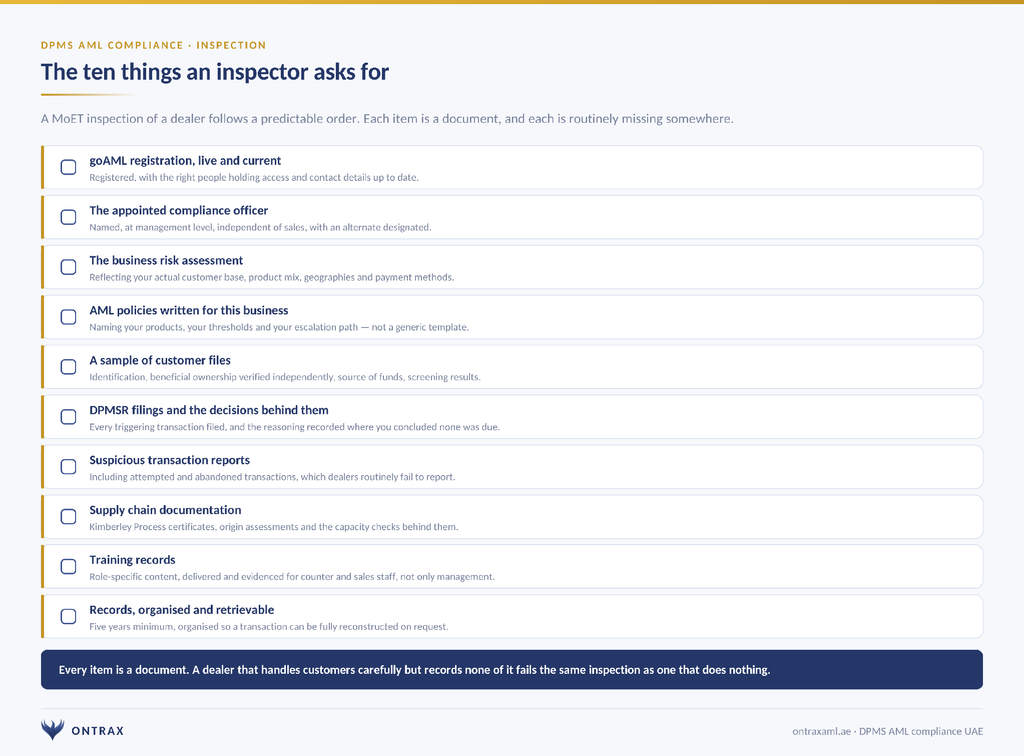
The ten items a MoET inspector requests from a dealer in precious metals and stones.
Registration on goAML comes first and must be live, with the right people holding access and contact details current. Then the appointed compliance officer: named, at management level, independent of the sales function, with an alternate designated. Our guide to the compliance officer and MLRO role in the UAE sets out the independence the position requires.
Then the documents. The business risk assessment reflecting your actual customer base, product mix, geographies and payment methods. The AML policies and procedures written for this business, naming your products, thresholds and escalation path — our guide to what a UAE AML policy must contain lists the sections that have to be there.
Then the evidence. A sample of customer files testing identification, independently verified beneficial ownership, source of funds and retained screening results. DPMSR filings and, critically, the reasoning recorded where you concluded no filing was due. Suspicious transaction reports including for attempted and abandoned transactions. Supply chain documentation. Training records evidencing role-specific content completed by counter and sales staff rather than management alone — the standard is set out in our guide to AML training in the UAE. And records, organised so a transaction can be fully reconstructed.
7. What changed under the 2025 framework
Many dealers built their programme under the 2018 law and have not revisited it. DPMS AML compliance was reshaped twice in quick succession, and a programme written before October 2025 is working from a repealed instrument.
Federal Decree-Law No. 10 of 2025 came into force on 14 October 2025 and replaced the 2018 framework. Its executive regulations, Cabinet Resolution No. 134 of 2025, followed on 14 December 2025 and supply the detail that governs DPMS AML compliance today, including the covered activities and the reporting thresholds.
Three changes matter particularly to this sector. Proliferation financing became a standalone criminal offence, which brings the dual-use and sanctions-evasion dimension of precious metals trading squarely into scope. Knowledge of illicit funds can now be inferred from objective circumstances rather than requiring proof of actual knowledge, which raises the cost of a deliberately incurious file. And penalties for legal persons were increased substantially.
The practical consequence for DPMS AML compliance is that a policy document citing Federal Decree-Law No. 20 of 2018 is not merely dated — it is citing law that no longer exists, and an inspector will read that as evidence the programme has not been maintained. Our AML Policy Development service rewrites the document against the current instruments.
A quick self-check: open your AML policy and search it for “2018”. If the number appears as the governing law rather than as history, the document predates two framework changes and needs replacing rather than amending.
8. A programme that fits a dealer
DPMS AML compliance does not require a bank’s compliance function. They need a defined set of things to exist, operate and be evidenced.
The minimum viable programme
- goAML registration, live, with named users and current contacts.
- An appointed compliance officer at management level, independent of sales, with a designated alternate.
- A documented scope assessment: which of your products are in scope by purity or by the 50% value rule.
- A business risk assessment reflecting your customer base, payment methods and supply routes.
- Policies and procedures naming your products, your thresholds and your escalation path.
- A CDD standard that is risk-driven, with EDD triggers matched to your actual customer profile.
- Screening on every customer regardless of transaction size.
- A DPMSR decision log capturing both limbs of the trigger and every reasoned decision not to file.
- Supply chain documentation: Kimberley Process certificates, origin assessments, capacity checks.
- Role-specific training for counter and sales staff, with completion recorded.
- Records held at least five years and organised to reconstruct a transaction.
Where the capacity comes from
The constraint on DPMS AML compliance in a dealership is almost never willingness — it is that the person carrying compliance also runs the shop. Our Virtual Compliance Officer service places a qualified, UAE-resident officer into the role, independent of your sales floor, with the access the position needs. Where the officer exists but the volume does not fit the hours, our Outsourced AML Function supplies the file work, screening and reporting capacity behind them — and our guide to what can and cannot be outsourced explains exactly where that line falls.
To find out where your DPMS AML compliance stands before a supervisor tells you, our AML Audit & Compliance Review tests the programme against the inspection list above, and our Independent AML Audit provides independent assurance for larger groups and refiners.
9. How Ontrax helps
Ontrax Compliance & Risk Management Ltd works with gold traders, jewellers, refiners and stone dealers across Dubai and the wider UAE. DPMS AML compliance is a sector-specific discipline and we treat it as one: the risk assessment reflects a precious metals book, the red flags are the ones that appear at a counter, and the DPMSR decision log is built to be read by an inspector.
We supply the officer through Virtual Compliance Officer, the capacity through Outsourced AML Function, the documents through AML Risk Assessment and AML Policy Development, onboarding through AML Know Your Customer (KYC), counter-staff capability through AML Training & Awareness Programs, screening through Transaction Monitoring & Screening, and assurance through Independent AML Audit.
If you take one action: Pull twelve months of sales to corporate customers settled by wire transfer at AED 55,000 or above, and compare that list to your DPMSR filings. The wire limb is the one most dealers have never filed against, and every gap is a reportable omission an inspection will find. Speak to Ontrax about reviewing your programme.
Frequently asked questions
Do gold and jewellery dealers need AML compliance in the UAE?
Yes. Dealers in precious metals and stones are designated non-financial businesses and professions under Federal Decree-Law No. 10 of 2025 and Cabinet Resolution No. 134 of 2025, supervised by the Ministry of Economy and Tourism. The obligation applies on the mainland and in commercial free zones, to any business that deals in precious metals or stones regularly and transacts at or above the covered threshold.
What is a DPMSR?
The Dealers in Precious Metals and Stones Report, filed on the goAML portal to the UAE Financial Intelligence Unit. It is triggered by transaction value rather than by suspicion, so it is filed whether or not anything about the customer looks wrong, and it is separate from any suspicious transaction report.
When must a dealer file a DPMSR?
Where an individual customer, resident or non-resident, pays AED 55,000 or more in cash or the foreign currency equivalent. And where the customer is a company or other legal entity, where the transaction is AED 55,000 or more whether in cash or by wire transfer. The second limb is the one most dealers overlook.
Does a wire transfer trigger a DPMSR?
Where the customer is a company or other entity, yes — a transaction of AED 55,000 or more by wire transfer triggers the report even with no cash involved. For individual customers the trigger is cash only.
Does the AED 55,000 threshold aggregate?
Yes. Linked and related transactions, instalments and structured transactions all count toward it. Cash equivalents including trade-ins count as cash. Issuing separate invoices for a single visit does not avoid the threshold, and deliberately structuring to stay below it is itself a red flag.
Which metals and stones are covered?
Gold at 500/1000 purity, silver at 800/1000, platinum at 850/1000 and palladium at 500/1000. Diamonds, coloured gemstones and pearls are covered above stated weights or diameters. In addition, any object where at least 50% of its value comes from precious metals or stones is in scope.
Does the 50% value rule catch luxury watches?
It can. The test is whether at least half the object’s value derives from precious metals or stones. A business selling high-value watches, decorative items or inlaid pieces should run that test on its actual product mix and document the conclusion rather than assume it falls outside.
Do I need to do due diligence on sales under AED 55,000?
Yes, where risk requires it. The threshold is a reporting trigger, not a due diligence trigger. Customer due diligence and enhanced due diligence apply on a risk basis including below AED 55,000, and sanctions screening applies to every customer regardless of transaction size.
Can I rely on what a corporate customer tells me about its owners?
No. Beneficial ownership must be verified through independent sources rather than customer self-declaration alone. Where beneficial ownership or source of funds cannot reasonably be verified, the guidance is to refuse the transaction or exit the relationship.
Is a DPMSR the same as a suspicious transaction report?
No, and neither replaces the other. A DPMSR is triggered by the value and payment profile. An STR is triggered by suspicion, at any value. Where a transaction is both over threshold and suspicious, file both.
What records must a dealer keep, and for how long?
Customer due diligence records, transaction records and correspondence, for at least five years. The period runs from the latest of termination of the relationship or account closure, completion of an occasional transaction, a final judgment, or dissolution of the legal person. Records must allow a transaction to be reconstructed and be available to authorities without undue delay.
What supply chain checks apply to gold and diamonds?
For rough diamonds, Kimberley Process certification should be checked and retained. For gold, the plausibility of the stated origin should be assessed against volume, supplier and route. Scrap volumes exceeding a supplier’s plausible capacity are a recognised indicator and should be tested.
Does a dealer need an appointed compliance officer?
Yes. A compliance officer at management level, independent of operational and revenue-generating roles, with an alternate designated. Where a business cannot appoint a suitable person internally, a third-party or virtual compliance officer route exists under conditions set by the Ministry of Economy and Tourism, with the supervisor’s prior written approval.
What happens at a MoET inspection?
The inspector works through goAML registration, the appointed officer, the business risk assessment, the policies, a sample of customer files, DPMSR and STR filings and the reasoning behind decisions not to file, supply chain documentation, training records, and whether records are organised enough to reconstruct a transaction. Each item is tested as a document.
Sources and further reading
· UAE Ministry of Economy & Tourism — AML for DNFBPs
· MoET supplemental guidance for dealers in precious metals and stones
· Cabinet Resolution No. 134 of 2025 — Executive Regulations to Federal Decree-Law No. 10 of 2025
· UAE Financial Intelligence Unit — goAML reporting platform
· Kimberley Process Certification Scheme
This briefing is general information on DPMS AML compliance in the UAE and is not legal advice. Thresholds and guidance change; verify the current position with the Ministry of Economy and Tourism before acting. Ontrax Compliance & Risk Management Ltd, Dubai International Financial Centre.