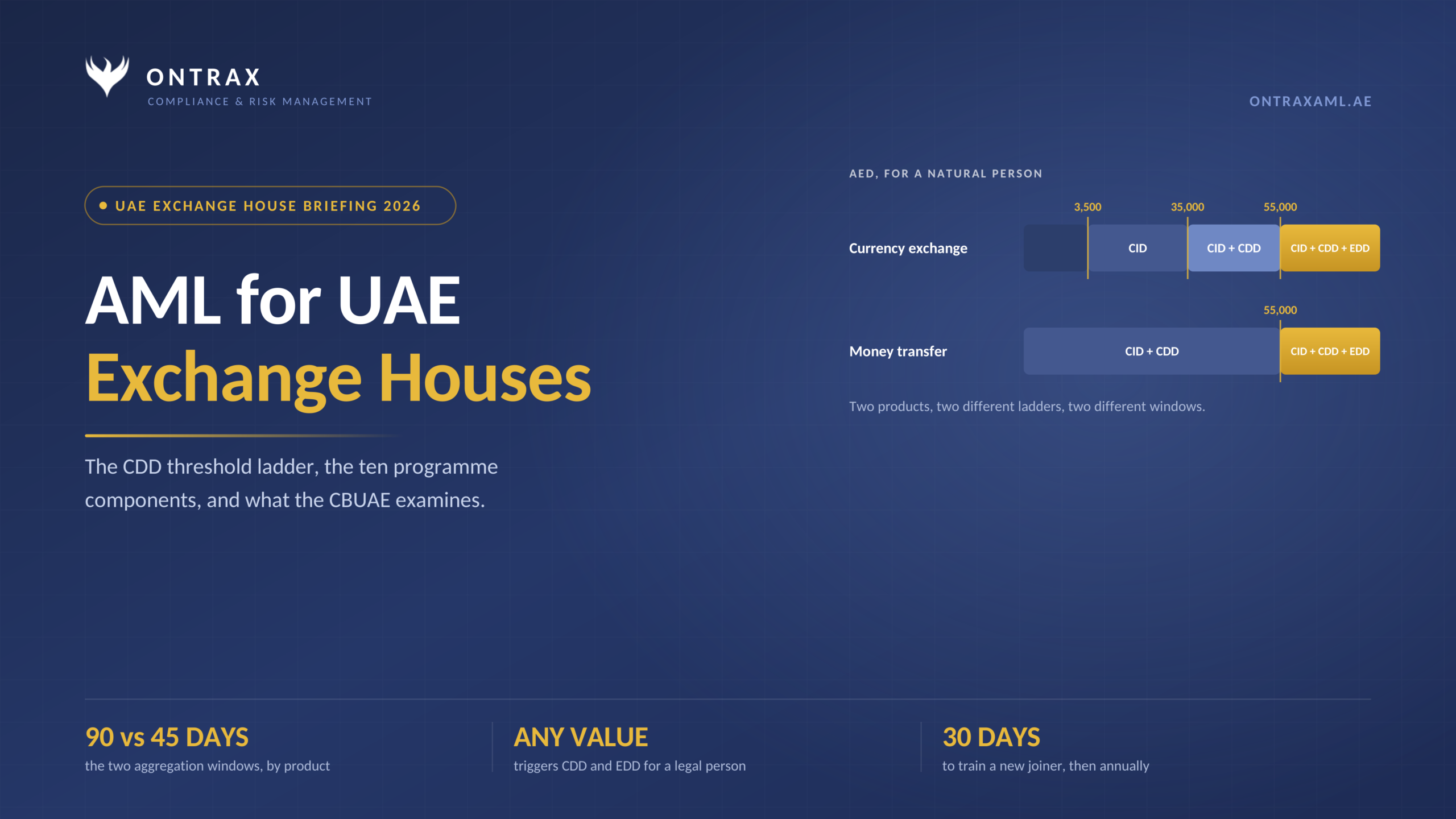

In short: A UAE exchange house must run a written, risk-based AML programme with ten named components, and must apply customer due diligence against a threshold ladder that differs by product. For currency exchange with a natural person, AED 3,500 triggers customer identification, AED 35,000 aggregated over ninety days triggers full due diligence, and AED 55,000 over the same window triggers enhanced due diligence. For money transfer the ladder is shorter and the window is forty-five days, with full due diligence applying at any value. A legal person, a counterparty, a politically exposed person, a dealer in precious metals, a third-party transaction or any high-risk circumstance triggers enhanced due diligence at any value. Governance expectations are stricter than the general standard: the compliance officer role must not be combined with other functions, an alternate must be appointed, and a compliance committee must exist. Failure to report carries AED 100,000 to AED 1,000,000 plus imprisonment.
An exchange house is examined differently from a bank, and differently again from a dealer in precious metals. The Central Bank of the UAE has issued guidance written specifically for this sector, and it is unusually prescriptive: it does not simply require customer due diligence, it sets out at what value, over what period, and in what combination. That specificity cuts both ways. It removes any argument about where the line sits, and it makes a shortfall easy for a supervisor to demonstrate.
This briefing works through what a UAE exchange house is actually held to. It covers the ten components of the programme, the threshold ladder in full, the governance requirements that are stricter here than elsewhere, counterparty risk, monitoring and reporting, training and employee risk, and the assurance obligations that close the loop. It is written to be used — the thresholds are reproduced in a table you can hand to a branch, and section nine is a readiness test. Where the exchange house model overlaps with obligations every UAE firm carries, we link through to the fuller treatment, starting with AML compliance for financial institutions.
A note on legal basis, stated plainly. The CBUAE’s sector guidance for exchange houses was issued in 2021 and cites Federal Decree-Law No. 20 of 2018 as amended and Cabinet Decision No. 10 of 2019. Both of those instruments have since been replaced — by Federal Decree-Law No. 10 of 2025, in force 14 October 2025, and Cabinet Resolution No. 134 of 2025, in force 14 December 2025. The thresholds and expectations below remain the CBUAE’s operational standard for the sector and are what an examination works through. The underlying statutory references have moved. Any exchange house policy document still citing only the 2018 and 2019 instruments should be updated, and that update is itself a finding waiting to happen.
1. The ten components of the programme
The CBUAE expects a written AML and CFT programme, approved internally, and scaled to the exchange house’s size, complexity, customer base, products and geographic exposure. The guidance names ten components. An examination works through them in order, and a programme missing one of them is not a partial programme — it is an incomplete one.
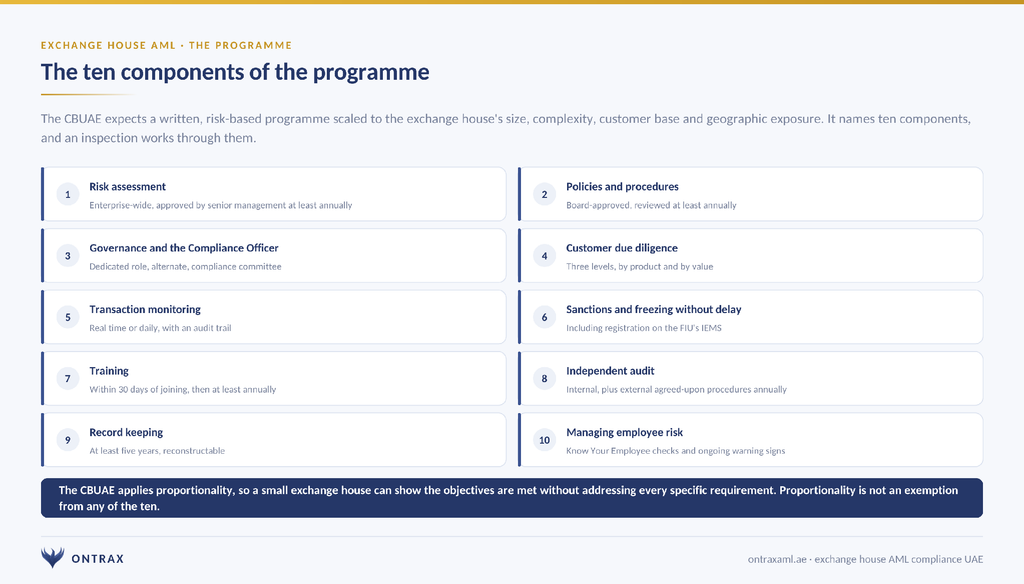
The ten components of a UAE exchange house AML programme, as named by the CBUAE.
Proportionality applies, and it is worth being precise about what it means. A smaller exchange house may demonstrate that the objectives of the guidance are met without addressing every single specific requirement in the manner a large one would. That is a genuine concession on method. It is not a concession on scope: all ten components still have to exist, and a small exchange house that has simply omitted independent audit or employee risk management has not applied proportionality, it has applied omission.
The most common structural failure we see is a programme written for a generic financial institution and lightly branded for the exchange house. It will have policies, it will have CDD, and it will fail on the two components that are specific to this sector: the threshold ladder in section three, and counterparty risk in section five. If your AML policy does not contain the AED figures and the two aggregation windows as written numbers, it was not written for an exchange house.
2. The risk assessment that sits underneath everything
Every other component depends on the enterprise-wide risk assessment, and the guidance is specific about who owns it. Senior management must review and approve the risk appetite statement, the methodology and the findings, at least annually, and must update the assessment after any major change to the business.
The assessment runs through six stages: identify the inherent risks across customers, products, services, delivery channels and geographies; assess the likelihood and impact of each; evaluate the controls already in place; determine the residual risk that remains after those controls; decide whether the residual risk sits inside the stated appetite; and document the whole chain so it can be followed by someone who was not in the room.
- Customer risk — the mix of walk-in and repeat customers, the proportion of legal persons, the presence of politically exposed persons, and exposure to dealers in precious metals and other DNFBP counterparties.
- Product and service risk — currency exchange and money transfer carry different profiles, which is precisely why the thresholds differ between them.
- Delivery channel risk — counter, agent, digital, and any non-face-to-face channel.
- Geographic risk — both where the exchange house operates and the corridors it serves, which for most UAE exchange houses is the defining exposure.
- New technology — risk must be assessed before approval is sought from the CBUAE to launch or use a new technology, not after it has been deployed.
That last point catches firms out. An exchange house that has already built a digital channel and then seeks approval has done the sequence backwards, and the risk assessment produced afterwards reads as justification rather than analysis. Our AML Risk Assessment service builds the methodology and the documentation trail in the order a supervisor expects to find it.
3. The CDD threshold ladder, in full
This is the centre of the sector guidance and the single most examined area. Three levels of diligence apply, and which one you owe depends on the product, the customer type and the value, aggregated over a period that is not the same for both products.
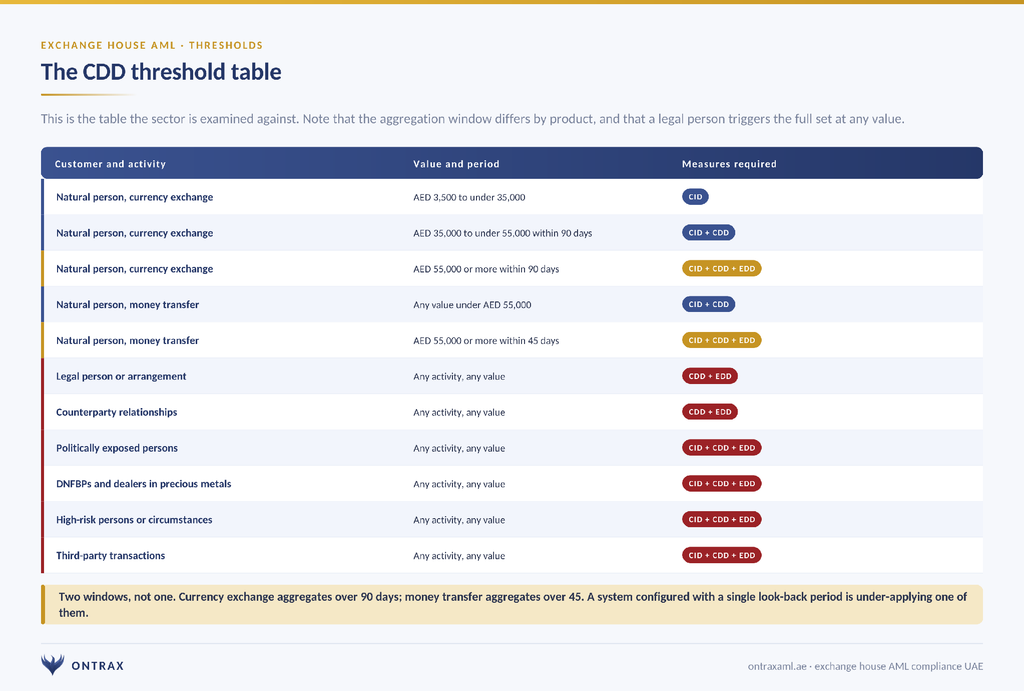
The CBUAE customer due diligence threshold table for UAE exchange houses, by product and value.
The three levels
- Customer identification (CID) — identify the customer and record the identification data. For a UAE national or resident this means the Emirates ID verified through the Federal Authority for Identity and Citizenship gateway or UAE Pass, with both a copy of the card and a record of the digital verification retained. For other identity documents, the original must be sighted and the copy marked as ‘Original Sighted and Verified’.
- Customer due diligence (CDD) — identification plus verification, understanding the purpose and intended nature of the relationship, and identifying the beneficial owner where the customer is not a natural person.
- Enhanced due diligence (EDD) — CDD plus additional measures: source of funds, source of wealth where appropriate, senior management approval, and more intensive ongoing monitoring.
The two windows
Currency exchange aggregates over ninety days. Money transfer aggregates over forty-five. This is the detail most often missed, and it is missed in a specific way: a transaction monitoring system is configured with one look-back period, applied to both products, and the shorter window silently under-applies on one side of the business while the longer one over-applies on the other.
Testing this is straightforward. Take a money transfer customer who sent AED 20,000 on three occasions across six weeks, and check whether the system aggregated them and escalated to enhanced due diligence at AED 55,000. If it did not, the configuration is wrong, and every similar customer is wrong with it. Our Transaction Monitoring & Screening work begins with exactly this kind of threshold replay, and the wider mechanics are set out in our guide to transaction monitoring in the UAE.
The categories where value is irrelevant
Six categories trigger enhanced due diligence at any value, with no threshold to reach. Legal persons and legal arrangements. Counterparty relationships. Politically exposed persons, their family members and close associates. DNFBPs, including dealers in precious metals and stones. Any customer or circumstance assessed as high risk. And transactions conducted on behalf of a third party.
The DPMS category deserves particular attention, because an exchange house serving a gold trading customer in Dubai is serving a sector with its own extensive obligations, and the enhanced measures have to be real rather than nominal. Our briefing on DPMS AML compliance in the UAE sets out what that customer is required to do, which is a useful lens for assessing whether they are doing it. For legal persons, the beneficial ownership question runs through the UAE register obligations covered in our guide to the UBO register.
4. Governance: where the standard is stricter here
Exchange house governance requirements go beyond the general financial institution standard in three specific ways, and all three are structural rather than procedural. A firm either has them or does not, and the answer is visible on an organisation chart.
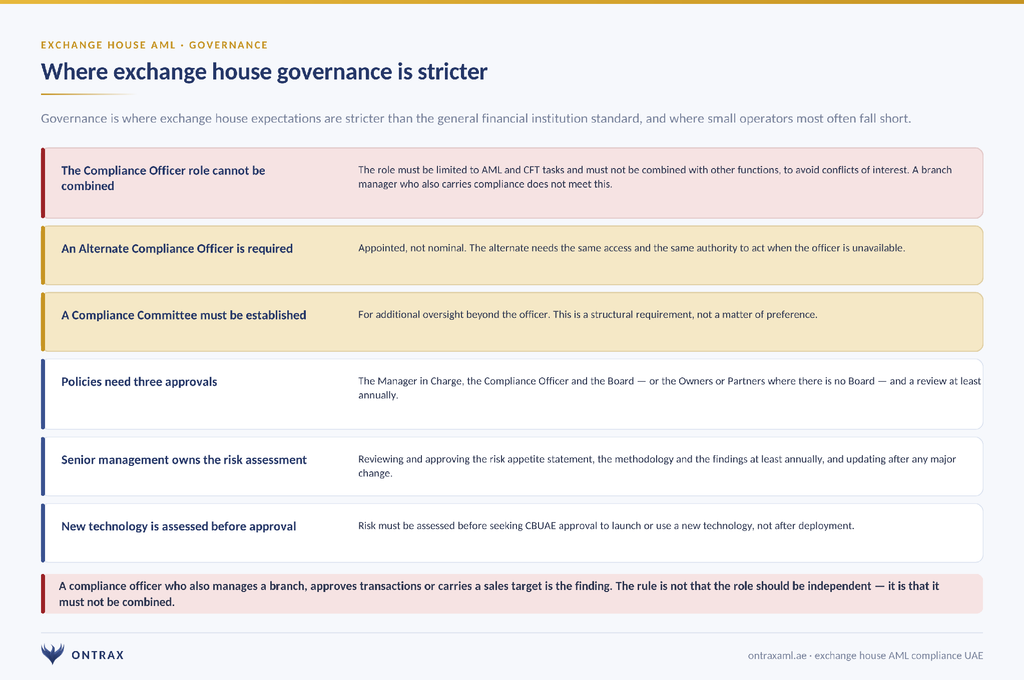
Where UAE exchange house AML governance expectations are stricter than the general standard.
The compliance officer role must not be combined
The guidance is explicit that the role must be limited to AML and CFT tasks and must not be combined with other functions, in order to avoid conflicts of interest. This is stronger than a general independence expectation. A branch manager who also carries compliance does not satisfy it. Nor does an operations head with a compliance title, or a compliance officer who approves transactions, carries a sales target, or reports to the person whose business they are meant to challenge.
For smaller exchange houses this is the hardest requirement to meet, because the economics of a dedicated non-revenue role are difficult at that scale. It is also non-negotiable. Where internal capacity does not stretch to a dedicated appointment, the realistic routes are an Outsourced AML Function supporting a named internal officer, or MLRO Provision. What cannot be done is to combine the role and hope the structure is not examined — and it is worth reading what can and cannot be outsourced before assuming a provider solves the appointment itself.
An alternate compliance officer is required
An alternate must be appointed, with the same access to information and the same authority to act when the officer is unavailable. An alternate who exists on paper, has never seen an alert and does not hold goAML credentials is not an alternate. The practical test is whether a suspicious transaction report could be filed on a day the officer is on leave.
A compliance committee must be established
The guidance requires a compliance committee for additional oversight beyond the officer. This is a structural requirement, not a matter of preference or scale. Minutes, membership, frequency and the matters escalated to it should all be documented, because a committee with no record of having met is indistinguishable from one that does not exist.
Policy approval runs through three parties
Policies and procedures must be approved by the Manager in Charge, the Compliance Officer and the Board — or the Owners or Partners where there is no Board — and reviewed at least annually. Three recorded approvals, and a dated annual review. Our AML Policy Development work produces the policy and the approval record together, because an unapproved policy is a draft regardless of how good it is. On what the appointment itself involves, our guide to the compliance officer and MLRO role in the UAE covers the ground.
5. Counterparty risk, which is specific to this sector
Few other sectors carry counterparty risk in the form an exchange house does. Correspondent arrangements, instant money transfer providers, hedging counterparties, banknote import and export relationships and special product arrangements all sit between the exchange house and the wider financial system, and each of them is a route through which risk arrives from outside the customer base entirely.
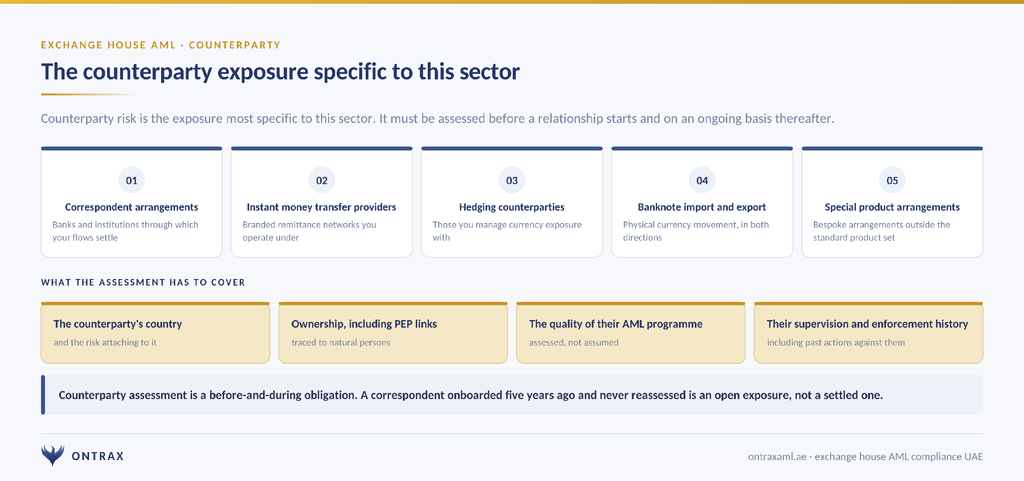
Counterparty relationships a UAE exchange house must assess, and what the assessment has to cover.
The assessment is required before a relationship begins and on an ongoing basis after that. It must cover the counterparty’s country and the risk attaching to it, its ownership structure traced to natural persons including any politically exposed person links, the quality of its own AML and CFT programme, and its supervisory and enforcement history.
The failure mode here is not a missing assessment. It is a stale one. A correspondent onboarded five years ago, reviewed once at onboarding and never since, is an open exposure that no amount of customer-level due diligence addresses. Counterparty relationships should sit in the same periodic review cycle as high-risk customers, with a documented refresh and a documented conclusion.
Banknote import and export deserves separate mention because it is physical. Currency moving across a border in either direction carries its own exposure, and the counterparties involved — including carriers and correspondent banks — should be assessed as part of the arrangement rather than treated as logistics.
6. Monitoring, sanctions and the duty to report
Monitoring runs continuously while customer due diligence refreshes annually. They are different clocks, and an exchange house that treats periodic review as its monitoring has only one of them running.
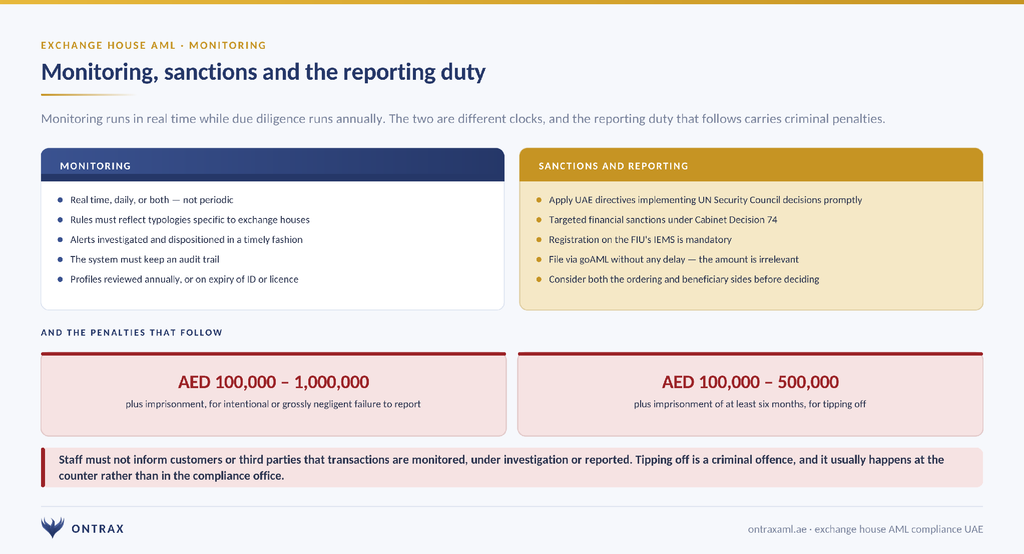
Transaction monitoring, sanctions obligations and the reporting duty for UAE exchange houses, with penalties.
Monitoring
Transaction monitoring must operate in real time, daily, or both. Rules must reflect typologies specific to the exchange house sector rather than generic banking scenarios. Alerts must be investigated and dispositioned in a timely fashion, and the system must maintain an audit trail capable of showing what was flagged, who looked at it, what they concluded and when.
Customer profiles must be reviewed at least annually, or on the expiry of the identity document or trade licence, whichever comes first. The guidance is clear that the exchange house must not rely on the customer to report changes to their information. A refresh process that consists of waiting to be told is not a refresh process.
Sanctions
UAE directives implementing United Nations Security Council decisions must be applied promptly, and targeted financial sanctions obligations under Cabinet Decision No. 74 of 2020 apply in full, including the duty to freeze without delay. Registration on the Financial Intelligence Unit’s Integrated Enquiries Management System is mandatory, and it is the mechanism through which listings and notifications reach you.
Screening must consider both the ordering and the beneficiary side of a transfer before a decision is made, not only the customer standing at the counter.
Reporting
Suspicious transaction and suspicious activity reports are filed through goAML without any delay, and the amount involved is irrelevant — there is no de minimis below which suspicion need not be reported. If you are not yet registered, or the registration is held by someone who has left, our guide to goAML registration in the UAE sets out the process.
The penalties attached to this component are among the most severe in the framework. Intentional or grossly negligent failure to report carries a fine of AED 100,000 to AED 1,000,000 together with imprisonment. Tipping off — informing a customer or any third party that a transaction is being monitored, investigated or reported — carries imprisonment of at least six months together with a fine of AED 100,000 to AED 500,000.
Tipping off is worth dwelling on, because it is overwhelmingly a counter-level risk rather than a compliance-department one. It happens when a teller explains a delay, apologises for a hold, or tells a regular customer their transfer is being looked at. That is a criminal offence committed in a moment of ordinary courtesy, and the only effective control is training that addresses it directly by name.
7. Training, employee risk, audit and records
Two of the ten components concern people: the ones the exchange house employs, and the ones who independently test what has been built. Both are frequently treated as administrative, and both are commonly where an examination finds its clearest evidence.
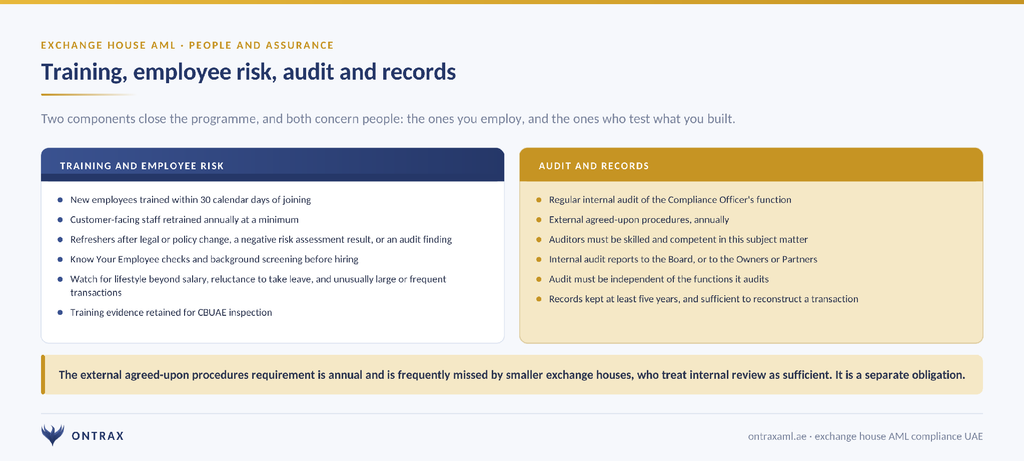
Training, employee risk management, independent audit and record keeping for UAE exchange houses.
Training
New employees must be trained within thirty calendar days of joining. Customer-facing staff must be retrained at least annually. Additional training is required after a change in law or internal policy, after a negative result in the risk assessment, and after an adverse audit finding. Evidence of all of it must be retained and produced on inspection. The practical content for an exchange house is narrower and more useful than generic AML training: the threshold ladder, the two aggregation windows, the identity verification routes, the tipping-off prohibition and the internal escalation path. Our AML Training & Awareness Programs are built around role rather than topic, and our guide to AML training in the UAE covers the frequency and evidence requirements across sectors.
Know Your Employee
Background checks are required before hiring, and the obligation does not stop at onboarding. The guidance identifies ongoing warning signs that should be acted on: a lifestyle beyond what the salary supports, reluctance to take vacation, and involvement in unusually large or frequent transactions. These are not disciplinary matters in the first instance; they are risk indicators, and the programme should say who reviews them and what happens next.
Independent audit
Two separate obligations sit here, and they are regularly conflated. Regular internal audit of the compliance officer’s function, reporting to the Board or to the Owners or Partners. And external agreed-upon procedures, performed annually. Auditors must be skilled and competent in this subject matter, and the audit must be independent of the functions it audits. Smaller exchange houses frequently treat an internal review as satisfying both, which it does not. Our Independent AML Audit is scoped to the external requirement, and an AML Audit & Compliance Review is the lighter diagnostic where the question is readiness rather than assurance. What to expect from the supervisor’s own visit is covered in our guide to the UAE AML inspection.
Records
Records must be kept for at least five years and must be sufficient to reconstruct an individual transaction. Reconstruction is the operative standard: identification data, the transaction itself, the monitoring output, the investigation and the conclusion should fit together into a single retrievable narrative. A system that can produce each element from a different place but cannot assemble them does not meet the test in practice.
8. The resourcing question, answered honestly
Most of the gap between what the guidance requires and what a mid-sized exchange house has in place is a capacity gap rather than a knowledge one. The requirements are published, the thresholds are explicit, and nobody in the sector is unaware of them. What is missing is a dedicated person with the time to run the programme and the independence to do it properly.
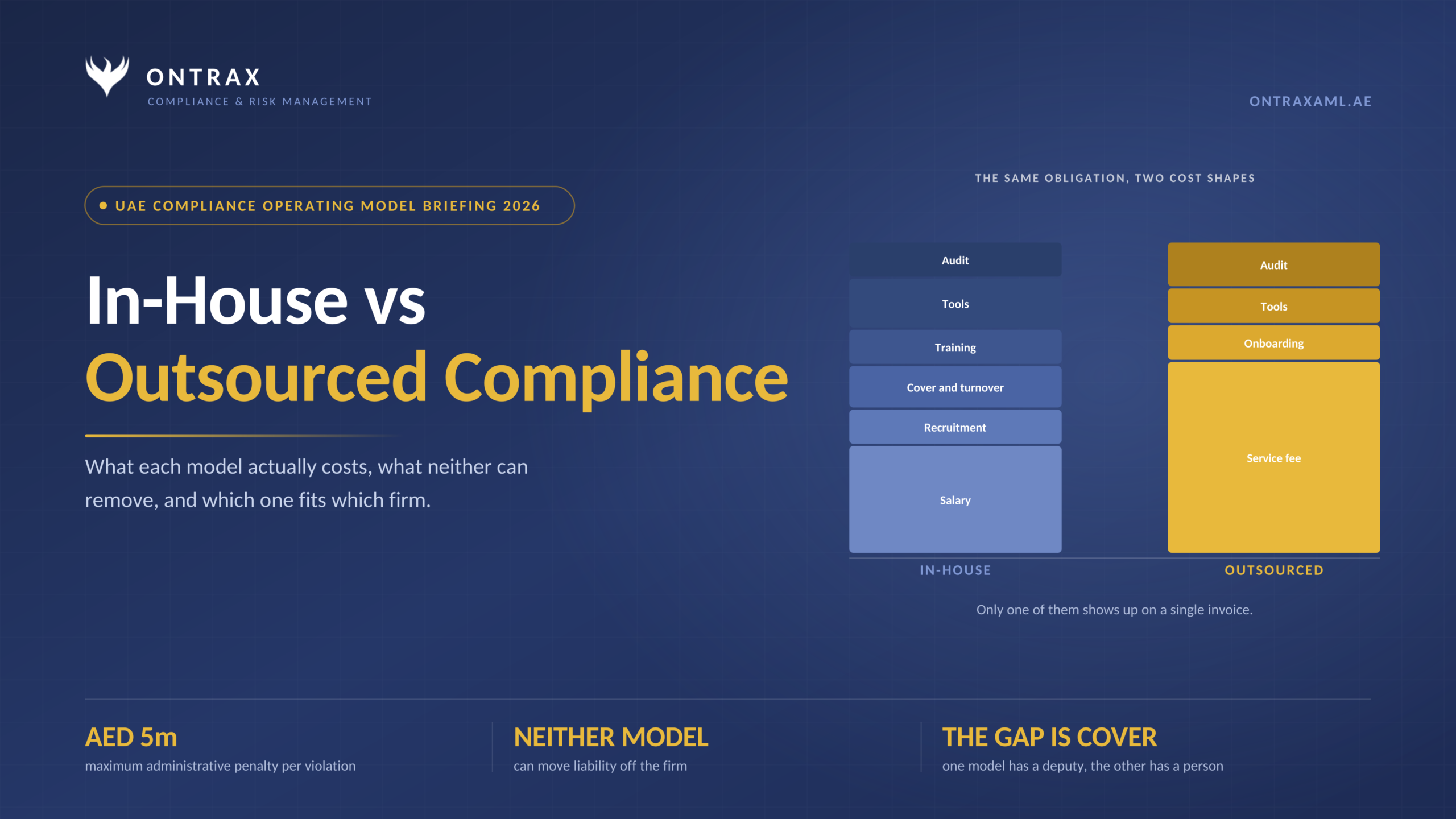
There are three realistic shapes. A full in-house function, which suits an exchange house with branch scale, significant corridor exposure and the volume to justify a dedicated team. A Virtual Compliance Officer or Outsourced AML Function supporting a named internal officer, which suits most single-licence and small-network operators. Or a hybrid, where the appointment and the daily operation stay internal and the specialist components — risk assessment methodology, threshold configuration, independent testing, training design — are bought in. Our analysis of in-house versus outsourced compliance sets out what each model actually costs, including the components that do not appear on an invoice.
Whichever shape is chosen, three things do not move. The appointment is the exchange house’s. The reporting decision is the exchange house’s. And the liability is the exchange house’s. A provider can carry the work. No provider carries the obligation.
9. A readiness test you can run this week
Nine questions. Each one maps to a specific expectation in the guidance, and each one has a documentary answer or does not.
- Does your written programme contain all ten components, including independent audit and employee risk management, and not merely reference them?
- Does your policy state the AED thresholds as figures, and does it state ninety days for currency exchange and forty-five days for money transfer as separate windows?
- Can you produce a monitoring replay showing a money transfer customer correctly aggregated to AED 55,000 across forty-five days and escalated to enhanced due diligence?
- Is your compliance officer’s role limited to AML and CFT, with no branch, operational, sales or transaction-approval responsibility?
- Is there a named alternate with goAML access who has handled a case in the last twelve months?
- Has the compliance committee met, and are there minutes?
- When was each counterparty relationship — correspondent, money transfer provider, hedging, banknote, special product — last reassessed, and where is that recorded?
- Was the external agreed-upon procedures engagement performed within the last twelve months, by someone independent of the functions audited?
- For a transaction eighteen months old, can you assemble the identification, the monitoring output, the investigation and the conclusion into one retrievable record?
A no to any of the first six is a structural gap and should be closed before an examination rather than during one. A no to the last three is an evidence gap, which is usually faster to fix but no less visible when it is found.
Working with Ontrax
Ontrax Compliance & Risk Management Ltd is an AML compliance consultancy based in the Dubai International Financial Centre. For a licensed exchange house, the work usually begins with an AML Audit & Compliance Review against the ten components and the threshold ladder, which establishes where the gaps actually are rather than where they are assumed to be. From there we build or rebuild the AML risk assessment and the policies and procedures, configure and test transaction monitoring and screening against both aggregation windows, deliver role-based training to counter staff and management, and provide the independent AML audit the external requirement calls for. Where the compliance officer role cannot be resourced internally without combining it with another function, we provide MLRO Provision and an Outsourced AML Function that supports a compliant appointment. Our full approach for regulated firms is set out on our AML compliance for financial institutions page.
If you would like the threshold ladder reviewed against your current monitoring configuration, that is a short engagement and it is the one that most often finds something.
Frequently asked questions
What are the CDD thresholds for a UAE exchange house?
For currency exchange with a natural person: AED 3,500 to under AED 35,000 requires customer identification; AED 35,000 to under AED 55,000 aggregated within ninety days requires identification plus customer due diligence; AED 55,000 or more within ninety days requires identification, due diligence and enhanced due diligence. For money transfer with a natural person: any value under AED 55,000 requires identification plus due diligence; AED 55,000 or more aggregated within forty-five days adds enhanced due diligence. Legal persons, counterparties, politically exposed persons, DNFBPs including dealers in precious metals, high-risk cases and third-party transactions require enhanced due diligence at any value.
Why do currency exchange and money transfer have different aggregation windows?
Because the CBUAE assesses the two products as carrying different risk profiles. Currency exchange aggregates over ninety days and money transfer over forty-five. The practical consequence is that a single look-back period configured across both products will be wrong for one of them, and systems configured this way under-apply enhanced due diligence on the money transfer side.
Can an exchange house compliance officer also manage a branch?
No. The CBUAE guidance states the compliance officer role must be limited to AML and CFT tasks and must not be combined with other functions, in order to avoid conflicts of interest. A branch manager carrying compliance, an operations head with a compliance title, or an officer who approves transactions or holds a sales target does not meet this requirement.
Does a UAE exchange house need an alternate compliance officer?
Yes. The guidance requires an alternate to be appointed, with the access and authority to act when the officer is unavailable. The alternate should hold goAML credentials and be capable of filing a report independently, otherwise the appointment is nominal.
Is a compliance committee mandatory for an exchange house?
Yes. The guidance requires a compliance committee to provide oversight beyond the compliance officer. It is a structural requirement rather than a matter of scale or preference, and it should have documented membership, meeting frequency and minutes.
What is counterparty risk for an exchange house?
It is the risk arising from the relationships that connect the exchange house to the wider financial system: correspondent arrangements, instant money transfer providers, hedging counterparties, banknote import and export relationships, and special product arrangements. Each must be assessed before the relationship begins and on an ongoing basis, covering country risk, ownership traced to natural persons, the counterparty’s own AML programme, and its supervisory and enforcement history.
How often must exchange house customer profiles be reviewed?
At least annually, or on the expiry of the identity document or trade licence, whichever comes first. The exchange house must not rely on the customer to report changes to their information.
How quickly must a new exchange house employee be trained?
Within thirty calendar days of joining. Customer-facing staff must then be retrained at least annually, with additional training after a change in law or internal policy, a negative risk assessment result, or an adverse audit finding. Evidence must be retained.
Does an exchange house need an external AML audit?
Yes, and it is separate from internal audit. The guidance requires regular internal audit of the compliance officer’s function, reporting to the Board or to the Owners or Partners, and in addition external agreed-upon procedures performed annually by someone skilled and competent in the subject matter and independent of the functions audited.
What are the penalties for failing to report a suspicious transaction?
Intentional or grossly negligent failure to report carries a fine of AED 100,000 to AED 1,000,000 together with imprisonment. Tipping off — informing a customer or third party that a transaction is being monitored, investigated or reported — carries imprisonment of at least six months and a fine of AED 100,000 to AED 500,000.
Is there a minimum amount below which a suspicious transaction need not be reported?
No. Reports are filed through goAML without delay regardless of the amount involved. The threshold ladder governs the level of due diligence applied; it has no bearing on the duty to report suspicion.
How long must an exchange house keep records?
At least five years, and the records must be sufficient to reconstruct an individual transaction. Reconstruction is the operative test: identification data, transaction detail, monitoring output, investigation and conclusion should assemble into a single retrievable record.
Does the 2021 CBUAE guidance still apply after the 2025 AML law changes?
The guidance remains the CBUAE’s operational standard for the sector and is what an examination works through. Its statutory citations have moved: it references Federal Decree-Law No. 20 of 2018 as amended and Cabinet Decision No. 10 of 2019, which have been replaced by Federal Decree-Law No. 10 of 2025 and Cabinet Resolution No. 134 of 2025. Exchange house policies still citing only the older instruments should be updated.
Can an exchange house outsource its compliance function?
The underlying work can be supported by an external provider, but the appointment, the reporting decision and the liability remain with the exchange house. Where a dedicated internal officer is not viable, the compliant route is an outsourced function or MLRO provision supporting a named internal appointment — not the combination of the compliance role with another function.
Sources and further reading
· CBUAE — Guidance for Licensed Exchange Houses on AML/CFT
· Cabinet Resolution No. 134 of 2025 — Executive Regulations to Federal Decree-Law No. 10 of 2025
· UAE Supervisory Sub-Committee — Joint Guidance on the AML/CFT/CPF Compliance Officer and MLRO
· CBUAE — Guidance on transaction monitoring and sanctions screening
· UAE Financial Intelligence Unit — goAML
This briefing is general information on AML obligations for licensed exchange houses in the UAE and is not legal advice. The CBUAE sector guidance referenced here predates the 2025 legislative changes and its statutory citations should be read accordingly. Verify thresholds and penalty figures against the current text of the instruments before relying on them. Ontrax Compliance & Risk Management Ltd, Dubai International Financial Centre.