
In short: The choice between in-house and outsourced compliance in the UAE is not a choice about whether obligations apply. An appointed officer inside the firm, an alternate, senior management approval, the decision to report, liability and accountability to the supervisor are fixed in both models. What differs is who performs the work underneath them. In-house spreads cost across salary, recruitment, cover, turnover, training, tooling and management time. Outsourced concentrates most of it into a fee, with independent validation still bought separately in both cases. The downside is identical either way: administrative penalties from AED 10,000 to AED 5,000,000 per violation, criminal fines of AED 5 million to AED 100 million for money laundering by a legal person, and personal liability for senior management in defined circumstances.
Most firms approach outsourced compliance as a budget question and get a misleading answer, because they compare a salary against a fee. Those are not the two things being compared.
A salary buys one person’s time. An outsourced compliance fee buys a function. Neither buys away the obligation, and the parts of the obligation that cannot move — the appointment, the approvals, the reporting decision, the liability — are identical in both models and cost the same in both, which is to say they cost management attention rather than money.
This briefing sets out what each model actually costs: the floor that neither removes, the line items compared honestly, the costs that do not appear in the business case, the published downside figures a decision should be weighed against, which model fits which firm, and the nine questions to ask before committing either way. For the legal limits on what can be delegated at all, our guide to outsourced AML compliance is the companion piece and should be read first if you have not already.
A note on numbers. This briefing does not quote salary ranges or provider fees, because any figure given here would be a guess dressed as research. What it does give is the complete list of cost components to price, and the penalty figures — which are published and specific — to price them against.
1. The floor neither model removes
Settle this before comparing in-house and outsourced compliance at all. Six obligations exist whether compliance is in-house or outsourced, and no outsourced compliance provider and no internal hire makes any of them go away.
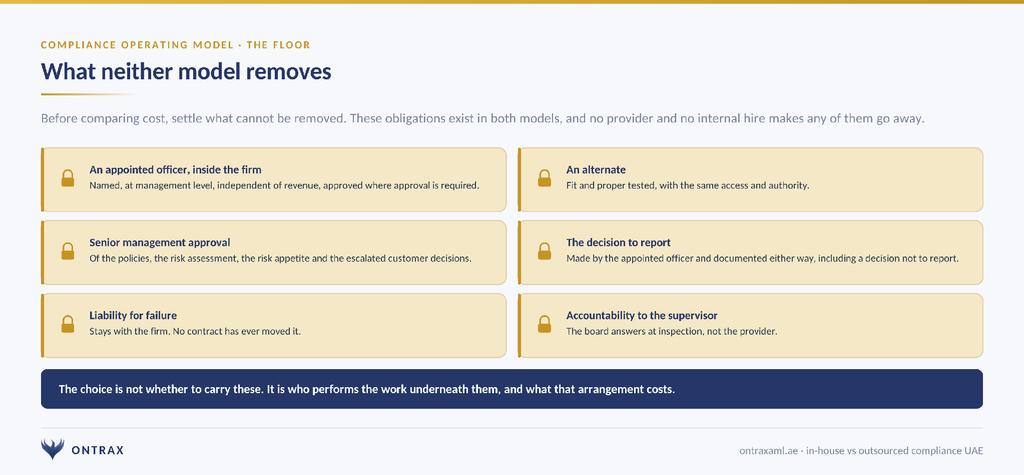
What neither in-house nor outsourced compliance removes: the six fixed obligations.
An appointed officer inside the firm, named, at management level, independent of revenue and approved where approval is required. An alternate, fit and proper tested, with the same access and authority. Senior management approval of the policies, the risk assessment, the risk appetite and the escalated customer decisions. The decision to report, made by the appointed officer and documented either way. Liability for failure, which stays with the firm. And accountability to the supervisor, which the board answers for at inspection. Our guide to the compliance officer and MLRO role in the UAE sets out what each of those requires in practice.
The point this settles: Outsourced compliance is not a transfer of responsibility and was never available as one. Joint supervisory guidance states that the role of the compliance officer or MLRO, and the compliance function as a whole, must not be outsourced under any circumstances. Specific tasks can be delegated with a Letter of No Objection. The choice is about who does the work, not about who carries it.
2. The line items, compared honestly
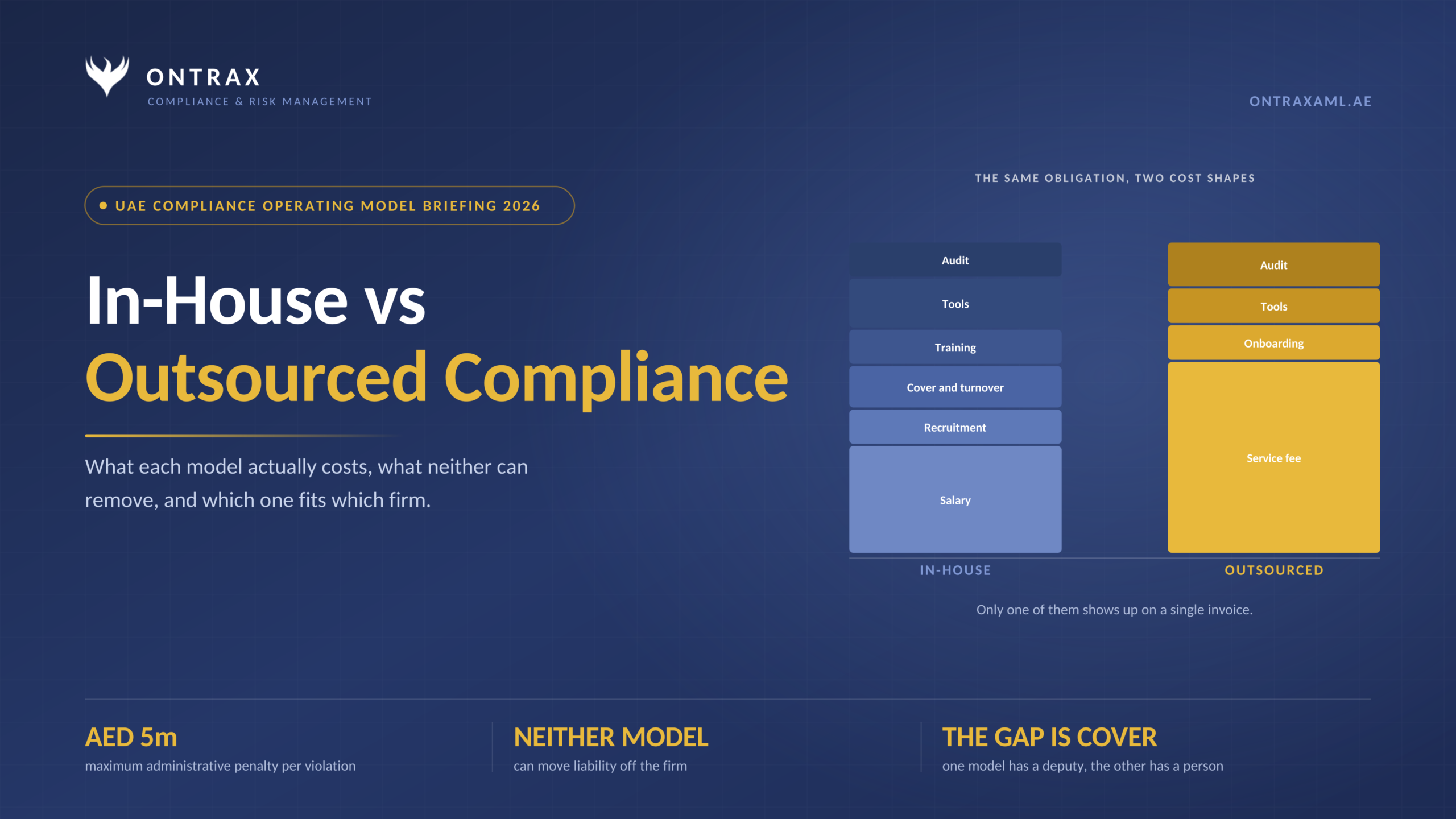
Compare outsourced compliance and in-house components rather than headline figures. The in-house model spreads cost across six budgets; outsourced concentrates most of it into one, which makes it look cheaper than it is and more expensive than it is depending on which budget you are looking at.
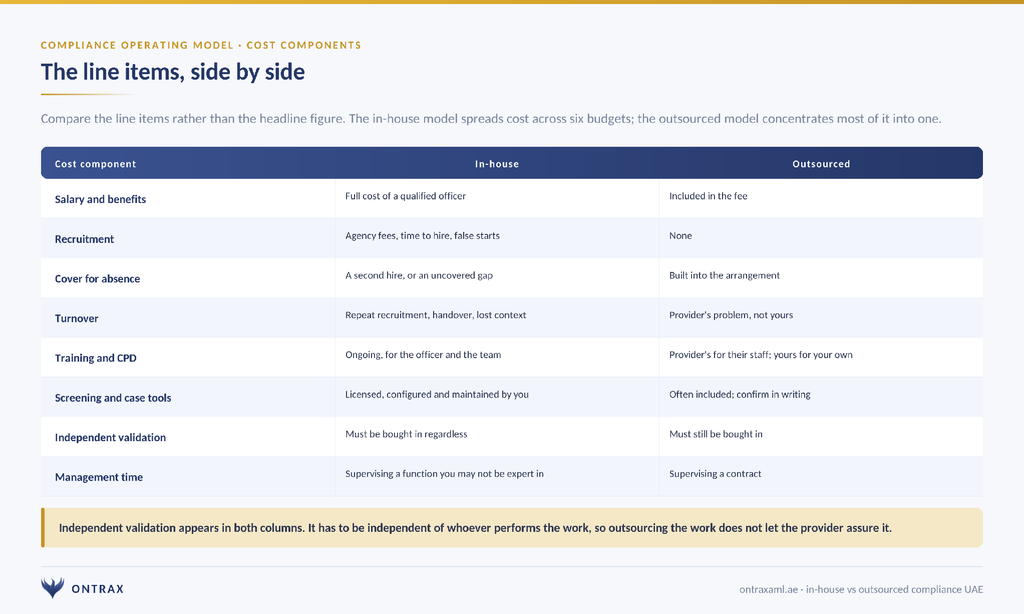
In-house vs outsourced compliance cost components in the UAE, line by line.
Where in-house carries more
In-house compliance carries recruitment, with agency fees, time to hire and the cost of a false start. Cover for absence, which means either a second hire or an uncovered gap. Turnover, which means repeat recruitment, handover and the loss of accumulated context about your own business. Training and continuing development for the officer and the wider team. And screening and case management tooling licensed, configured and maintained for a team of one, usually at list price.
Where outsourced carries more
Outsourced compliance carries scope risk, because what is not written into the agreement is billed separately or simply not done. Presence risk, because an officer covering several clients is not in your business daily. And transition risk, because in outsourced compliance the accumulated knowledge of your book sits with the provider and leaves with the contract.
Where both carry the same
Independent validation appears in the in-house and outsourced compliance columns alike. It must be independent of whoever performs the work, which means a provider cannot validate its own output any more than an internal analyst can sign off their own rule tuning. Our Independent AML Audit service exists precisely for that gap, and our guide to transaction monitoring in the UAE explains why the independence requirement is explicit in the CBUAE guidance.
Management time is constant across in-house and outsourced compliance, though it changes shape. In-house you supervise a function you may not be expert in. Outsourced you supervise a contract, and the supervisor expects that supervision to be documented and periodic rather than assumed.
3. The costs that do not appear in the business case
Both in-house and outsourced compliance carry costs that surface after the decision.
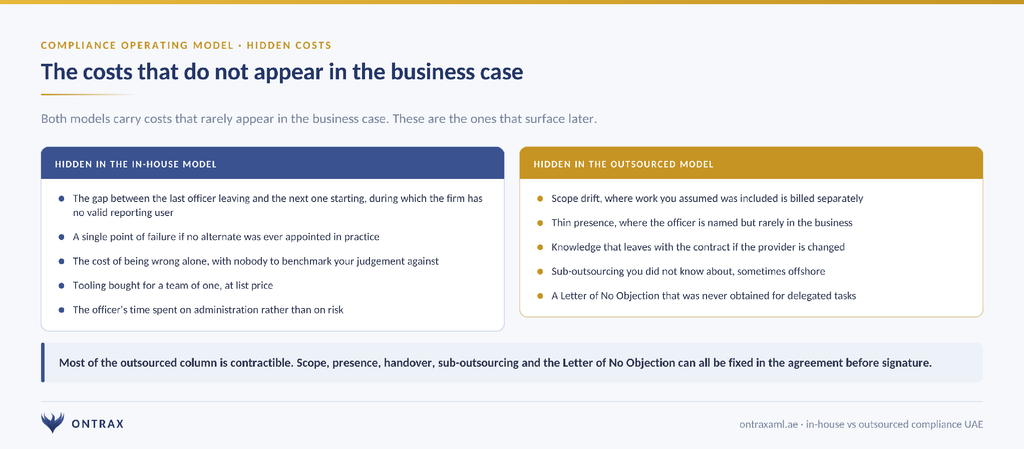
Hidden costs in the in-house and outsourced compliance models.
Hidden in in-house compliance compliance model
The gap between one officer leaving and the next starting, during which the firm may have no valid reporting user at all — a point our guide to goAML registration covers, because the replacement has to re-register through SACM before they can file anything. A single point of failure where an alternate was appointed on paper but never in practice. The cost of being wrong alone, with no second opinion to test a judgement against. Tooling bought at single-seat prices. And an officer whose time goes on administration rather than on risk.
Hidden in outsourced compliance compliance model
Scope drift, where work assumed to be included is billed separately. Thin presence, where the officer is named but rarely in the business. Knowledge that leaves with the contract. Sub-outsourcing you did not know about, sometimes performed outside the UAE. And a Letter of No Objection that was never obtained for the delegated tasks — which is a breach rather than an administrative oversight, as our guide to what can and cannot be outsourced explains.
The asymmetry worth noticing: Almost everything hidden in the outsourced compliance column is contractible. In outsourced compliance, scope, presence, handover, sub-outsourcing and the Letter of No Objection can all be fixed in the agreement before signature. Most of what is hidden in the in-house compliance column cannot be contracted away — it is a consequence of having one person.
4. The downside, which is the same in both models
A business case for in-house or outsourced compliance should be weighed against the published cost of getting it wrong, because that figure does not change with the operating model.
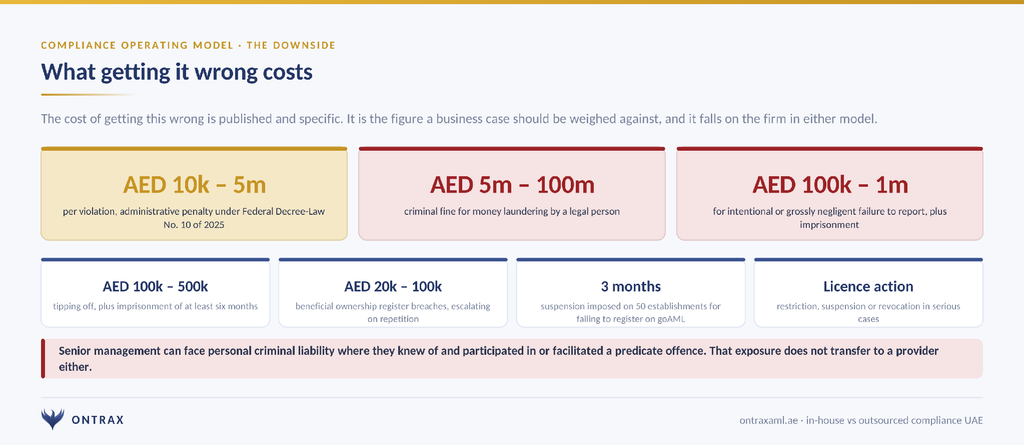
The published penalty figures that apply to UAE AML failures regardless of operating model.
Administrative penalties under Federal Decree-Law No. 10 of 2025 run from AED 10,000 to AED 5,000,000 per violation, with restriction or suspension of responsible directors and managers, and licence action in serious cases. Money laundering by a legal person carries criminal fines of AED 5 million to AED 100 million. Intentional or grossly negligent failure to report carries AED 100,000 to AED 1,000,000 and imprisonment. Tipping off carries AED 100,000 to AED 500,000 and imprisonment of at least six months.
Alongside those, the sector record. Beneficial ownership register breaches escalate from a written warning through fixed fines to around AED 100,000 for repeated non-compliance. Fifty establishments were suspended for three months for failing to register on goAML at all. And in the first half of 2025 the Ministry of Economy and Tourism recorded 1,063 DNFBP violations with fines exceeding AED 42 million, of which real estate brokerages alone accounted for 495 violations and roughly AED 18.5 million.
Senior management can face personal criminal liability where they knew of and participated in or facilitated a predicate offence, and knowledge can be inferred from objective circumstances rather than requiring proof of actual knowledge. That exposure does not transfer to a provider, and it is the part of the calculation boards most often leave out.
The practical implication for the cost comparison is that the downside is a constant. It therefore cannot be used to justify either model — what justifies a model is which one more reliably prevents the failure. Our guide to the UAE AML inspection sets out what that prevention has to look like on paper.
5. Which model fits which firm
Neither in-house nor outsourced compliance is better in the abstract. Whether outsourced compliance is the right answer turns on volume, complexity and whether real cover exists.
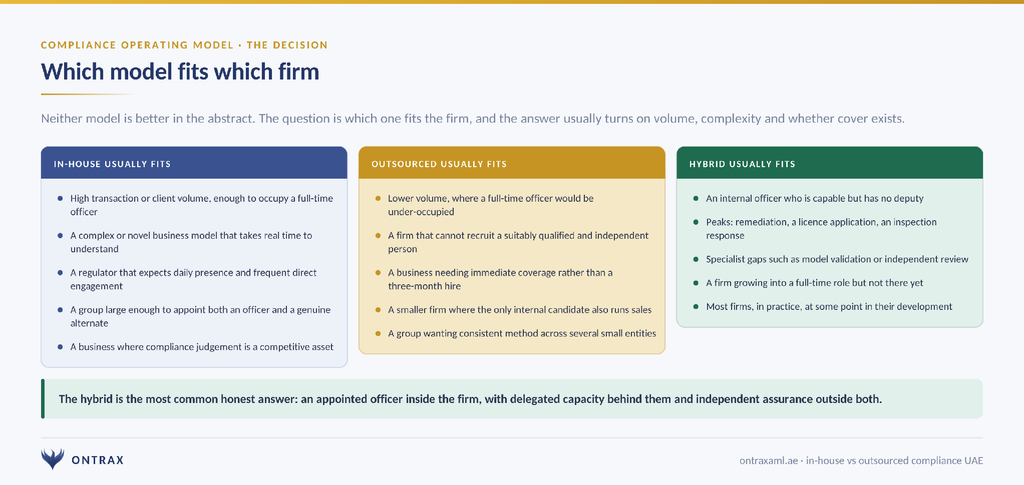
Which compliance operating model fits which kind of UAE firm.
In-house compliance usually fits
High transaction or client volume, enough to occupy a full-time officer. A complex or novel business model that takes real time to understand. A regulator expecting daily presence and frequent direct engagement. A group large enough to appoint both an officer and a genuine alternate. And a business where compliance judgement is a competitive asset rather than an overhead.
Outsourced compliance usually fits
Lower volume, where a full-time officer would be under-occupied. A firm that cannot recruit a suitably qualified and independent person — which is the condition the Ministry of Economy and Tourism’s third-party compliance officer route is written for. A business needing immediate coverage rather than a three-month hire. A smaller firm where the only internal candidate also runs sales, which is the independence problem the rules exist to prevent. And a group wanting consistent method across several small entities.
The hybrid, which is what most firms actually need
An appointed officer inside the firm, outsourced compliance capacity behind them, and independent assurance outside both. That shape fits an internal officer who is capable but has no deputy; peaks such as remediation, a licence application or an inspection response; specialist gaps such as model validation; and firms growing into a full-time role but not yet there. In practice most firms pass through it. Our MLRO Provision service provides the deputy cover, our Outsourced AML Function the capacity, and our Virtual Compliance Officer the officer where there is none.
Firms in the financial free zones have an extra outsourced compliance layer to weigh, because the MLRO of a DIFC Authorised Firm is an Authorised Individual approved by name. Our MLRO Services for DIFC & ADGM and our guide to DIFC AML compliance cover how that changes the calculation.
6. Nine questions to ask before you commit
These apply to in-house and outsourced compliance alike. An internal appointment with no approved name, no real alternate and undocumented delegation fails the same tests as a weak outsourced compliance contract.
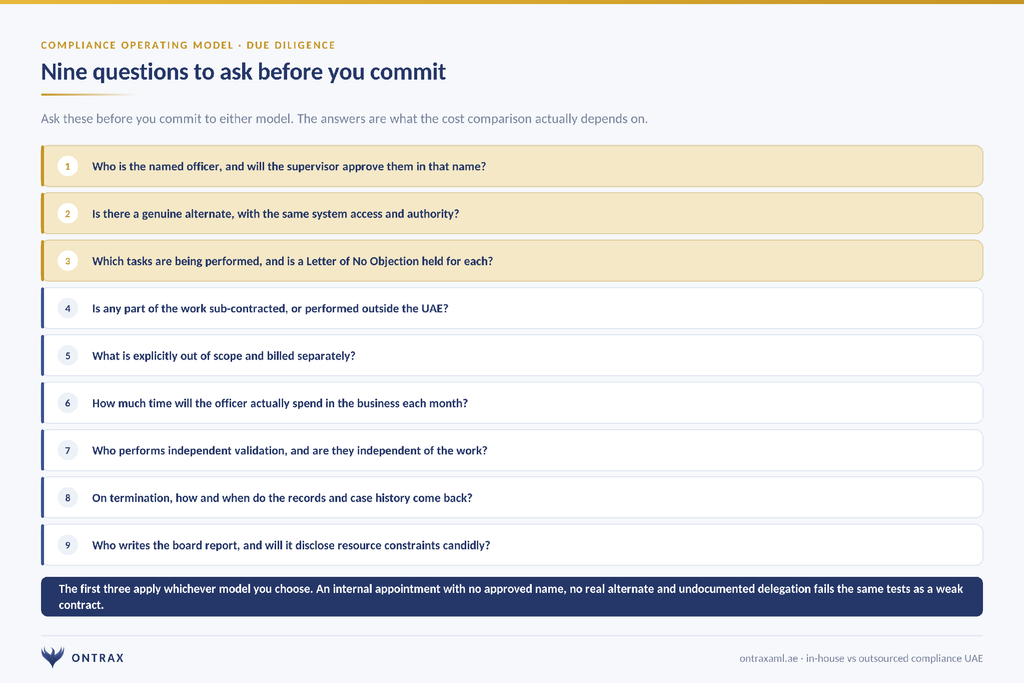
Nine questions to ask before choosing between in-house and outsourced compliance.
- Who is the named officer, and will the supervisory authority approve them in that name?
- Is there a genuine alternate, with the same system access and the same authority to act?
- Which specific tasks are being performed, and is a Letter of No Objection held for each?
- Is any part of the work sub-contracted, or performed outside the UAE?
- What is explicitly out of scope and billed separately?
- How much time will the officer actually spend inside the business each month?
- Who performs independent validation, and are they independent of the people doing the work?
- On termination, how and when do the records and the case history come back to you?
- Who writes the board report, and will it disclose resource constraints candidly?
The one that reveals the most: “How much time will the officer actually spend inside the business each month?” A provider who answers with a number and a pattern is selling a function. A provider who answers in general terms is selling a name on a licence, and a supervisor asking the same question later will get the same vague answer.
7. Building the business case properly
If you have to put an outsourced compliance paper to a board, the structure below produces a defensible comparison rather than a salary-versus-fee argument.
Price the whole in-house column
For in-house compliance: salary and benefits at the level a suitably senior and independent officer commands, plus recruitment including the probability of a false start, plus cover for absence, plus expected turnover over three years, plus training, plus tooling at single-seat pricing, plus management time. Comparing only the first of those against a provider fee is the error that makes most of these papers wrong.
Price the whole outsourced compliance column
For outsourced compliance: the fee, plus anything explicitly out of scope, plus your own retained time supervising the arrangement, plus the onboarding cost of the provider learning your business, plus the transition cost if you change provider in three years.
Put independent validation in both
It belongs in the in-house and outsourced compliance columns at the same figure, because it has to be independent either way. Treating it as an outsourcing cost only is a common distortion. Our AML Audit & Compliance Review and Independent AML Audit sit outside both models by design.
State the downside once, as a constant
The penalty exposure is identical whether you run compliance in-house or outsourced, so it belongs in the paper as context rather than in either column. What differs between in-house and outsourced compliance is the probability of the failure, and that is the real argument: which model more reliably produces a documented decision, on time, by an approved person who was actually available.
Decide what you are optimising for
Decide whether outsourced compliance is being judged on cost, continuity, independence, speed to operational, or depth of knowledge about your own business. Most firms discover they are optimising for continuity and independence rather than cost, which usually points at the hybrid. Underneath any model, the risk assessment, the policies and the training still have to exist and still have to be current.
8. How Ontrax helps
Ontrax Compliance & Risk Management Ltd builds all three outsourced compliance shapes, and will say plainly when a firm does not need the one it asked for. Where a firm has nobody suitable to appoint, our Virtual Compliance Officer service supplies a qualified, UAE-resident officer independent of your revenue lines. Where the officer exists but the volume does not fit the hours, our Outsourced AML Function supplies the capacity behind them. Where the gap in your outsourced compliance arrangement is cover rather than capability, our MLRO Provision provides the deputy.
Underneath any of them we build the documents that have to exist regardless: the AML Risk Assessment, the AML Policy, the training programme — the standard for which is set out in our guide to AML training in the UAE — and the Transaction Monitoring & Screening that generates the alerts. For licensed financial institutions carrying the full CBUAE expectation, our AML Compliance for Financial Institutions service covers the programme end to end.
If you take one action: Write down what happens tomorrow if your compliance officer resigns today. If the answer involves a recruitment process, your current model has an uncovered gap that no budget comparison has priced, and it is the gap a supervisor will find first. Speak to Ontrax about the model that fits.
Frequently asked questions
Is outsourced compliance cheaper than in-house in the UAE?
It depends on volume, and on whether the comparison is honest. A salary compared against a fee usually favours the fee, but that comparison omits recruitment, cover, turnover, training, tooling and management time. Priced in full, outsourcing tends to be cheaper at lower volumes and in-house tends to be cheaper once a full-time officer would be fully occupied.
Can a UAE firm outsource its compliance function entirely?
No. Joint supervisory guidance issued on behalf of eight UAE authorities states that the role of the compliance officer or MLRO, and the compliance function as a whole, must not be outsourced under any circumstances. Specific tasks such as enhanced due diligence, training, framing controls and system support may be outsourced after obtaining a Letter of No Objection from the relevant supervisory authority.
What does outsourcing not remove?
An appointed officer inside the firm; an alternate; senior management approval of policies, the risk assessment, risk appetite and escalated customer decisions; the decision to report; liability for failure; and accountability to the supervisor at inspection. These are identical in both models.
What costs do firms forget when pricing in-house compliance?
Recruitment including the chance of a false start, cover for absence, turnover over a three-year horizon, ongoing training, screening and case tooling at single-seat pricing, and the management time spent supervising a function the firm may not be expert in. Independent validation also has to be bought in regardless.
What costs do firms forget when pricing outsourced compliance?
Work that is out of scope and billed separately, the firm’s own time supervising the arrangement, the onboarding cost of a provider learning the business, and the transition cost if the provider is changed. Most of these can be fixed in the agreement before signature.
Does independent validation count as an outsourcing cost?
No, it belongs in both columns. Validation must be independent of the people who perform the work, so a provider cannot validate its own output and an internal analyst cannot sign off their own work. Treating it as an outsourcing cost only distorts the comparison.
What is a hybrid compliance model?
An appointed officer inside the firm, delegated capacity behind them for volume work, and independent assurance outside both. It fits firms with a capable officer but no deputy, firms facing a temporary peak such as remediation or an inspection, and firms growing toward a full-time role. In practice most firms pass through it.
When does a firm genuinely need a full-time in-house officer?
When transaction or client volume would occupy one; when the business model is complex enough that understanding it takes sustained time; when the regulator expects daily presence; and when the firm is large enough to appoint both an officer and a genuine alternate rather than a nominal one.
Can a small firm use a third-party compliance officer?
Where it cannot appoint a suitably qualified and independent officer internally, yes — subject to conditions set by the Ministry of Economy and Tourism, including the supervisory authority’s prior written approval, the same fit and proper evaluation, genuine independence, unrestricted access to information and systems, a clear contract and periodic performance review. Accountability stays with the board.
What are the penalties if the model fails?
Administrative penalties from AED 10,000 to AED 5,000,000 per violation under Federal Decree-Law No. 10 of 2025, with director restriction or suspension and licence action in serious cases. Criminal fines of AED 5 million to AED 100 million for money laundering by a legal person. AED 100,000 to AED 1,000,000 plus imprisonment for failure to report, and AED 100,000 to AED 500,000 plus at least six months’ imprisonment for tipping off.
Does the penalty exposure differ between the two models?
No. The exposure sits with the firm in both cases, and senior management can face personal criminal liability in defined circumstances regardless of who performs the work. Because the downside is constant, it cannot justify either model — what justifies a model is which one more reliably prevents the failure.
How do I test whether a provider is selling a function or a name?
Ask how much time the officer will spend inside the business each month, and expect a number and a pattern rather than a general assurance. Then ask who the alternate is, what is out of scope, whether any work is sub-contracted or performed outside the UAE, and how records are returned on termination.
Does the answer change for DIFC and ADGM firms?
Yes, in one respect. The MLRO of a DIFC Authorised Firm is an Authorised Individual approved by the DFSA in their own name, and must be UAE resident with a deputy appointed. That makes the named individual the central question rather than the contract, whichever model is chosen.
What should a board paper on this contain?
The fully priced in-house column, the fully priced outsourced column, independent validation in both at the same figure, the penalty exposure stated once as a constant, and an explicit statement of what the firm is optimising for — cost, continuity, independence, speed, or depth of knowledge about the business.
Sources and further reading
· UAE Supervisory Sub-Committee — Joint Guidance on the AML/CFT/CPF Compliance Officer and MLRO
· Cabinet Resolution No. 134 of 2025 — Executive Regulations to Federal Decree-Law No. 10 of 2025
· Ministry of Economy & Tourism — DNFBP guidelines
· CBUAE — Guidance on transaction monitoring and sanctions screening
· DFSA — AML, Counter-Terrorist Financing and Sanctions FAQs
This briefing is general information on compliance operating models in the UAE and is not legal advice. It deliberately contains no salary or fee estimates. Verify penalty figures against the current text of the instruments before relying on them. Ontrax Compliance & Risk Management Ltd, Dubai International Financial Centre.