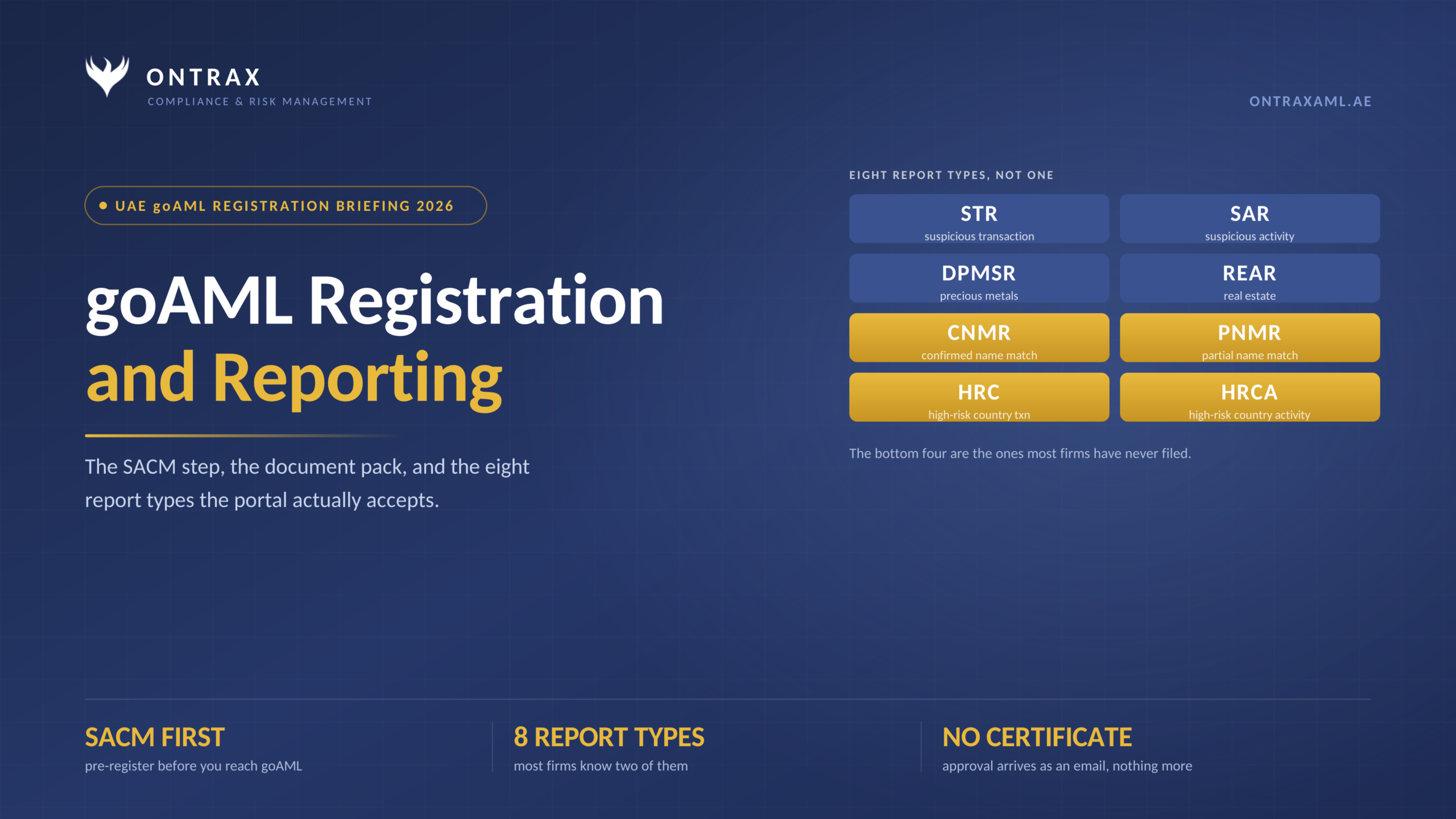

In short: goAML is the UAE Financial Intelligence Unit’s reporting platform and the sole channel for suspicious and threshold reports. Registration is mandatory and free for financial institutions, virtual asset service providers and every category of DNFBP, on the mainland and in free zones. The process begins outside goAML: you pre-register in SACM, the Service Access Control Manager, to obtain a username, set up Google Authenticator for the one-time password, then register the organisation on the portal and await supervisory approval. No certificate is issued — approval arrives as an email. The portal accepts eight report types: STR, SAR, DPMSR, REAR, CNMR, PNMR, HRC and HRCA. Reports are filed without delay, and unjustified internal delay is itself a breach.
Almost every UAE business subject to AML obligations knows goAML registration is required. Far fewer know how goAML registration actually works, and fewer still know what the platform accepts once they arrive.
Two things cause most of the difficulty with goAML registration. The first is that goAML registration does not begin on the goAML portal — there is a separate access-control system in front of it, and firms that go straight to the reporting site find that nothing works. The second is that the platform accepts eight distinct report types, of which most registered firms have filed one or two and have never been told the rest exist.
This briefing covers goAML registration end to end: who must register, the seven steps in order, the document pack and why applications get rejected, all eight report types and what triggers each, the two sets of clocks that operate, and the failures that surface at inspection long after the account was opened. For what happens after a report is filed, our guide to the UAE AML inspection covers how supervisors test the reporting record.
1. Who must complete goAML registration
goAML registration is not sector-specific and there is no size threshold that exempts a small firm.
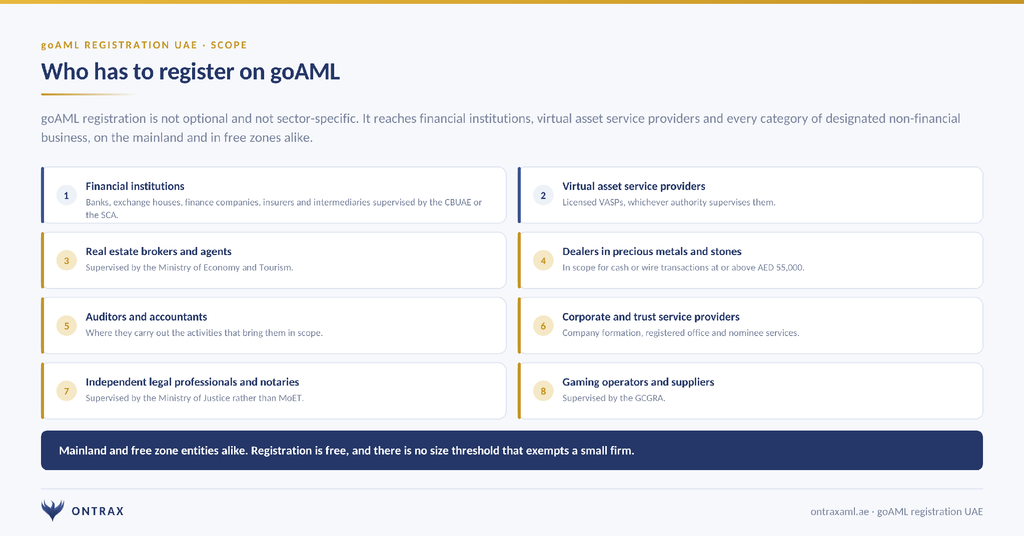
Who must complete goAML registration in the UAE: financial institutions, VASPs and every DNFBP category.
goAML registration catches financial institutions supervised by the Central Bank or the Securities and Commodities Authority, as are licensed virtual asset service providers. On the non-financial side the categories are real estate brokers and agents, dealers in precious metals and stones, auditors and accountants, corporate and trust service providers, independent legal professionals and notaries, and gaming operators and suppliers.
Mainland and free zone entities are treated alike. Our sector guides for real estate brokers and dealers in precious metals and stones set out the specific reporting triggers that apply once registration is complete.
goAML registration is free of charge. Cost is never the reason a firm is unregistered — in practice the reason is that nobody owned the task, or that the person who did left before finishing it.
2. The seven steps, in order
The goAML registration step that catches firms out comes third, and nothing on the reporting portal functions without it.
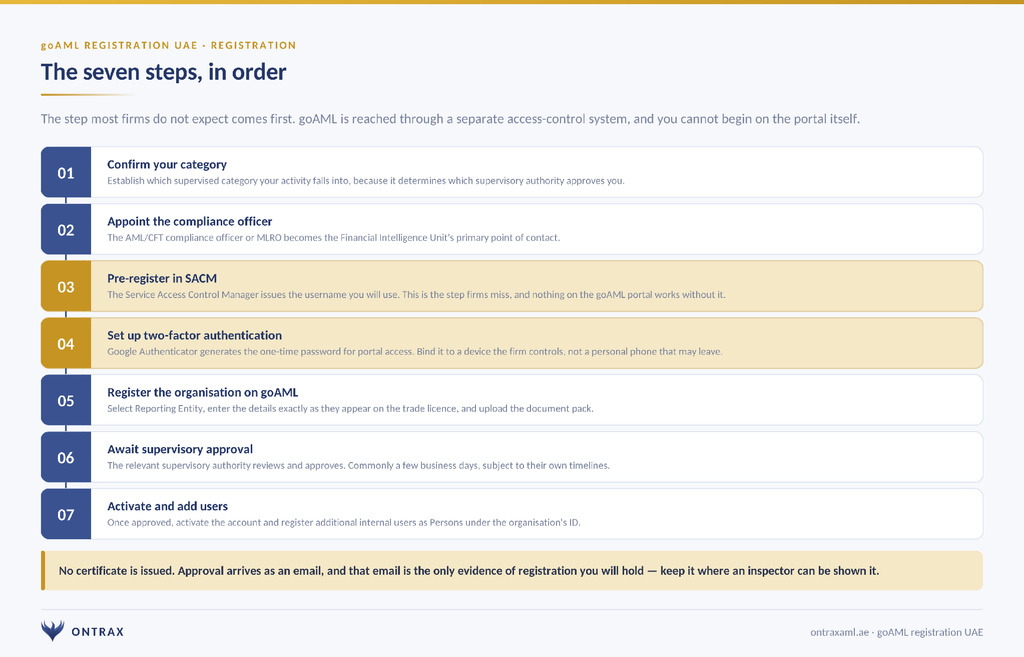
The seven steps of goAML registration in the UAE, including the SACM pre-registration most firms miss.
Step one: confirm your category
Establish which supervised category your activity falls into, because goAML registration is routed by it. It determines which supervisory authority reviews and approves your application, and getting it wrong sends the application to the wrong queue.
Step two: appoint the compliance officer
The AML/CFT compliance officer or MLRO becomes the Financial Intelligence Unit’s primary point of contact. Our guide to the compliance officer and MLRO role in the UAE sets out the seniority and independence the position requires, and our MLRO Provision service supplies it where the firm cannot appoint internally.
Step three: pre-register in SACM
The Service Access Control Manager is a separate system that issues the username goAML registration depends on. This is the step most firms do not know about, and it is the explanation when somebody reports that the goAML portal will not let them begin.
Step four: set up two-factor authentication
Google Authenticator generates the one-time password for portal access. Bind it to a device or account the firm controls rather than an individual’s personal phone — see section 6 for why this matters more than it appears to.
Step five: register the organisation
On goAML, select Reporting Entity and enter the details exactly as they appear on the trade licence. This is the only part of goAML registration that happens on the reporting portal itself. Upload the document pack as described in section 3.
Step six: supervisory approval
The relevant supervisory authority reviews and approves. Commonly a few business days, subject to the authority’s own timelines. Where documents are rejected they can be re-uploaded, which requires pop-ups to be enabled in the browser — a small detail that costs firms a surprising amount of time.
Step seven: activate and add users
Once approved, activate the reporting account and register additional internal users as Persons under the organisation’s ID. goAML registration is complete at this point, not before.
What you will and will not receive: No goAML certificate is issued. Approval arrives as an email, and that email is the only documentary evidence of registration the firm will hold. Save it somewhere an inspector can be shown it, not in the personal mailbox of whoever completed the application.
3. The document pack, and why applications get rejected
The goAML registration pack is short and usually uploaded as a single PDF. goAML registration rejections are almost always caused by a mismatch rather than a missing document.
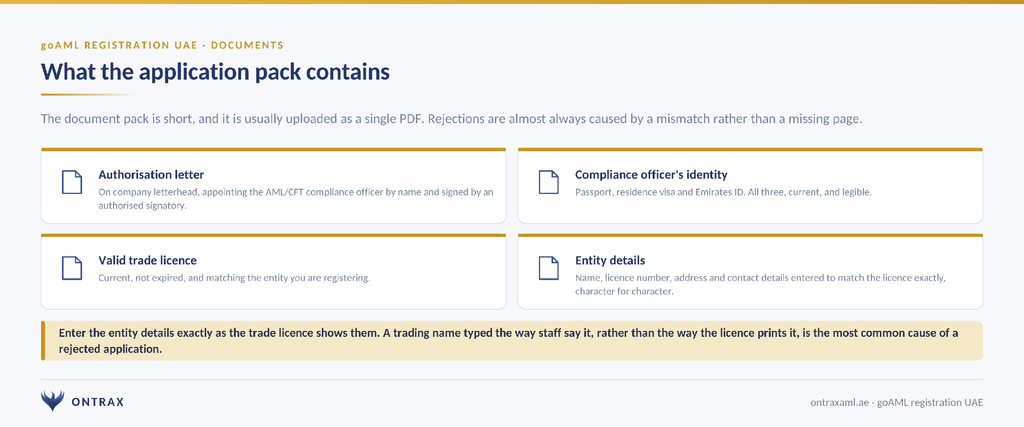
The goAML registration document pack and the detail that causes most rejections.
You need an authorisation letter on company letterhead appointing the AML/CFT compliance officer by name and signed by an authorised signatory. The compliance officer’s passport, residence visa and Emirates ID — all three, current and legible. A valid trade licence, matching the entity being registered. And the entity details entered to match the licence exactly.
The most common cause of rejection: Entity details typed the way staff refer to the business rather than the way the trade licence prints it. A trading name with a different word order, an abbreviated legal form, or an address in the format used on correspondence rather than on the licence will cause a mismatch. Copy from the licence, character for character.
Note what else sits in the pack conceptually even where it is not uploaded: a supervisor approving the application expects the firm to have an AML programme behind it. Our AML Policy Development and AML Risk Assessment services build the documents that make a registration credible rather than nominal, and our guide to what a UAE AML policy must contain sets out what belongs in them.
4. All eight report types
This is the section most firms need after goAML registration and have never been given. goAML accepts eight report types, each with its own trigger.
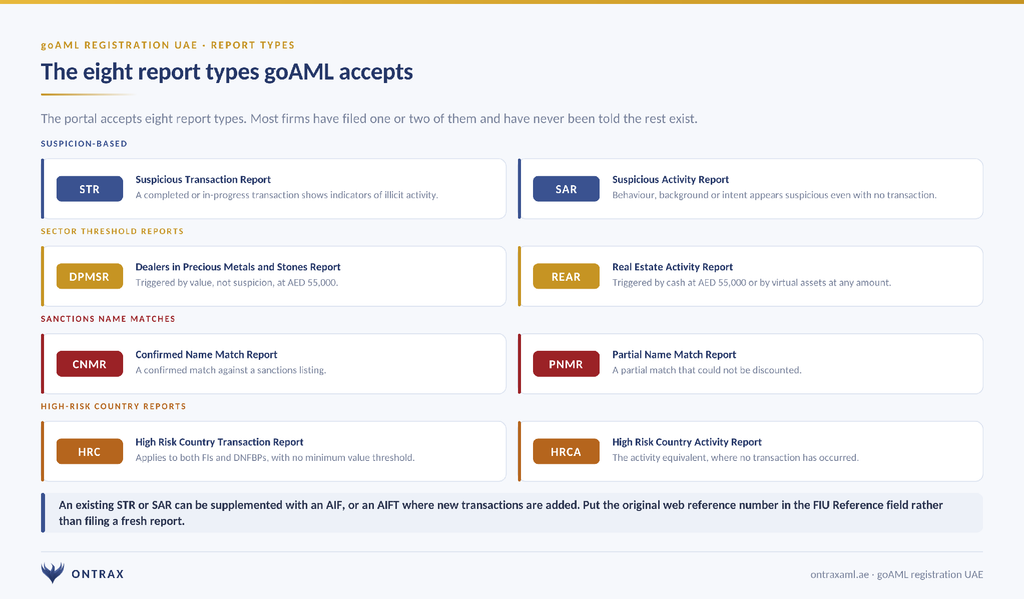
The eight report types the UAE goAML portal accepts and what triggers each one.
Suspicion-based
The STR, a Suspicious Transaction Report, is filed where a completed or in-progress transaction shows indicators of illicit activity. The SAR, a Suspicious Activity Report, is filed where a client’s behaviour, background or intent appears suspicious even though no transaction has taken place. The distinction matters: a customer who abandons an application after being asked for source of funds has generated no transaction and may still warrant a SAR.
Sector threshold reports
The DPMSR and the REAR are triggered by value rather than suspicion. The DPMSR applies to dealers in precious metals and stones at AED 55,000 — in cash from an individual, or in cash or by wire transfer from a company. The REAR applies to freehold property transactions where cash reaches AED 55,000 in aggregate, or where virtual assets form any part of the payment at any amount.
Sanctions name matches
The CNMR, a Confirmed Name Match Report, is filed on a confirmed match against a sanctions listing. The PNMR, a Partial Name Match Report, is filed where a partial match could not be discounted. These two are directly connected to your screening process — our guide to sanctions screening in the UAE sets out which lists bind you and the clock that applies, and our Transaction Monitoring & Screening service operates the screening that generates them.
High-risk country reports
The HRC, a High Risk Country Transaction Report, applies to both financial institutions and DNFBPs and carries no minimum value threshold. The HRCA, a High Risk Country Activity Report, is the activity equivalent where no transaction has occurred.
The absence of a value threshold on the HRC is the detail to note. A small transaction involving a high-risk jurisdiction is reportable on its own terms, which means the obligation cannot be managed by setting a de minimis in your procedures.
An existing STR or SAR can be supplemented rather than replaced. An AIF adds further information, and an AIFT adds information where new transactions are involved. The original web reference number goes in the FIU Reference field.
5. Two different clocks
Firms completing goAML registration routinely confuse the deadline for filing with the length of time the portal will hold their work. They are unrelated.
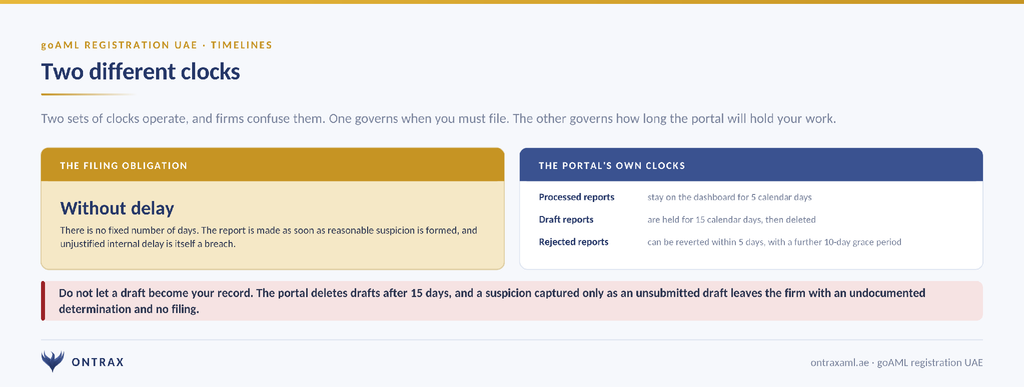
The two sets of clocks in goAML: the filing obligation and the portal’s own retention periods.
The filing obligation that follows goAML registration is to report without delay, as soon as reasonable suspicion is formed. There is no fixed number of days in the statute, and unjustified internal delay is itself treated as a regulatory breach. A firm that identifies a suspicion on Monday, convenes a committee on Thursday and files the following week has a timing problem even though no deadline was stated.
The goAML portal’s own clocks are administrative and unrelated to the filing duty. Processed reports stay on the dashboard for five calendar days. Draft reports are held for fifteen calendar days and are then deleted. Rejected reports can be reverted and edited within five days, with a further ten-day grace period for resubmission.
The trap in those numbers: A draft is not a filing and it does not survive. A suspicion captured only as an unsubmitted goAML draft disappears after fifteen days, leaving the firm with a determination it cannot evidence and a report it never made. Record the determination in your own case file, not in the portal’s drafts folder.
6. What goes wrong after registration
Completing goAML registration is the easy part of goAML registration. These are the goAML registration failures that appear at inspection, often years later.
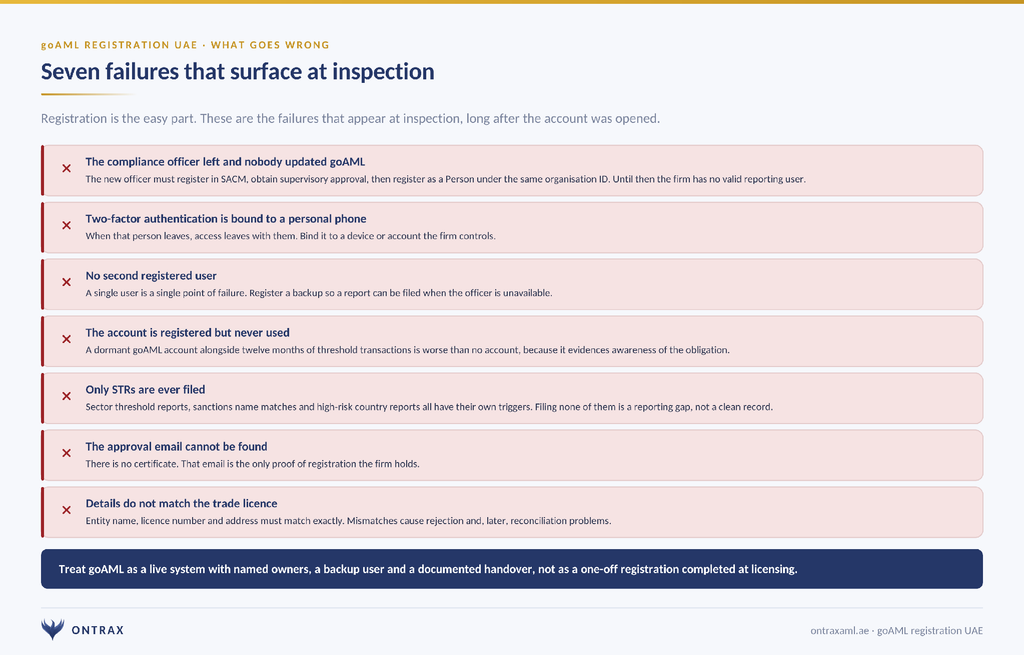
Seven goAML failures that surface at inspection long after registration.
The compliance officer leaves and nobody updates the goAML registration. This is the most frequent and most serious. The replacement must register in SACM, obtain supervisory approval, and then register as a Person under the same organisation ID. Until that is done the firm has no valid reporting user, and discovering it at the moment a report is due is the worst possible time. Where turnover is a risk, an Outsourced AML Function or a Virtual Compliance Officer arrangement provides continuity — within the limits our guide to outsourced AML compliance describes.
Two-factor authentication bound to a personal phone rather than to the firm. When that individual leaves, portal access leaves with them. No second registered user, so a single absence stops the firm reporting. An account registered but never used, which is worse than no account because it evidences awareness of the obligation alongside twelve months of unreported threshold transactions.
Only STRs ever filed, when sector threshold reports, sanctions name matches and high-risk country reports each have their own triggers. The approval email that nobody can find, when it is the only proof of registration that exists. And entity details that do not match the trade licence, causing rejection at the time and reconciliation problems later. An AML Audit & Compliance Review tests all of these, and an Independent AML Audit covers them within the wider programme.
Treat goAML as a live system with named owners, a registered backup user and a documented handover procedure — not as a one-off task completed at licensing and never revisited.
7. Registering a group: several entities, one officer
Groups holding several licences find goAML registration more awkward than single entities do, and the awkwardness is structural rather than technical.
Each licensed legal person is a separate reporting entity and needs its own goAML registration. A group with a mainland trading company, a free zone holding entity and a second operating licence completes goAML registration three times, with three organisation IDs, even where one compliance officer covers all three. There is no group registration that collapses them.
The same individual can be the registered officer for more than one entity, but each appointment is separate: a separate authorisation letter, a separate application, and a separate approval from whichever supervisory authority covers that entity. Where the entities sit under different supervisors — a brokerage under MoET and a legal practice under the Ministry of Justice, for example — the applications go to different queues and are approved on different timelines.
Reporting then has to be filed under the correct organisation ID. A report about activity in the trading company filed under the holding company’s ID is a misfiled report, and reconciling it afterwards is considerably harder than getting it right. Groups should maintain a simple register of which entity holds which goAML ID and who is the registered user on each — it belongs in the AML policy rather than in somebody’s notebook.
The group question worth asking now: List every licence your group holds and, for each, name the goAML organisation ID and the registered user. If any licence has no entry, that entity is unregistered — and a group that reports diligently through one entity while another has never registered has a gap that looks worse, not better, for the diligence shown elsewhere.
8. A maintenance routine that holds
goAML registration fails quietly after the event. A short routine prevents almost all of it.
- Name an owner for the goAML account and a named deputy, in writing, in your AML policy.
- Register at least two users under the organisation ID so a single absence cannot stop a filing.
- Bind two-factor authentication to a firm-controlled device or account, not an individual’s phone.
- Store the approval email in the compliance file alongside the licence and the policy.
- Add a goAML step to your staff offboarding checklist, so a departure triggers the SACM re-registration.
- Review the eight report types against your own activity annually and record which could apply to you.
- Log every report filed, with its web reference number, in your own records rather than relying on the portal.
- Record every determination not to file, with the reasoning, in your own case file.
- Test the login quarterly. An account nobody has opened in a year is an account nobody can open in a hurry.
The last two matter most at inspection. A supervisor testing your reporting record will ask for the determinations as well as the filings, and the determination not to report is the one firms most often cannot produce. Role-specific AML training is what makes staff recognise the triggers in the first place, and customer due diligence is what generates the information a report depends on.
9. How Ontrax helps
Ontrax Compliance & Risk Management Ltd handles goAML registration and the reporting that follows it for financial institutions, VASPs and DNFBPs across the UAE. We take firms through SACM pre-registration, the document pack, the portal application and supervisory approval, and then build the reporting routine that keeps the account live long after goAML registration is complete.
Where the firm cannot appoint a suitable officer internally, our Virtual Compliance Officer service supplies one, and our MLRO Provision service provides deputy cover so a departure never leaves the account without a valid user. Our Outsourced AML Function supplies the reporting capacity behind the officer, and our Transaction Monitoring & Screening service generates and handles the alerts that produce CNMRs, PNMRs and HRCs.
If you take one action: Log in to goAML today. If nobody can, the account has no valid user and the firm cannot report — which is a live breach rather than an administrative inconvenience, and it will not be discovered at a convenient moment. Speak to Ontrax about registration and reporting.
Frequently asked questions
What is goAML?
goAML is the reporting platform operated by the UAE Financial Intelligence Unit and the sole channel through which suspicious and threshold reports are filed. Registration on it is mandatory for financial institutions, virtual asset service providers and all categories of designated non-financial business and profession.
Who must register on goAML in the UAE?
Financial institutions, VASPs, and DNFBPs including real estate brokers and agents, dealers in precious metals and stones, auditors and accountants, corporate and trust service providers, independent legal professionals and notaries, and gaming operators. Mainland and free zone entities alike, with no size exemption.
What is SACM and why does it come first?
SACM is the Service Access Control Manager, a separate access-control system that issues the username used on goAML. You pre-register there before you can register the organisation on the reporting portal. Firms that go straight to goAML find the process will not start, and this is usually why.
How long does goAML registration take?
Commonly a few business days once a complete application is submitted, subject to the supervisory authority’s own timelines. Registration is free of charge. Where documents are rejected they can be re-uploaded, which requires pop-ups to be enabled in the browser.
What documents are needed for goAML registration?
An authorisation letter on company letterhead appointing the AML/CFT compliance officer by name and signed by an authorised signatory; the compliance officer’s passport, residence visa and Emirates ID; and a valid trade licence. Entity details must be entered to match the licence exactly.
Is a goAML certificate issued?
No. Approval arrives as an email, and that email is the only documentary evidence of registration the firm holds. It should be stored in the compliance file rather than in an individual’s mailbox.
What report types does goAML accept?
Eight: STR (Suspicious Transaction Report), SAR (Suspicious Activity Report), DPMSR (Dealers in Precious Metals and Stones Report), REAR (Real Estate Activity Report), CNMR (Confirmed Name Match Report), PNMR (Partial Name Match Report), HRC (High Risk Country Transaction Report) and HRCA (High Risk Country Activity Report).
What is the difference between an STR and a SAR?
An STR is filed where a completed or in-progress transaction shows indicators of illicit activity. A SAR is filed where a client’s behaviour, background or intent appears suspicious even though no transaction has occurred — for example a customer who abandons an application when asked for source of funds.
What are CNMR and PNMR reports?
A CNMR is a Confirmed Name Match Report, filed where a match against a sanctions listing is confirmed. A PNMR is a Partial Name Match Report, filed where a partial match could not be discounted. Both arise directly from the screening process.
Is there a value threshold for high-risk country reports?
No. The HRC applies to both financial institutions and DNFBPs with no minimum value threshold, which means the obligation cannot be managed by setting a de minimis in your procedures. The HRCA is the equivalent where no transaction has occurred.
What is the deadline for filing a report on goAML?
Without delay, as soon as reasonable suspicion is formed. The statute sets no fixed number of days, and unjustified internal delay is itself treated as a regulatory breach. Portal retention periods — five days for processed reports, fifteen for drafts — are administrative and are not filing deadlines.
What happens if the compliance officer leaves?
The replacement must register in SACM, obtain supervisory approval, and then register as a Person under the same organisation ID. Until that is complete the firm has no valid reporting user. Adding a goAML step to the staff offboarding checklist prevents the gap.
Can an existing report be supplemented?
Yes. An AIF adds further information to an existing STR or SAR, and an AIFT is used where new transactions are added. The original web reference number is entered in the FIU Reference field rather than filing a fresh report.
What are the penalties for failing to register or report?
Administrative fines, commonly starting in the tens of thousands of dirhams and scaling up to AED 5,000,000 per violation, with possible business restrictions or licence suspension. Money laundering by a legal person carries criminal fines of AED 5 million to AED 100 million under the 2025 framework, and tipping off a customer about a report carries imprisonment or a fine.
Sources and further reading
· UAE Financial Intelligence Unit — goAML portal
· goAML registration and AML compliance for UAE DNFBPs — Rosemont Partners
· Cabinet Resolution No. 134 of 2025 — AML executive regulations
· UAE Ministry of Economy & Tourism — AML for DNFBPs
This briefing is general information on goAML registration and reporting in the UAE and is not legal advice. Portal processes and report types change; verify the current position with the Financial Intelligence Unit and your supervisory authority before acting. Ontrax Compliance & Risk Management Ltd, Dubai International Financial Centre.