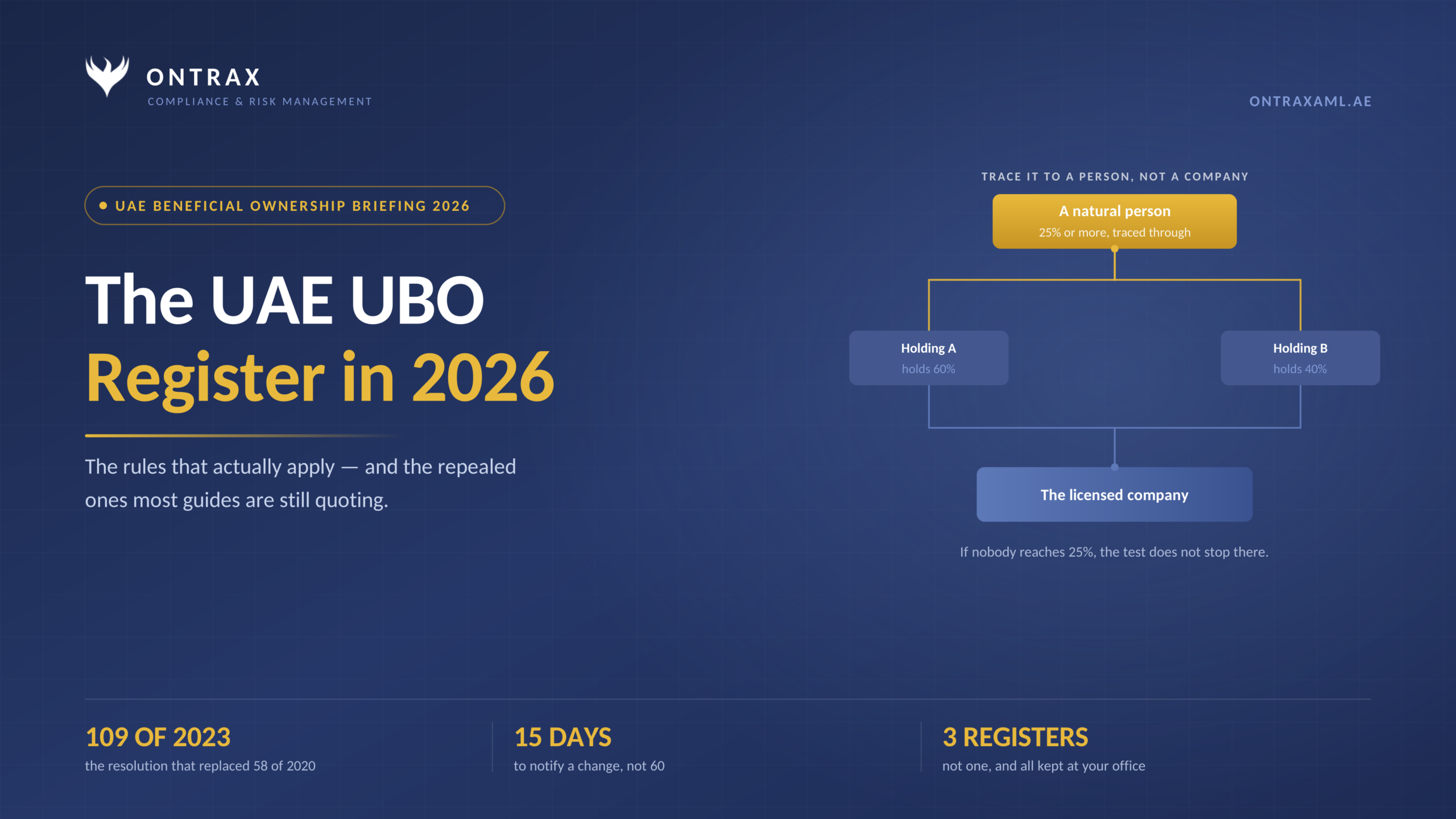

In short: The UAE beneficial ownership regime is governed by Cabinet Resolution No. 109 of 2023, in force from 16 November 2023, which repealed Cabinet Decision No. 58 of 2020. Penalties sit in Cabinet Decision No. 132 of 2023, which repealed Cabinet Decision No. 53 of 2021. Every legal person licensed on the UAE mainland or in a non-financial free zone must maintain three registers — real beneficiaries, partners or shareholders, and nominee director declarations where applicable — at its registered office, and notify changes within 15 days. A real beneficiary is a natural person owning or controlling 25% or more, directly or indirectly; failing that, the person exercising control by other means; failing that, the senior management official. Only DIFC and ADGM entities sit outside the federal regime.
There is an unusual problem with UBO register guidance in the UAE: a great deal of it is confidently wrong. The regime has been replaced twice since 2020, and a large share of published material — including material produced by advisers — still cites instruments that were repealed years ago.
That matters more than a footnote would suggest, because a UBO register built on the wrong instrument fails in ways nobody notices until a registrar asks. A company whose UBO register was built to the 2020 rules may be tracking the wrong deadline, filing in the wrong place, or relying on an exemption that no longer exists in the form it remembers. And a policy document citing a repealed decision tells an inspector that the compliance framework has not been maintained, which colours everything else they look at.
This briefing sets out what the UAE UBO register regime actually requires in 2026: which instruments are current, who is genuinely in scope, how the three-step test for identifying a real beneficiary works, what each of the three registers must contain, the 15-day clock and what starts it, where filings go, and the claims circulating online that should be ignored. For the due diligence side of the same subject — identifying beneficial owners of your customers rather than your own company — see our guide to KYC and CDD requirements in the UAE.
1. Which instruments actually apply
Start here, because every other UBO register obligation downstream depends on it.
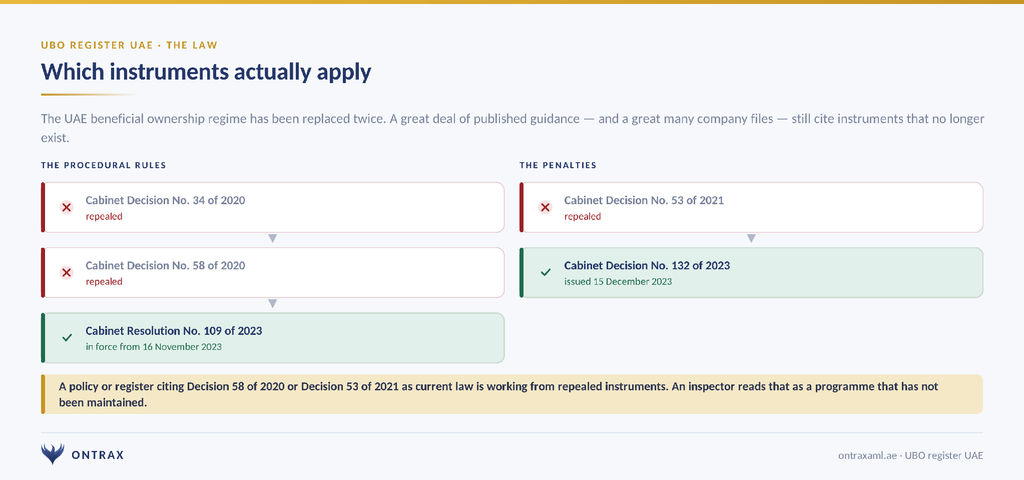
The UAE UBO register instruments: which were repealed and which are current.
The procedural rules have been replaced twice. Cabinet Decision No. 34 of 2020 was repealed and replaced by Cabinet Decision No. 58 of 2020. Cabinet Decision No. 58 of 2020 was in turn repealed and replaced by Cabinet Resolution No. 109 of 2023, which has been in force since 16 November 2023 and is the current procedural instrument.
The penalties followed the same pattern. Cabinet Decision No. 53 of 2021 set the original schedule and was repealed and replaced by Cabinet Decision No. 132 of 2023, issued on 15 December 2023.
A quick document test: Open your company’s UBO register template, your corporate governance policy and any advice letter you hold on this subject, and search them for “58 of 2020” and “53 of 2021”. If either number appears as current law rather than as history, the document predates the current regime and should be replaced rather than amended.
This is the same discipline we apply to AML documents generally — our AML Policy Development service rewrites against current instruments, and our guide to what a UAE AML policy must contain explains why citing repealed law is treated as a maintenance failure rather than a typographical one.
2. Who must keep a UBO register
The UBO register reaches wider than most owners assume, and the exemptions are narrower than the version that circulates informally.
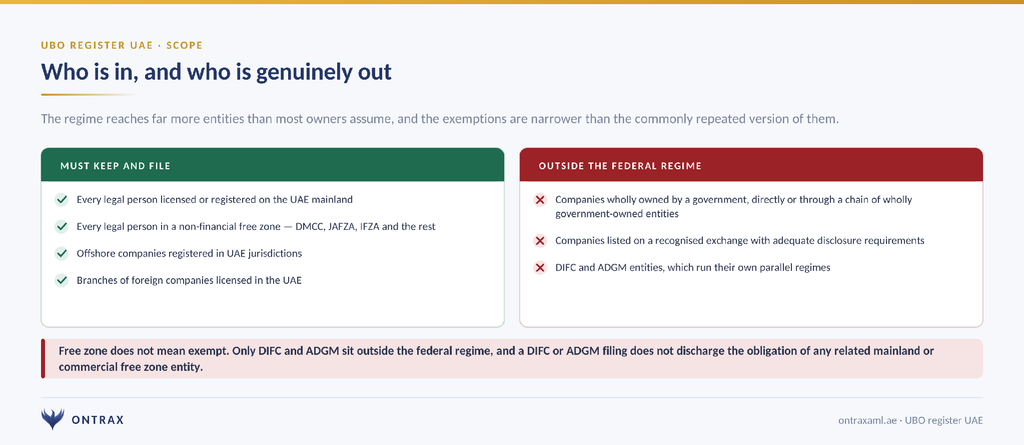
Who must keep a UAE UBO register, and which entities genuinely sit outside the federal regime.
Every legal person licensed or registered on the UAE mainland is in scope. So is every legal person in a non-financial free zone — DMCC, JAFZA, IFZA and the rest. Offshore companies registered in UAE jurisdictions are in scope, as are branches of foreign companies licensed in the UAE.
The genuine exemptions
Three categories sit outside. Companies wholly owned by a government, whether directly or through a chain of wholly government-owned entities. Companies listed on a recognised exchange with adequate disclosure requirements. And DIFC and ADGM entities, which operate their own parallel regimes rather than the federal one.
“We are in a free zone, so we are exempt” is the most common and most expensive misunderstanding about the UAE UBO register. Only DIFC and ADGM sit outside the federal framework. Every other free zone is inside it. And a DIFC or ADGM filing does not discharge the obligation of any related mainland or commercial free zone entity in the same group — our guide to DIFC AML compliance covers how the two regimes sit alongside each other.
3. Identifying the real beneficiary: a three-step cascade
Completing a UBO register is not a single question. It is three questions asked in order, and the third always produces an answer.
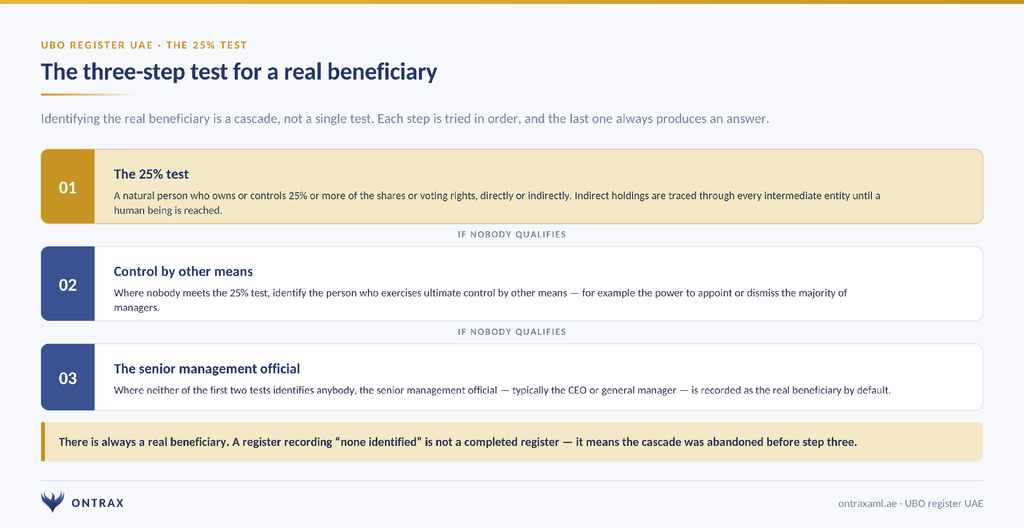
The three-step cascade for identifying a real beneficiary under the UAE UBO register regime.
Step one: the 25% test
A real beneficiary — the UAE’s statutory term for a beneficial owner — is a natural person who owns or controls 25% or more of the shares or voting rights, directly or indirectly. Indirect holdings are traced through every intermediate entity until a human being is reached. A corporate shareholder is never the answer — it is a step on the way to the answer.
Step two: control by other means
Where nobody meets the 25% threshold, the question becomes who exercises ultimate control by other means. The clearest example is the power to appoint or dismiss the majority of the managers, but control can also arise through contractual arrangements, financing terms or family structures.
Step three: the senior management official
Where neither of the first two steps identifies anybody, the senior management official — typically the chief executive or general manager — is recorded as the real beneficiary by default.
What this means in practice: There is always a real beneficiary. A UBO register recording “none identified” is not a completed register — it means the cascade was abandoned before step three. This is one of the most common findings when a registrar reviews a filing.
The same cascade applies when you are identifying the beneficial owner of a customer rather than your own company, which is why this subject sits at the centre of customer due diligence. Our AML Know Your Customer (KYC) service builds that process, and the sector guides for real estate and precious metals dealers both set out how far verification has to go when the customer is a corporate buyer.
4. Three registers, not one
Companies routinely maintain a UBO register and believe the obligation is discharged. It is not — three registers are required, and the UBO register is only the first.
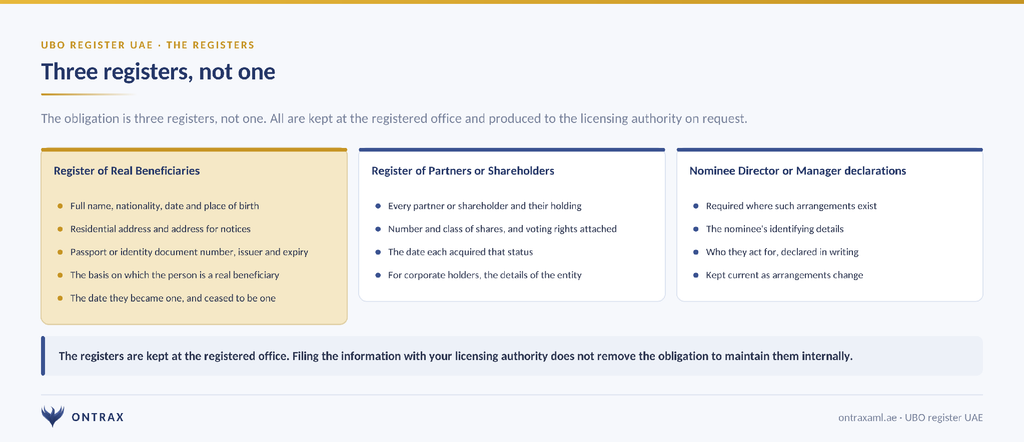
The three registers required under the UAE UBO register regime and what each must contain.
The Register of Real Beneficiaries holds, for each person, full name, nationality, date and place of birth, residential address and an address for notices, passport or identity document number with issuer and expiry, the basis on which they are a real beneficiary, and the dates on which they became one and ceased to be one.
The Register of Partners or Shareholders holds every partner or shareholder and their holding, the number and class of shares and the voting rights attached, the date each acquired that status, and for corporate holders the details of the entity.
Nominee Director or Manager declarations are required where such arrangements exist, recording the nominee’s identifying details and, in writing, who they act for.
All three registers are kept at the registered office. Filing the information with your licensing authority does not remove the obligation to maintain them internally, and a request to produce them is answered from the office, not from a portal.
5. The 15-day clock, and where filings go
The UBO register timing rule is short. The list of events that start it is longer than most companies track.
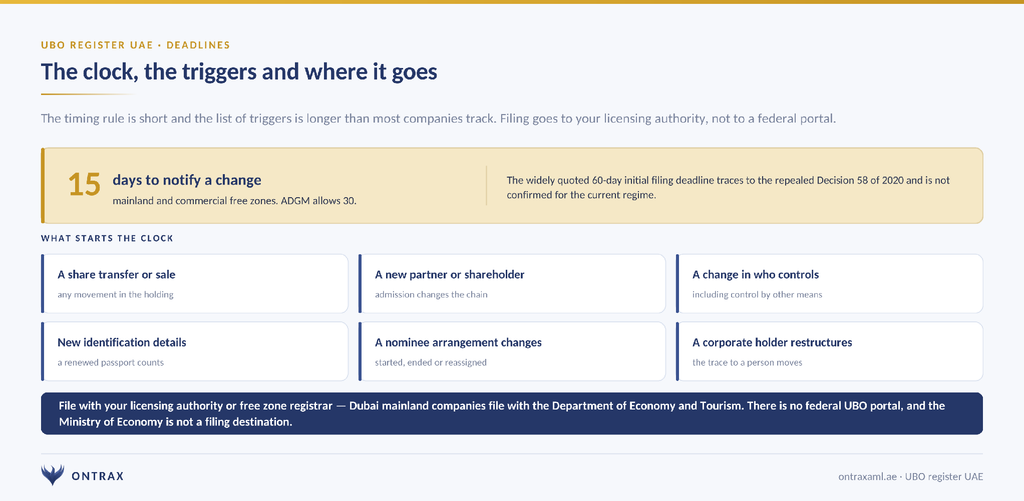
The 15-day notification clock for the UAE UBO register, what triggers it, and where filings go.
Changes must be notified within 15 days for mainland and commercial free zone entities. ADGM allows 30 days. The widely quoted 60-day initial filing deadline traces to the repealed Cabinet Decision No. 58 of 2020 and is not confirmed under the current regime, so it should not be relied on.
What starts the clock
- A share transfer or sale, however small.
- The admission of a new partner or shareholder.
- A change in who ultimately controls the company, including control exercised by other means.
- A change in a real beneficiary’s identification details — a renewed passport counts.
- A nominee arrangement starting, ending or being reassigned.
- A corporate shareholder restructuring, where that moves the trace to a different natural person.
The trigger companies miss most often: A renewed passport. The ownership has not changed and nothing commercial has happened, so nobody thinks to update the UBO register — but the identification details on the register are now wrong, and the 15-day clock ran from the date the company became aware.
Where the filing goes
Filings go to your licensing authority or free zone registrar. Dubai mainland companies file with the Dubai Department of Economy and Tourism. There is no federal UBO portal, and the Ministry of Economy is not a filing destination — two claims that appear frequently online and send people to the wrong place.
6. Six claims to stop relying on
Because the regime changed twice in three years, a substantial amount of confident UBO register guidance is out of date. These are the claims worth checking against your own documents.
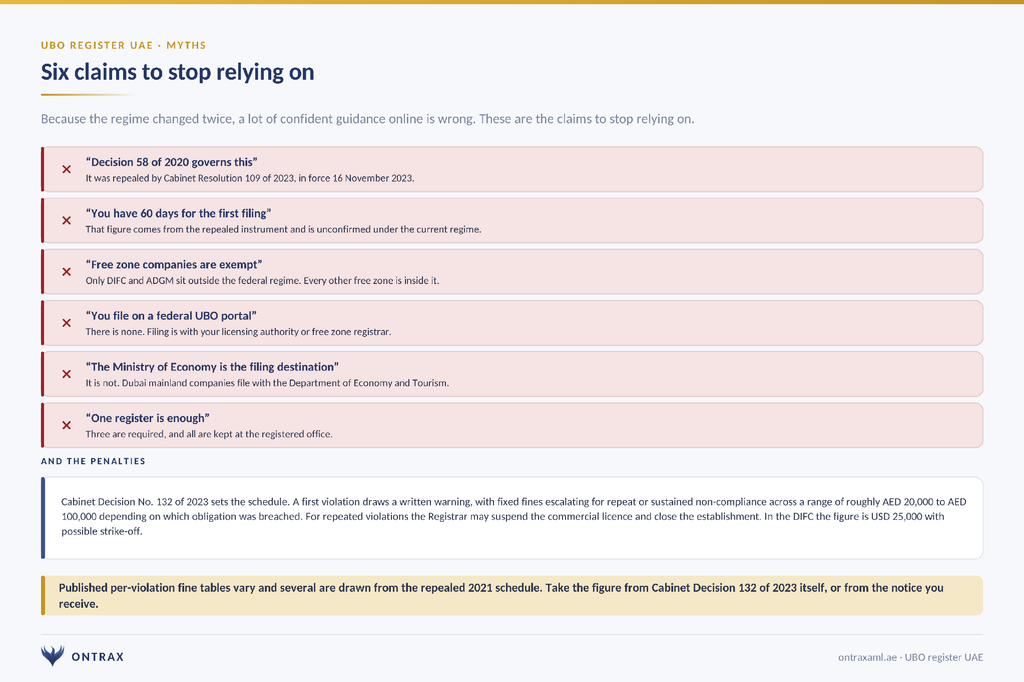
Six common misconceptions about the UAE UBO register, and the current penalty position.
That Decision 58 of 2020 governs the regime — it was repealed by Cabinet Resolution 109 of 2023. That there is a 60-day initial filing deadline — that figure comes from the repealed instrument. That free zone companies are exempt — only DIFC and ADGM are. That filings are made on a federal UBO portal — there is none. That the Ministry of Economy is the filing destination — it is not. And that one register is enough — three are required.
The penalty position
Cabinet Decision No. 132 of 2023 sets the schedule. A first violation draws a written warning, with fixed fines escalating for repeat or sustained non-compliance across a range of roughly AED 20,000 to AED 100,000 depending on which obligation was breached. For repeated violations the Registrar may suspend the commercial licence and close the establishment. In the DIFC the figure is USD 25,000, with possible strike-off from the public register.
Published per-violation fine tables vary between sources, and several are drawn from the repealed 2021 schedule rather than the current one. Take the figure from Cabinet Decision No. 132 of 2023 itself, or from the notice you actually receive, rather than from a summary.
7. Where the UBO register meets your AML programme
Companies treat the UBO register as a corporate filing and beneficial ownership verification as an AML control, run by different people who never compare notes. Supervisors read them together.
The connection is direct. The same 25% cascade that identifies your own real beneficiary identifies your customers’, and the same evidentiary standard applies in both directions — beneficial ownership is verified through independent sources rather than accepted on a declaration. A firm that accepts a customer’s word about its owners while maintaining a meticulous UBO register for itself has an inconsistency that is difficult to explain.
There is also a consistency test that inspectors apply and firms rarely run on themselves. Your UBO register says who controls your company. Your bank’s onboarding file says the same thing. Your customers’ onboarding files say it about them. Where any two of those documents disagree, the disagreement is the finding, regardless of which version turns out to be right.
Group structures make this harder and more important. Where a UAE group holds entities across the mainland, a commercial free zone and the DIFC, three different beneficial ownership regimes apply to the same ultimate owners, with different deadlines and different filing destinations. The trace is identical; the obligations are not. Our MLRO Services for DIFC & ADGM cover the free zone side of that split.
A consistency check worth running: Take your UBO register, your most recent bank onboarding pack and your trade licence, and compare the ownership they each describe. In a group with any structural history, these three documents frequently disagree — and the UBO register is usually the one that was never updated.
8. Getting the register right
For most companies the UBO register is a short exercise done once properly, then maintained. The difficulty is almost always the trace rather than the paperwork.
Build the ownership map first
A UBO register starts with the ownership map. Draw the full structure above the licensed entity: every shareholder, every intermediate holding company, every jurisdiction, and the percentage at each level. Multiply through the chain to find who reaches 25% at the top. Where a chain exits the UAE, the trace continues — a foreign holding company is not an endpoint.
Work the cascade properly
If nobody reaches 25%, do not stop. Ask who exercises control by other means, and document the analysis. If that produces nobody, record the senior management official and note why the first two steps did not apply. The reasoning is part of the register’s defensibility.
Collect the data set in full
Partial entries are the most common UBO register finding. Each real beneficiary needs the complete set: name, nationality, date and place of birth, residential address, notice address, identity document details with issuer and expiry, basis of beneficial ownership, and the relevant dates.
Put the 15-day clock somewhere it will be seen
The UBO register fails quietly, because the triggering events are corporate rather than compliance events. Share transfers and passport renewals happen in other parts of the business. Tie the register to whoever handles corporate changes and to the annual licence renewal cycle, and test it in your AML Audit & Compliance Review alongside everything else.
Keep it with the rest of the file
The UBO register sits at the registered office with your business risk assessment, your policies and your customer files. When a supervisor conducts an inspection, the question is whether the whole set can be produced together and whether it is internally consistent — a UBO register that contradicts the shareholder information in your customer onboarding file is worse than either document alone.
9. How Ontrax helps
Ontrax Compliance & Risk Management Ltd works on beneficial ownership from both directions: your own UBO register, and the beneficial ownership verification your AML programme has to perform on customers. Both rest on the same cascade and the same evidence standard.
For your own UBO register, we build the ownership map, work the cascade, assemble the complete data set and put the maintenance trigger somewhere it will survive. For customers, our AML Know Your Customer (KYC) service builds verification that goes to independent sources rather than customer declarations, and our Transaction Monitoring & Screening service screens the beneficial owners the trace identifies, not only the account holder.
Where the compliance function is thin, our Virtual Compliance Officer and Outsourced AML Function services supply the capacity — within the limits our guide to outsourced AML compliance sets out. Where you want the whole framework tested, our Independent AML Audit covers it, and our AML Training & Awareness Programs make sure the people who process share transfers know they have started a 15-day clock.
If you take one action: Draw your ownership structure on one page, multiply the percentages through every intermediate entity, and check the result against what your UBO register currently says. Most companies with any structural complexity find the register names a shareholder rather than the natural person the trace actually reaches. Speak to Ontrax about getting the register right.
Frequently asked questions
What is the UAE UBO register?
A register of real beneficiaries — the natural persons who ultimately own or control a company — that every legal person licensed on the UAE mainland or in a non-financial free zone must maintain at its registered office, alongside a register of partners or shareholders and nominee director declarations where applicable.
Which law governs the UBO register in 2026?
Cabinet Resolution No. 109 of 2023, in force from 16 November 2023, which repealed Cabinet Decision No. 58 of 2020. Penalties sit in Cabinet Decision No. 132 of 2023, issued 15 December 2023, which repealed Cabinet Decision No. 53 of 2021. Guidance citing 58 of 2020 or 53 of 2021 as current is out of date.
Who counts as a real beneficiary?
A natural person who owns or controls 25% or more of the shares or voting rights, directly or indirectly. If nobody meets that test, the person who exercises ultimate control by other means. If neither applies, the senior management official is recorded by default.
Do free zone companies need a UBO register?
Yes, unless they are in the DIFC or ADGM, which run their own parallel regimes. Every other free zone — DMCC, JAFZA, IFZA and the rest — sits inside the federal framework. A DIFC or ADGM filing does not discharge the obligation of a related mainland or commercial free zone entity.
How many registers are required?
Three: a Register of Real Beneficiaries, a Register of Partners or Shareholders, and nominee director or manager declarations where such arrangements exist. All are kept at the registered office and produced to the licensing authority on request.
What is the deadline for updating the UBO register?
Changes must be notified within 15 days for mainland and commercial free zone entities. ADGM allows 30 days. The 60-day initial filing deadline quoted in much online guidance traces to the repealed Cabinet Decision No. 58 of 2020 and is not confirmed under the current regime.
What events require an update?
A share transfer or sale; the admission of a new partner or shareholder; a change in who ultimately controls the company; a change in a real beneficiary’s identification details, including a renewed passport; a nominee arrangement starting, ending or being reassigned; and a corporate shareholder restructuring that moves the trace to a different person.
Where do you file UBO information in the UAE?
With your licensing authority or free zone registrar. Dubai mainland companies file with the Dubai Department of Economy and Tourism. There is no federal UBO portal, and the Ministry of Economy is not a filing destination.
What are the penalties for UBO non-compliance?
Cabinet Decision No. 132 of 2023 sets the schedule: a written warning for a first violation, with fixed fines escalating for repeat or sustained non-compliance across a range of roughly AED 20,000 to AED 100,000 depending on the obligation breached. For repeated violations the Registrar may suspend the licence and close the establishment. In the DIFC the figure is USD 25,000 with possible strike-off.
Can a company be the real beneficiary?
No. A corporate shareholder is a step in the trace, not the answer. Ownership is followed through every intermediate entity, including foreign ones, until a natural person is identified. If the chain exits the UAE, the trace continues.
What if no one owns 25%?
Move to the second step and identify who exercises ultimate control by other means — for example the power to appoint or dismiss the majority of managers. If that produces nobody, record the senior management official. A register recording “none identified” is incomplete.
Is the UBO register the same as customer due diligence?
No, though they use the same test. The UBO register concerns your own company’s ownership and is filed with your licensing authority. Customer due diligence concerns your customers’ beneficial owners and is verified through independent sources as part of your AML programme. Both apply, and they should be consistent with each other.
Do branches of foreign companies need to file?
Yes. Branches of foreign companies licensed in the UAE are within the scope of the federal regime, as are offshore companies registered in UAE jurisdictions.
Does a listed parent company exempt a UAE subsidiary?
The exemption applies to companies listed on a recognised exchange with adequate disclosure requirements. A UAE subsidiary of a listed group is not automatically exempt by virtue of the parent’s listing — assess the subsidiary’s own position and document the conclusion.
Sources and further reading
· UAE Ministry of Economy & Tourism
· Dubai Department of Economy & Tourism
· UAE UBO disclosure rules — Kayrouz & Associates
· UAE UBO requirements and the repealed instruments
· Cabinet Resolution No. 134 of 2025 — AML executive regulations
This briefing is general information on the UAE UBO register and is not legal advice. Verify the current text of Cabinet Resolution No. 109 of 2023 and Cabinet Decision No. 132 of 2023, and the requirements of your own licensing authority, before acting. Ontrax Compliance & Risk Management Ltd, Dubai International Financial Centre.