
In short: Transaction monitoring in the UAE is governed by dedicated CBUAE guidance that sets out what licensed financial institutions must have in place: a risk-based framework reviewed on trigger events, multi-factor scenarios built from a typology assessment, thresholds segmented by product and customer type, data testing and validation at least every 12 to 18 months, validation performed independently of the people who built and use the system, and active board oversight. The FSRA’s thematic review findings point the same way. Most failures are not detection failures — they are documentation failures.
Almost every UAE firm subject to AML obligations has a transaction monitoring system. Far fewer can answer the questions a supervisor actually asks about it: why is this threshold set here, who validated it, when was the data behind it last tested, and what happened to the alerts it produced last quarter.
That gap is the subject of this briefing. Transaction monitoring in the UAE is one of the few AML controls with its own dedicated regulatory guidance — the CBUAE’s Guidance for Licensed Financial Institutions on Transaction Monitoring and Sanctions Screening — and that guidance is unusually specific. It names testing intervals. It requires independence between the people who build a model and the people who validate it. It expects scenarios to be documented alongside their assumptions. Firms that treat transaction monitoring as a software purchase rather than a programme consistently fail against it.
What follows sets out the full expectation: the four programme elements, how scenarios and thresholds should be built, what above-the-line and below-the-line testing mean in practice, the data governance almost nobody gets right, and the seven questions a supervisor will put to you. If you want the companion control, our guide to sanctions screening in the UAE covers the list-matching side of the same obligation, and Ontrax’s Transaction Monitoring & Screening service covers both.
1. Transaction monitoring is a programme, not a system
The most common structural mistake in AML transaction monitoring is buying a tool and treating the obligation as discharged. The CBUAE’s guidance is built on four elements, and a system without the other three is a control sitting on its own.
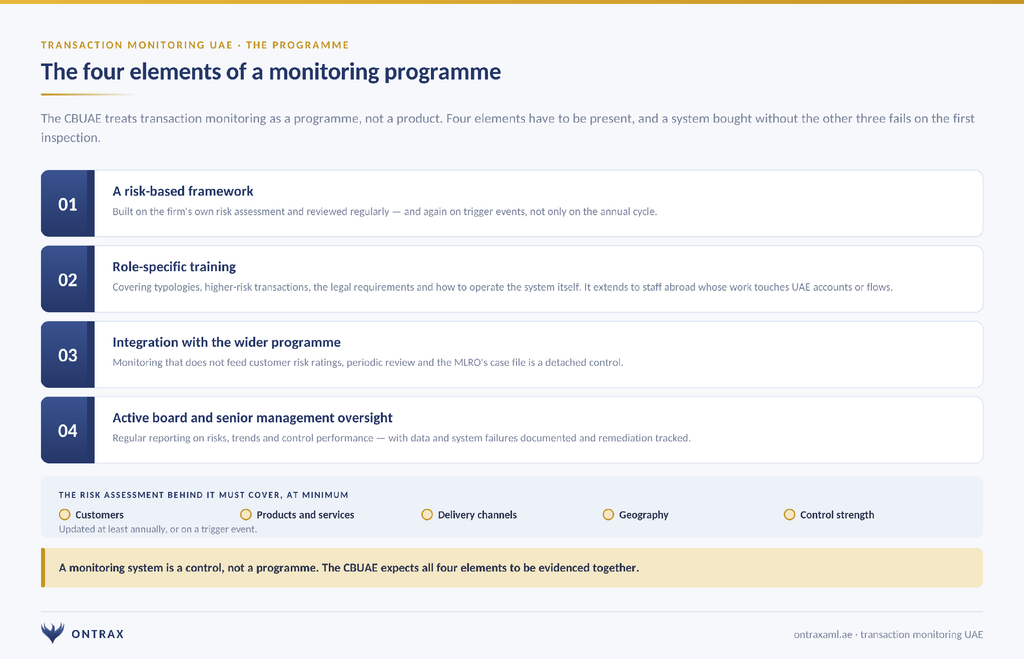
The four elements of a UAE transaction monitoring programme, and the risk assessment that has to sit underneath them.
The first element is a risk-based framework. The monitoring a firm performs must flow from its own risk assessment, and that assessment has to cover customers, products and services, delivery channels and geography, together with the strength of existing controls. It is updated at least annually and again on a trigger event — a new product, a new market, a new acquisition, a significant finding. Where the business risk assessment is stale, every threshold downstream of it is unsupported.
Scale matters to what is expected. The guidance says plainly that institutions with a larger scale of operations are expected to have automated systems in place. Smaller institutions may use less automated approaches, provided they are appropriately executed for the volume of daily activity. Manual tools such as business-line reporting and staff escalation are accepted as part of the mix, but they only work with training behind them.
The second element is role-specific AML training covering typologies, higher-risk transactions, the legal requirements and the operation of the system itself. The requirement reaches further than most firms assume: mandatory training extends to staff located abroad whose work involves UAE accounts or flows. A group operations centre in another country is inside the perimeter.
The third is integration. Transaction monitoring that does not feed customer risk ratings, periodic review scheduling and the MLRO’s case file is a detached control. Where practicable, monitoring should operate at customer or relationship level rather than account level, including across a financial group — and that matters most for politically exposed persons and other higher-risk customers, where account-level monitoring misses the pattern entirely.
The fourth is active board and senior management oversight, which is covered in section 7.
A useful self-test: can you show the line from a specific sentence in your business risk assessment to a specific scenario running in your monitoring system today? If the two documents were written by different people at different times and never reconciled, that line does not exist.
2. Building a scenario: from typology to deployed threshold
A transaction monitoring rule is not written by choosing a number that produces a manageable number of alerts. The CBUAE sets out a path, and expects the assumptions at each step to be recorded.
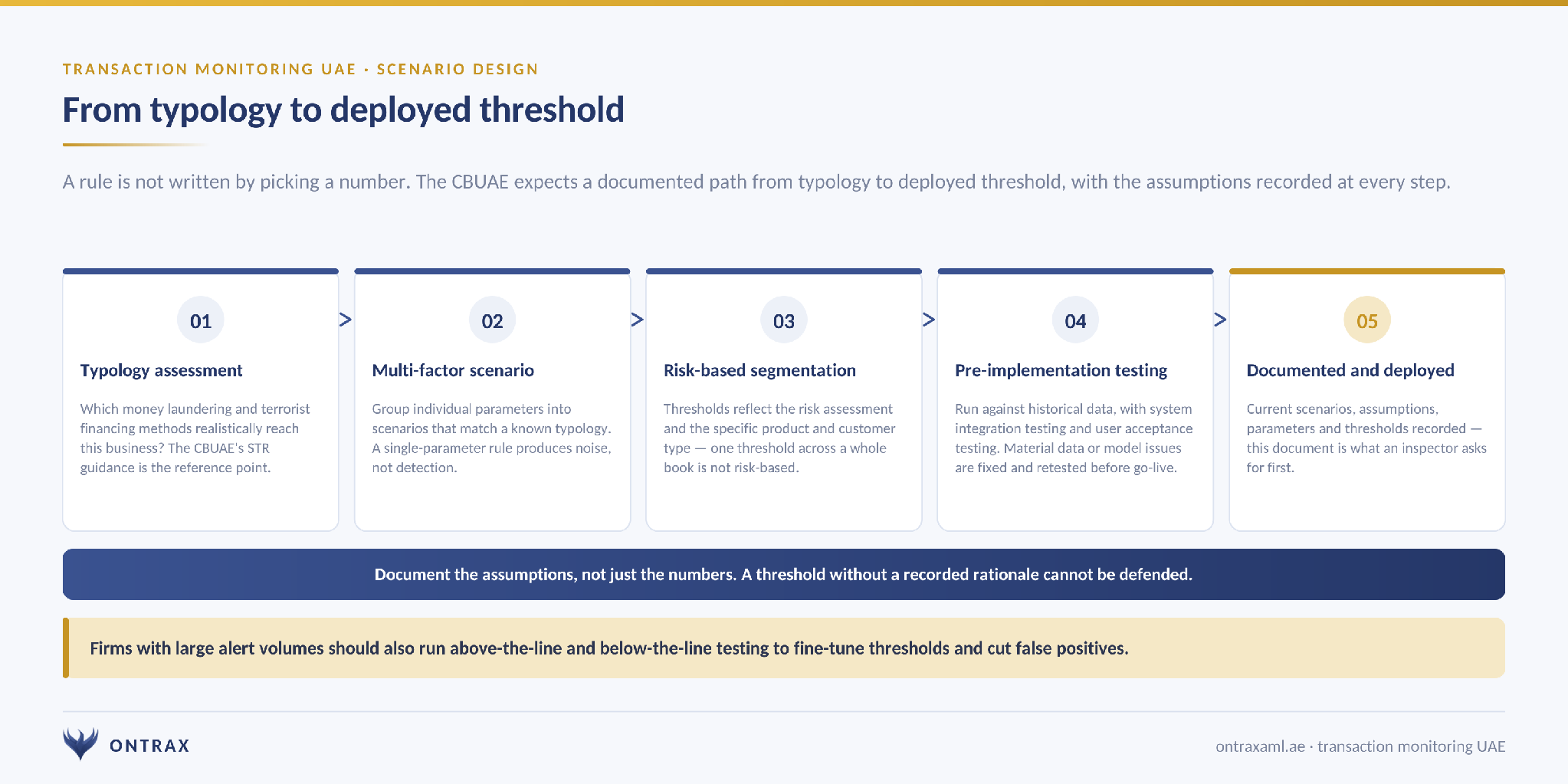
The documented path from typology assessment to a live threshold — the sequence a UAE transaction monitoring review follows.
Start from a typology assessment
Firms using automated systems should run a typology assessment to design rule-based or scenario-based monitoring. The question is which money laundering and terrorist financing methods realistically reach this business, given its customers, products and geographies. The CBUAE’s guidance on suspicious transaction reporting is the reference point for typologies, and it is the document most firms have never opened.
Build multi-factor scenarios, not single parameters
Individual parameters should be grouped into multi-factor scenarios aligned with known typologies. A rule that fires on a single condition — any transfer over a round figure, any cash deposit above a threshold — produces volume without discrimination. A scenario that combines amount, velocity, counterparty geography and deviation from the customer’s own profile produces alerts worth investigating.
Segment the thresholds
Thresholds should reflect the institution’s risk assessment and the specific product and customer type, supported by risk-based segmentation. One threshold applied across an entire book is, by definition, not risk-based: it is simultaneously too tight for low-risk retail customers and too loose for the higher-risk segment the customer due diligence process has already flagged. The output of your KYC and CDD work should be visible in how the thresholds are set.
Test before you deploy
Pre-implementation testing should run against historical data and include system integration testing and user acceptance testing. Where testing reveals material data or model issues, those issues must be remediated and the scenario retested before deployment. A rule that goes live untested is a rule nobody can defend.
Document it
Institutions must document their current scenarios, assumptions, parameters and thresholds. This document is usually the first artefact requested in a transaction monitoring review, and the speed with which a firm produces it tells a supervisor most of what they need to know.
The documentation test: If an inspector asks why a threshold is set at its current level and the answer is that it came with the system, or that it was set to keep alert volumes manageable, the scenario is undocumented in the sense the CBUAE means. The rationale is the record, not the number.
3. Alerts: scoring, routing and the MI each stage owes
Supervisors do not ask how many alerts a transaction monitoring system produced. They ask what happened to them.
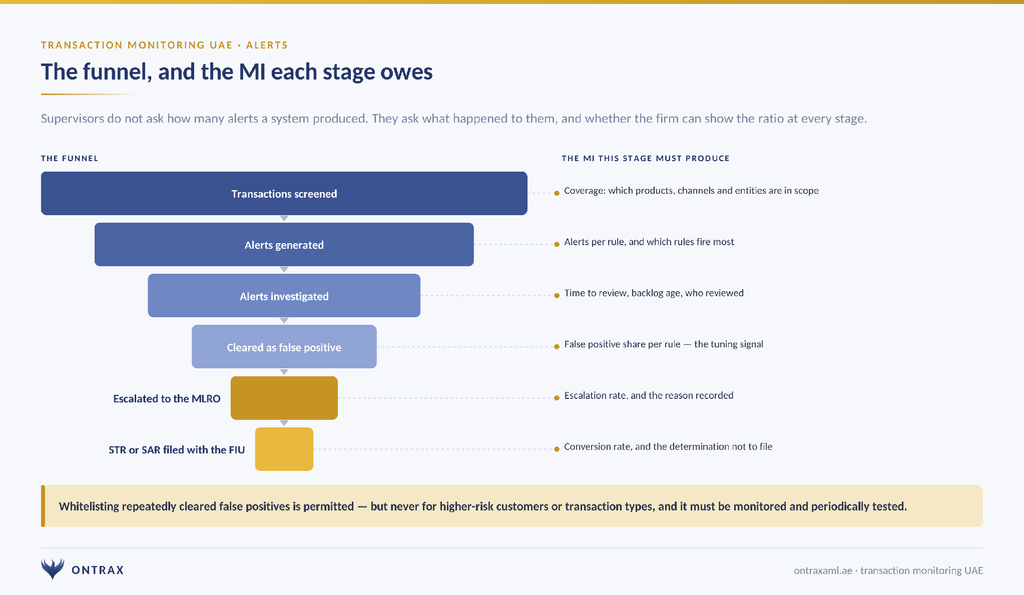
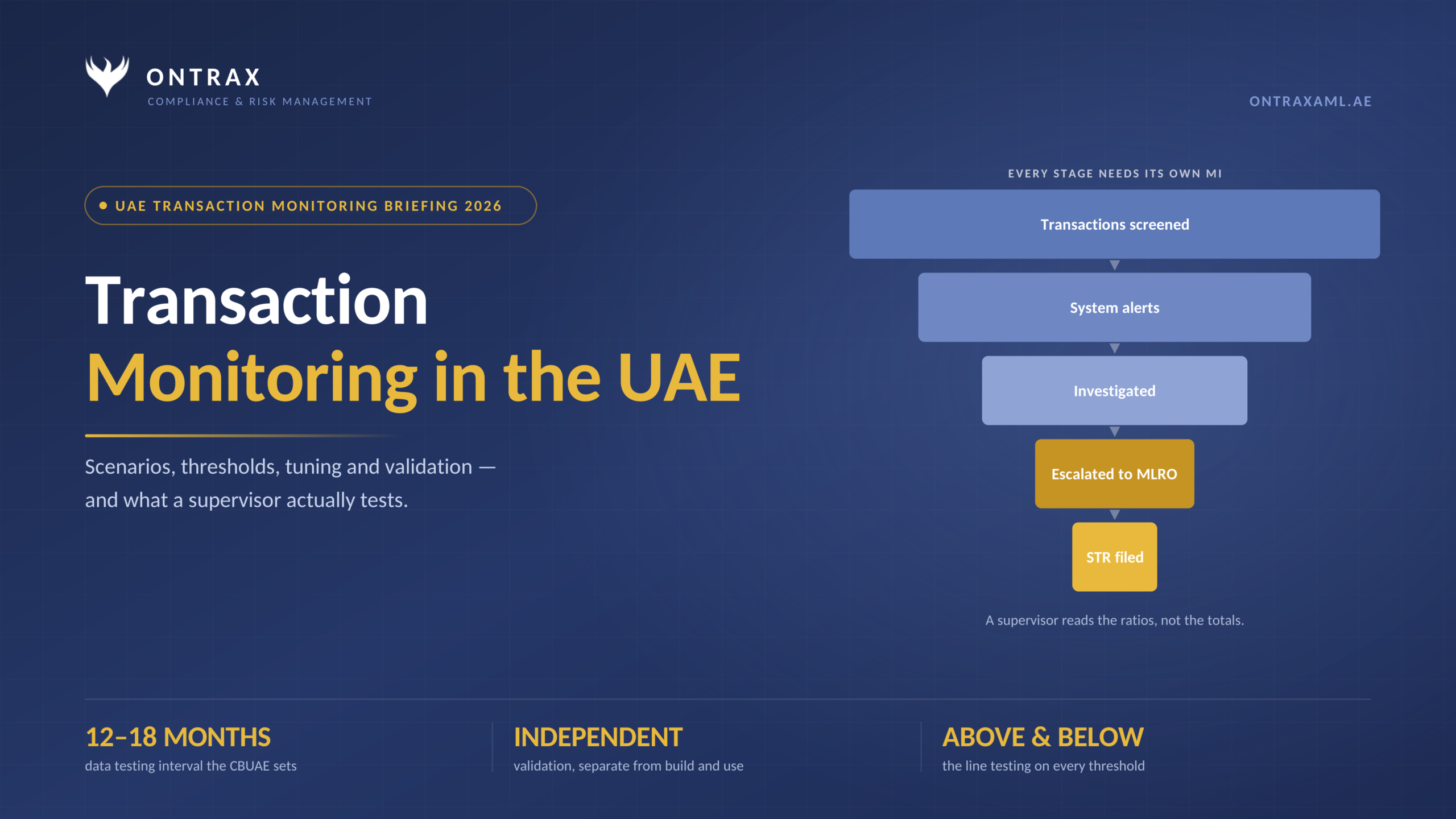
The alert funnel in UAE transaction monitoring, and the management information each stage has to produce.
The guidance permits — and for high-volume institutions effectively expects — risk-weighted alert scoring. Alerts carrying a higher score can be routed to senior or specialist investigators, with the remainder distributed evenly, for example on a round-robin basis. This is a practical answer to the volume problem, and it is also evidence of a risk-based approach in operation.
Internal referrals from the business must be transferred to appropriate personnel for further research, and the transaction monitoring and sanctions functions must have clear and distinct responsibilities across the process chain, including alert handling and the filing of reports. Where capacity is the constraint rather than capability, alert triage is one of the AML tasks that can legitimately be supported by an outsourced AML function — though as our guide to what can and cannot be outsourced explains, the determination to file always stays with the appointed officer.
The management information that matters
Transaction monitoring outputs must be documented and tracked. The MIS should show, at minimum, alerts generated per rule and the proportion of those alerts cleared as false positives, taken forward for investigation, or converted into a report to the Financial Intelligence Unit. Declining rule productivity, or a shift in a rule’s performance, may indicate a data or calibration problem rather than a change in customer behaviour.
These ratios are the substance of the control. A rule generating four hundred alerts a month of which three hundred and ninety-eight are cleared without action is not detecting anything; it is consuming the capacity that would otherwise investigate the two that mattered.
Suppression and whitelisting
Suppressing or whitelisting repeatedly cleared false positives is permitted. Two conditions attach, and both are routinely breached. It must not be applied to higher-risk customers or transaction types. And it must be monitored and periodically tested, rather than set once and left. A whitelist that has grown for three years without review is a list of customers the firm has stopped monitoring.
Management is expected to use these results to manage risk — including applying restrictions or risk markers to customers whose activity keeps surfacing. Monitoring that produces findings but never changes how a customer is treated is an exercise, not a control.
4. Tuning and validation: two different tests
Firms frequently report that their AML transaction monitoring has been tuned, and mean that someone adjusted thresholds to reduce alert volumes. That is not what the guidance means.
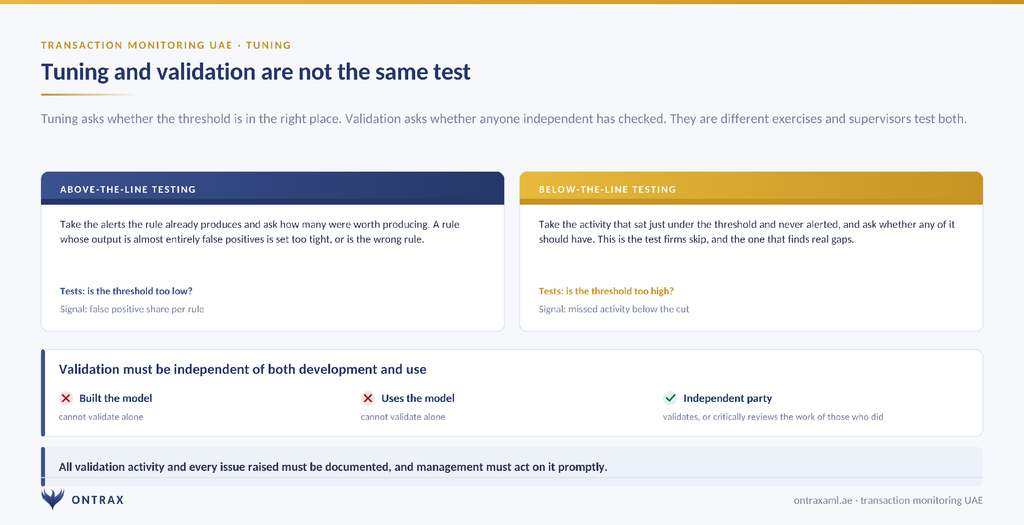
Above-the-line and below-the-line testing in UAE transaction monitoring, and the independence requirement for validation.
Above-the-line and below-the-line testing
Institutions with large transaction volumes should consider above-the-line and below-the-line testing to fine-tune thresholds and reduce false positives. The two look in opposite directions.
Above-the-line testing examines the alerts a rule already produces and asks how many were worth producing. A rule whose output is almost entirely false positives is either set too tight or is the wrong rule for the typology.
Below-the-line testing takes the activity that sat just underneath the threshold and never alerted at all, and asks whether any of it should have. This is the test firms skip, because it requires deliberately looking for what the system missed. It is also the test that finds real gaps, and the one a thorough supervisor will ask about.
Post-implementation testing
Systems should be reassessed periodically and after any material irregularity, including back-testing to confirm that rules still target the riskier activity they were designed for. Where tuning is material, it must be pre-tested against sample or historical data and reflected in updated documentation — the same discipline as a new scenario.
Validation has to be independent
This is the requirement most often failed outright. Validation must be performed by people with sufficient expertise and sufficient independence from the development and use of the system. Where developers or users carry out part of the validation, an independent party must critically review their work. All validation activity and every issue identified must be documented, and management must act on the issues promptly.
In a small compliance team this is difficult to arrange internally, which is why validation is frequently scoped into an independent AML audit. What does not satisfy the requirement is the analyst who tunes the rules also signing off that the rules are correctly tuned.
Where a third-party system is used, the institution remains ultimately responsible for compliance. Vendor models must be validated by the institution, and contingency plans must exist for system failure. Buying a well-regarded platform transfers none of this.
5. The data governance almost nobody meets
A transaction monitoring system is only as good as the data feeding it, and this is where the CBUAE sets its most specific numerical expectation.
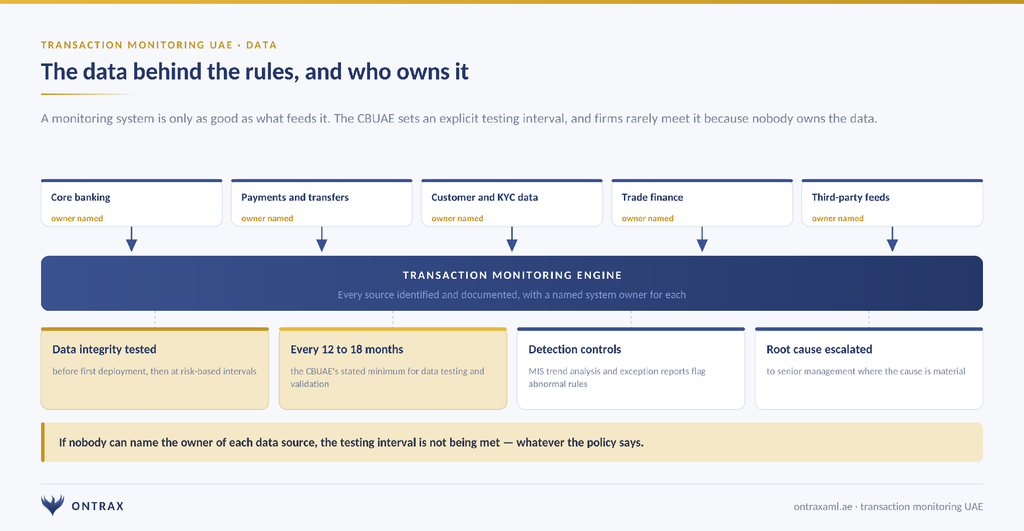
Data lineage for UAE transaction monitoring: every source documented, every source owned, tested every 12 to 18 months.
Institutions must identify and document all data sources feeding transaction monitoring, and name a system owner for each. Data integrity and quality should be tested before initial deployment and thereafter at risk-based intervals — and the guidance states that data testing and validation should typically occur at a minimum every 12 to 18 months.
The interval to diarise: Every 12 to 18 months, the data feeding your transaction monitoring system should be tested and validated. Most UAE firms cannot evidence having done this even once, because no individual was ever named as the owner of each feed and the task therefore belonged to nobody.
Detection controls are expected on top of this. Management information trend analysis and exception reports should identify rules behaving abnormally — a rule that stops firing, or one that suddenly fires far more often — and where the cause is material, root cause analysis should be escalated to senior management.
The practical failure mode in AML transaction monitoring is mundane. A payments system is upgraded, a field changes name, and a scenario that depended on it quietly stops producing alerts. Nobody notices for eleven months because nobody was watching rule-level productivity. The firm is not detecting, and does not know it.
Records
Records must be kept in an organised way that permits data analysis and transaction tracking, and must be sufficient to reconstruct individual transactions. They must be available to the competent authorities immediately on request. Retention runs for at least five years, measured depending on circumstances from the transaction date, the end of the relationship, the completion of a CBUAE inspection, a final judgment, or the termination of the legal person — though firms in the DIFC and ADGM are held to six. Our guide to the UAE AML inspection sets out what that request looks like in practice.
6. What the FSRA found, and why it matters outside the ADGM
The ADGM’s Financial Services Regulatory Authority has published thematic review findings on AML, CFT and targeted financial sanctions. Although directed at ADGM firms, the findings describe transaction monitoring weaknesses common across the UAE and are a reasonable proxy for what any supervisor will look for.
On transaction monitoring, the FSRA’s position is that manual monitoring of high-risk customers and transactions must remain commensurate with the scale and volume of the underlying business activity. A firm that grew its book substantially while keeping the same manual process has a finding waiting, regardless of how diligent the process is.
The FSRA also expects scenario testing and calibration backed by adequate resources — the resourcing point being made explicitly, which is unusual and worth noting. And on screening, firms must be fully aware of the data elements being screened and the lists being screened against, particularly where a third-party provider is involved. Screening systems require periodic effectiveness reviews.
Two further findings sit adjacent to monitoring and are worth acting on. Business risk assessments should address terrorist financing and proliferation financing, not money laundering alone. And outsourcing does not transfer responsibility — a point developed in our guide to outsourced AML compliance.
The FSRA identified automation of screening and monitoring as good practice and encouraged it. For a firm that has outgrown spreadsheets, the regulatory direction of travel is not ambiguous.
7. Governance: what the board has to see
Active oversight by the board and senior management is one of the four transaction monitoring programme elements, and it is tested by asking what the board was shown and what it did about it.
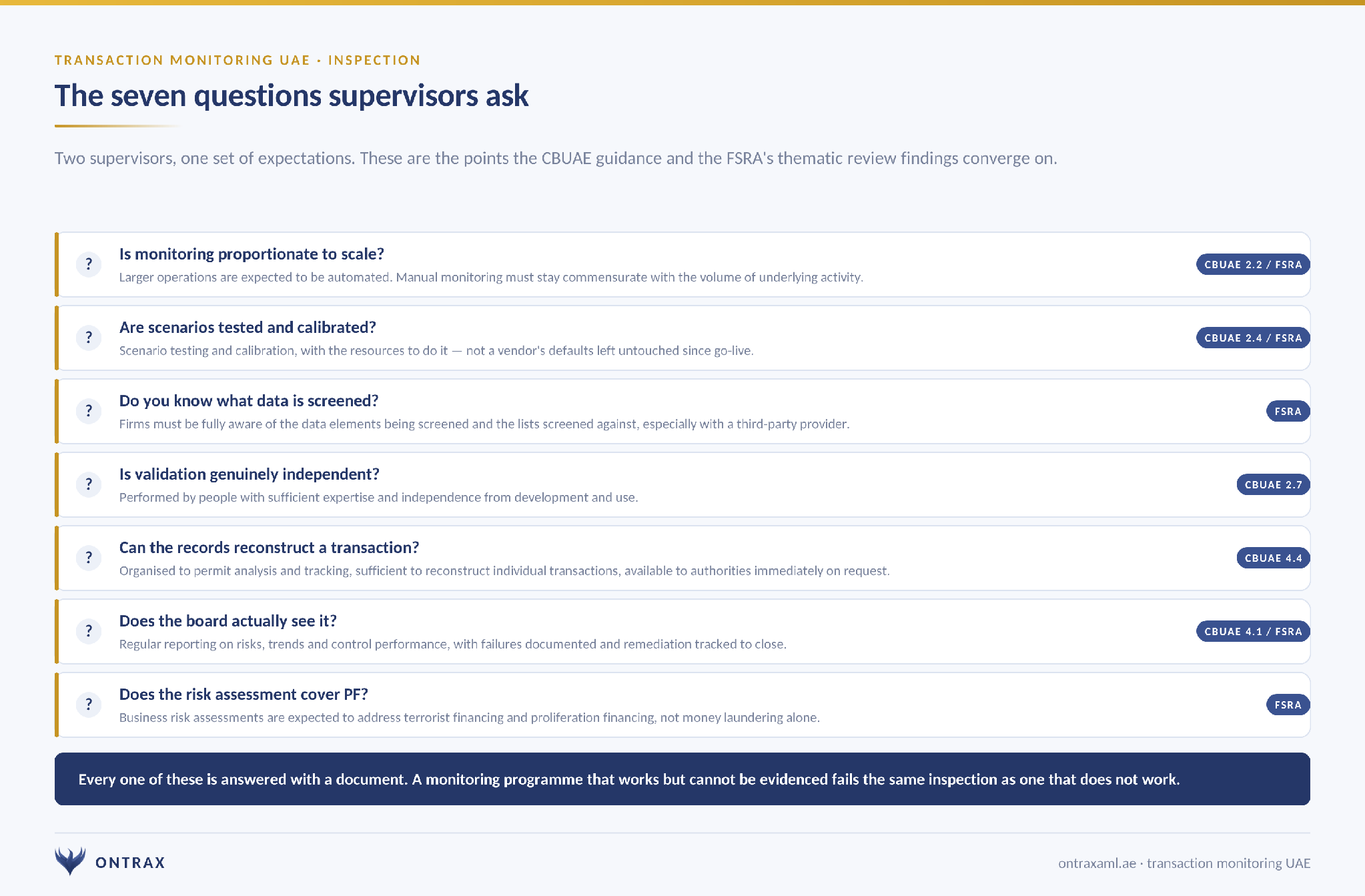
The questions a UAE supervisor puts to a transaction monitoring programme, mapped to the CBUAE and FSRA sources.
The board, or a committee designated by it, together with senior management, should receive regular reports on financial crime risks, trends and control performance. Problems such as data or system failures must be documented, and the status of remediation reported regularly to senior management until closed.
Transaction monitoring programmes must also be independently tested by auditors with sufficient technological expertise. That qualifier matters: an audit function that can test a policy but cannot interrogate a rule set is not providing the assurance the guidance contemplates. Where that expertise is not available internally, it is a standard scope item for an independent AML audit.
The reporting pack that works
- Alert volumes by rule, with the trend over at least four quarters, so declining productivity is visible.
- False positive share per rule, and which rules are candidates for tuning.
- Investigation backlog and ageing, with the oldest open alert named.
- Escalations to the MLRO, reports filed with the FIU, and the conversion rate between them.
- Data testing status against the 12 to 18 month interval, by source.
- Validation findings outstanding, with owners and dates.
- Any rule disabled, suppressed or whitelisted during the period, and on whose authority.
The last item is the one boards most often do not see and most need to. Where the MLRO function is thinly resourced, our MLRO Provision and Virtual Compliance Officer services provide the capacity to produce this pack to board standard; our guide to the MLRO role in the UAE sets out the authority the position needs to act on it.
8. A ninety-day remediation plan
For a firm that suspects its transaction monitoring programme would not survive scrutiny, this sequence addresses the highest-risk transaction monitoring items first and produces evidence at each stage.
Days 1 to 30 — find out what you actually have
- Produce the current scenario inventory: every live rule, its parameters, its threshold and the date it was last changed.
- For each rule, record whether a documented rationale exists. Most firms find that a minority do.
- List every data source feeding the system and name an owner for each. Record when each was last tested.
- Pull twelve months of alert MI by rule, with the false positive share and the escalation and filing rates.
- Identify who built the current rule set and who uses it, and establish whether anyone independent has ever validated it.
Days 31 to 60 — fix what the evidence shows
- Refresh the business risk assessment and map each live scenario to a typology it is designed to detect. Retire rules that map to nothing.
- Run above-the-line testing on the three highest-volume rules and below-the-line testing on the three thresholds covering the highest-risk segment.
- Re-segment thresholds by product and customer type where a single threshold currently spans the book.
- Review the whitelist and remove every higher-risk customer and transaction type from it.
- Schedule data testing for every source and put the 12 to 18 month interval into the compliance calendar.
Days 61 to 90 — build the evidence file
- Commission independent validation, scoped so that neither the builders nor the users sign their own work off.
- Document scenarios, assumptions, parameters and thresholds in a single controlled document with a version history.
- Stand up the board reporting pack described above and take it to the governing body.
- Run a dry inspection: assemble what a supervisor would request and time how long each item takes to produce.
- Close remediation items with named owners and dates, and report completion.
9. How Ontrax helps
Ontrax Compliance & Risk Management Ltd works on transaction monitoring in the UAE from both ends: the design of the rules and the evidence that defends them. Our Transaction Monitoring & Screening service covers scenario design against a documented typology assessment, threshold segmentation, above-the-line and below-the-line testing, data lineage and ownership, alert triage capacity, and the management information a board needs to exercise oversight.
Where the gap is assurance rather than design, our Independent AML Audit provides the validation the guidance requires to sit outside development and use. Where the underlying risk assessment is the weak link, our AML Risk Assessment service rebuilds the document the thresholds are supposed to flow from. And for licensed financial institutions carrying the full CBUAE expectation, our AML Compliance for Financial Institutions service covers the programme end to end — the subject of our companion guide for financial institutions.
If you take one action: Ask for the document that records your current scenarios, their assumptions, their parameters and their thresholds. If it does not exist as a single controlled document, that is the first finding any transaction monitoring review will record, and everything else follows from it. Speak to Ontrax about reviewing your monitoring programme.
Frequently asked questions
What is transaction monitoring in the UAE?
Transaction monitoring in the UAE is the ongoing scrutiny of customer transactions to identify activity inconsistent with the customer’s profile or consistent with a known money laundering, terrorist financing or proliferation financing typology. The CBUAE has issued dedicated guidance setting out what licensed financial institutions are expected to have in place, covering the framework, scenarios, thresholds, data, tuning, validation, governance and records.
Is an automated transaction monitoring system mandatory in the UAE?
Not universally. The CBUAE states that institutions with a larger scale of operations are expected to have automated systems in place. Smaller institutions may use less automated approaches, provided they are appropriately executed for the volume of daily activity. The FSRA adds that manual monitoring must remain commensurate with the scale and volume of the underlying business.
How often should transaction monitoring data be tested?
The CBUAE guidance states that data testing and validation should typically occur at a minimum every 12 to 18 months, in addition to testing before initial deployment. Each data source should be identified, documented and assigned a named system owner.
What is above-the-line and below-the-line testing?
Above-the-line testing examines the alerts a rule produces and asks how many were worth producing, identifying thresholds set too tight. Below-the-line testing examines the activity that fell just below the threshold and never alerted, asking whether any of it should have, and identifies thresholds set too high. The CBUAE suggests both for institutions with large transaction volumes.
Who can validate a transaction monitoring system?
Validation must be performed by people with sufficient expertise and sufficient independence from the development and use of the system. Where developers or users perform part of the validation, an independent party must critically review their work. The analyst who tunes the rules cannot be the person who certifies that they are correctly tuned.
Can false positives be whitelisted?
Yes, suppression or whitelisting of repeatedly cleared false positives is permitted, but it must not be applied to higher-risk customers or transaction types, and it must be monitored and periodically tested. A whitelist that has not been reviewed in years is effectively a list of customers who are no longer monitored.
What management information should transaction monitoring produce?
At minimum, alerts generated per rule and the proportion cleared as false positives, taken forward for investigation, or converted into a report to the FIU. Declining rule productivity or a shift in performance may indicate a data or calibration problem. Boards should also see backlog ageing, escalation and filing rates, data testing status, outstanding validation findings and any rule disabled or suppressed during the period.
Does using a third-party monitoring system transfer responsibility?
No. The institution remains ultimately responsible for compliance. It must validate the vendor’s models itself and maintain contingency plans for system failure. The FSRA makes the same point about screening: firms must be fully aware of the data elements being screened and the lists screened against, even where a provider operates the system.
Should transaction monitoring operate at account level or customer level?
Where practicable, monitoring should cover the customer or relationship level, including across a financial group, rather than individual accounts alone. This matters most for politically exposed persons and other higher-risk customers, where structuring activity across several accounts is invisible to account-level rules.
Does transaction monitoring training apply to staff outside the UAE?
Yes. The CBUAE guidance states that mandatory role-specific training extends to staff located abroad whose work involves UAE accounts or flows. A group operations or shared service centre in another jurisdiction is within the training perimeter.
How do thresholds relate to the business risk assessment?
Thresholds should reflect the institution’s risk assessment and the specific product and customer type, supported by risk-based segmentation. A single threshold applied across an entire customer book is not risk-based. If the risk assessment is out of date, every threshold derived from it is unsupported.
What happens to an alert after it is escalated?
The MLRO inquires into the circumstances, documents that inquiry, and determines whether a report to the Financial Intelligence Unit is required. The determination is recorded either way — including a decision not to report, which is the step most often left undocumented. Reports are filed through goAML, and DIFC firms additionally notify the DFSA immediately after submission.
How long must transaction monitoring records be kept?
At least five years under the federal framework, measured depending on circumstances from the transaction date, the end of the relationship, the completion of a CBUAE inspection, a final judgment or the termination of the legal person. Firms in the DIFC and ADGM are held to at least six years. Records must be organised so that individual transactions can be reconstructed and must be available to authorities immediately on request.
What is the most common transaction monitoring finding?
Rules that work but cannot be explained. The threshold produces sensible alerts, the team investigates them diligently, and nobody can produce the document recording why the threshold sits where it does, who validated it, or when the data behind it was last tested. The detection is adequate; the evidence is not.
Sources and further reading
· CBUAE — AML/CFT Guidance for LFIs on Suspicious Transaction Reporting
· ADGM FSRA — Thematic Review on AML/CFT and TFS: Findings and Outcomes
· ADGM FSRA — Thematic Review on Suspicious Activity and Transaction Reporting
· CBUAE — Anti-Money Laundering resources
This briefing is general information on transaction monitoring in the UAE and is not legal advice. Guidance changes; verify the current text with your supervisory authority before acting. Ontrax Compliance & Risk Management Ltd, Dubai International Financial Centre.