
Introduction
A financial institution can have a policy, screening software and a named compliance officer and still have an AML programme that does not work in practice. The harder test is whether its controls reflect the institution’s actual products, customer types, delivery channels, transaction flows and regulatory perimeter. That is the core of AML compliance for financial institutions UAE: a connected operating framework that identifies financial-crime risk, applies proportionate controls, escalates concerns and leaves a reliable evidence trail.
The UAE framework has a federal layer and several supervisory rulebooks. Federal Decree-Law No. 10 of 2025 and Cabinet Resolution No. 134 of 2025 form the current federal AML/CFT/CPF foundation [1, 2]. They apply alongside requirements issued by the relevant supervisor. A CBUAE-licensed bank or payment institution, a DFSA-supervised DIFC firm and an FSRA-supervised ADGM firm do not simply follow one identical checklist. Their common duties sit within different supervisory expectations, reporting channels and rulebooks.
This guide explains how to build a practical programme, where the main controls fit, and how to check whether they operate as designed. It is general information, not legal advice. Each firm should confirm the current rules that apply to its licence, business model and legal structure before changing its controls.
Fintech firms also need to map their licence and products before choosing controls. Teams comparing CBUAE AML requirements, DFSA AML requirements and FSRA AML requirements should apply each rulebook to the right legal entity. Strong UAE financial crime controls then connect those obligations to customer due diligence, screening, transaction monitoring and escalation.
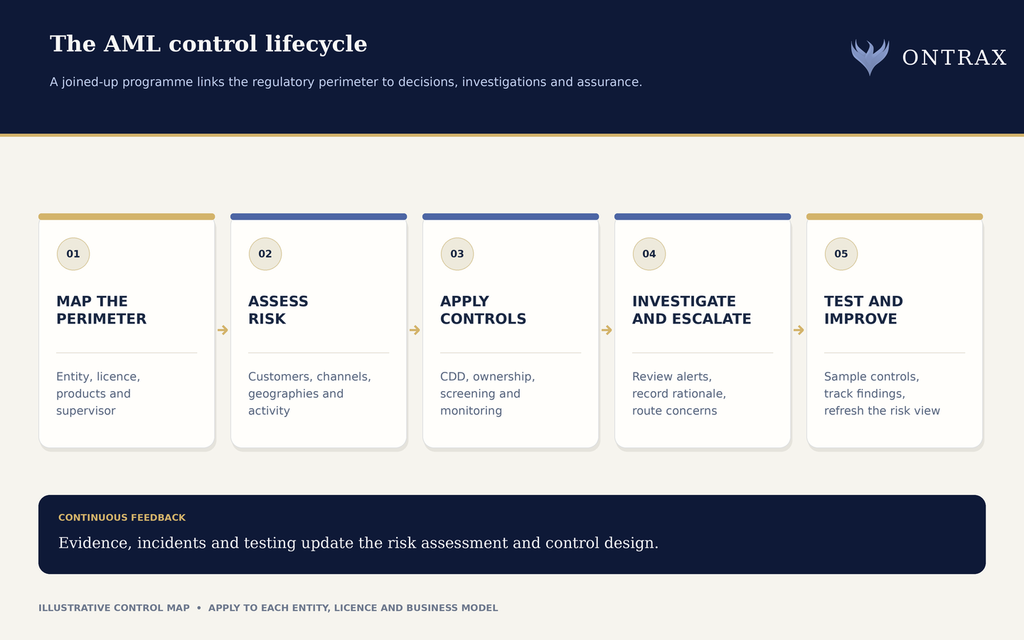
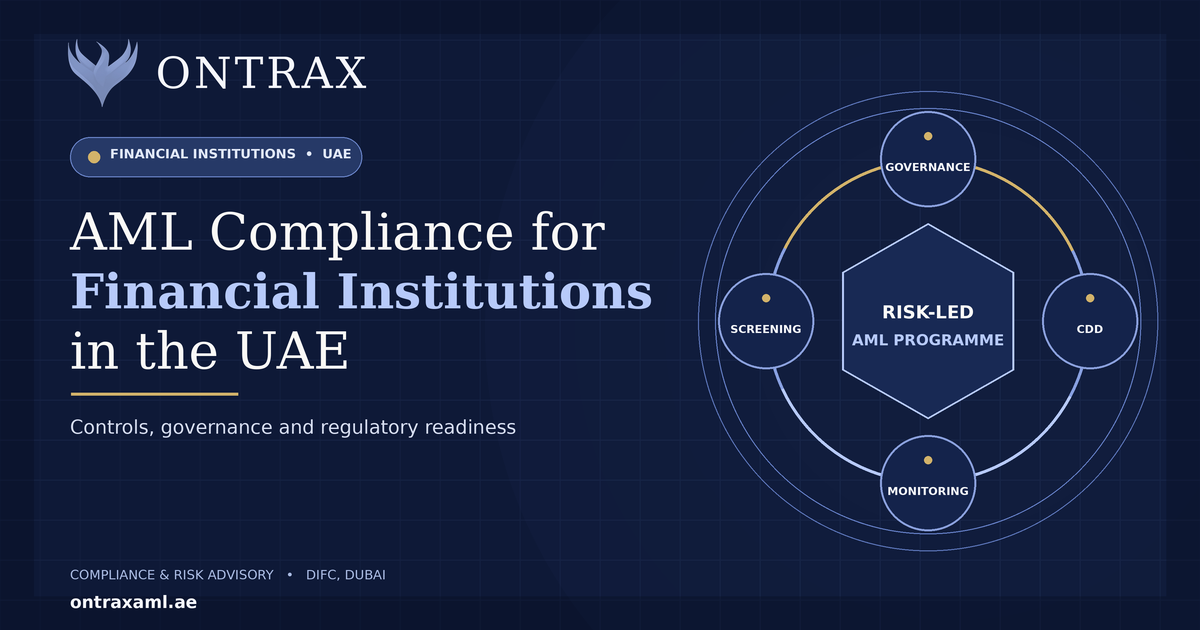
Figure 1. Risk assessment, customer controls, monitoring, escalation and assurance operate as a connected AML control lifecycle.
1. Start with the right regulatory perimeter
The first step is to identify which entity performs each regulated activity, where it operates, and which authority supervises that activity. A group may have a mainland entity, a DIFC branch and an ADGM subsidiary. A payments product may also sit alongside a bank partnership, a stored-value facility or a virtual-asset activity. The word “UAE” in a policy does not settle which requirements apply to each entity.
At the federal level, Federal Decree-Law No. 10 of 2025 addresses money laundering, terrorist financing and proliferation financing. Cabinet Resolution No. 134 of 2025 contains the Executive Regulations. The UAE Central Bank supervises entities within its remit and publishes its own rulebook and guidance. In the DIFC, the DFSA AML Module works with applicable federal legislation and DIFC law [6, 7]. In ADGM, the FSRA’s AML and Sanctions Rulebook applies alongside federal legislation [8]. Other UAE supervisors may have sector-specific rules and instructions.
Create a perimeter map that records: legal entity; licence and permitted activities; customer and product scope; operating locations; supervisor; applicable laws, rules and guidance; reporting route; required filings; and accountable senior roles. Assign an owner to review this map when the group launches a product, enters a new market, changes a licence or restructures an entity. The map should distinguish a legal obligation from supervisory guidance and an internal control choice, so that staff do not present a good-practice procedure as a statutory requirement.
Where a group standard is used, add local supplements. A group-wide baseline can set minimum expectations for customer due diligence, sanctions screening and escalation. The local supplement should identify additional obligations or different procedures for each entity. If two regulators use different terminology or filing processes, the procedure should name the relevant entity and explain the correct route rather than merging them into one ambiguous step.
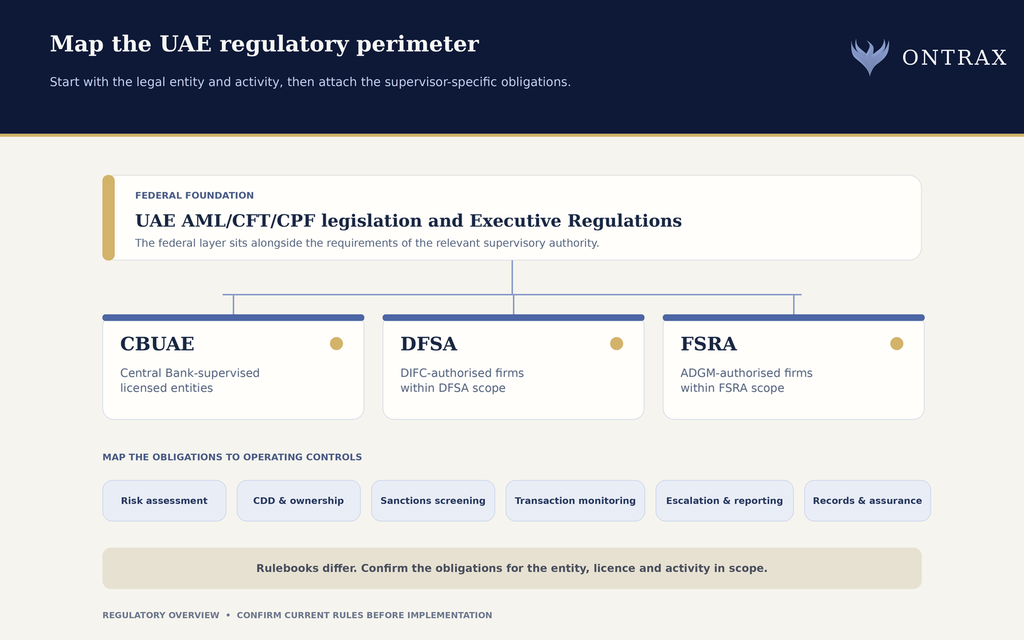
Figure 2. Apply the federal framework and relevant supervisory requirements to each entity, licence and activity.
2. Make the business risk assessment operational
A risk assessment is useful only when it changes the design or intensity of controls. It should describe the institution’s inherent risks, consider how existing controls reduce those risks, identify residual risk, and record the actions management has approved. A rating such as “medium” without evidence or an explanation does not show how the institution reached its conclusion.
Map products and services, customers, geographies, delivery channels, transaction types, counterparties, and material outsourcing. Then identify the data used to assess each dimension. A digital onboarding product may expose the firm to impersonation and synthetic identity risk; a cross-border remittance product may create risks associated with corridors, intermediaries and rapid movement of funds; a private banking product may require careful assessment of source of wealth and complex ownership. These are examples to test against the firm’s own facts, not automatic risk labels.
Keep inherent risk separate from control effectiveness. For example, a product may have high inherent exposure because it enables fast cross-border transfers. Strong customer verification and monitoring may reduce some residual risk, but management should not lower the rating merely because a control exists on paper. Test whether the control is configured correctly, used by the right teams, supported by complete data and followed up when it fails.
Use measurable indicators where possible: high-risk customer share; unresolved screening alerts; overdue periodic reviews; monitoring alert age; alert-to-escalation outcomes; quality assurance findings; missing beneficial ownership evidence; overdue remediation; and late regulatory filings. A metric needs a definition, an accountable owner and an action threshold. The purpose is not to create a dashboard full of green lights; it is to help decision-makers see weak points early.
Refresh the assessment when a material change occurs and on the cycle required by the applicable rulebook. A change in ownership, geography, product design, customer mix, transaction volume, threat pattern or regulatory expectation can alter risk. Keep version history, evidence, challenge comments, approval records and action owners together. Link the assessment to the policy, monitoring scenarios, staffing plan, training and internal audit programme.
3. Give governance real ownership
The board or governing body sets expectations, approves the risk appetite and oversees whether the controls are adequately resourced. Senior management turns that direction into operating decisions: who may approve higher-risk relationships, which issues must be escalated, what happens when system data is incomplete, and how the institution responds to overdue findings. Governance becomes weak when the AML function is expected to “own compliance” while business leaders retain the decisions that create or accept risk.
Set out responsibilities in a role matrix. It should distinguish the board, executive management, business owners, the AML compliance function, the MLRO, operations, technology, data owners, internal audit and external providers. The matrix should identify who performs a control, who reviews it, who approves exceptions, who receives escalations and who can stop activity. Avoid vague entries such as “all teams are responsible,” which make accountability difficult to test.
Protect the ability of the AML function and MLRO to raise concerns without commercial interference. A person may be asked to advise on a transaction, investigate a referral or prepare a report, but the decision trail should show how the issue was assessed and who approved any permitted action. Sales targets, customer relationships or payment deadlines must not silently override escalation controls.
Senior reporting should be concise enough to use and detailed enough to support challenge. A quarterly AML report might cover changes in risk, control performance, significant incidents, suspicious activity reporting statistics in a way that preserves confidentiality, regulatory correspondence, staffing, training, quality testing, third-party issues and open remediation. Numbers should be accompanied by context. “Forty alerts closed” means little unless management knows the relevant time period, risk mix, overdue cases and quality findings.
Document challenge and decisions. Minutes should show the issue raised, evidence considered, decision made, owner and due date. If management accepts a residual risk, record the reason, boundaries, compensating controls and review date. A signed policy is not evidence of active oversight by itself.
4. Build customer due diligence around risk
Customer due diligence begins with understanding who the customer is, who owns or controls a legal entity, why the relationship is being opened and what activity is expected. The precise verification steps depend on the customer, product, risk and applicable rules. The aim is not to collect the largest possible document bundle. It is to obtain reliable information sufficient to understand the relationship and manage its risks.
For an individual, a firm may need to establish identity, verify it using reliable sources, understand the purpose and intended nature of the relationship, and collect other information required by its rulebook and risk assessment. For a company, the institution should understand its legal form, business activity, ownership and control structure, authorised representatives and beneficial owners. Complex ownership structures need a clear explanation and evidence, not merely a name entered into a system.
Use standard, simplified or enhanced measures only where permitted and supported by the assessed risk. Enhanced due diligence may require additional information about the customer, beneficial owners, source of funds, source of wealth, expected activity, relationships and the reason for a transaction. The file should state what concern the additional measures address. Copying the same checklist into every high-risk file can create volume without insight.
Customer risk ratings should be explainable. Record the factors used, how they were weighted or considered, the rationale for any override and the review date. A system score can help with consistency, but staff should understand its inputs and limitations. If the rating is influenced by missing or stale data, that limitation should lead to an action rather than disappear into a numerical output.
Ongoing due diligence is not a calendar reminder alone. The firm should review a customer when risk changes, unusual activity appears, ownership or control information changes, a screening result is identified, or the relationship no longer matches its expected profile. Periodic review intervals should reflect risk and applicable obligations. Keep records of outreach, unanswered requests, decisions to restrict or continue the relationship and approvals for exceptions.
5. Screen sanctions and higher-risk parties effectively
Screening is a control process, not a software purchase. The institution needs to define which customers, beneficial owners, representatives, counterparties, payments and other relevant parties are screened, against which applicable lists, at what point, and how possible matches are handled. The firm should confirm the lists and instructions that bind its entity and products. A foreign list may be relevant to a firm’s risk or contractual obligations, but its legal status should not be assumed to be identical to UAE targeted financial sanctions.
A useful workflow covers list ingestion, data quality, name matching, alert assignment, investigation, escalation, decision, any required action and record retention. Screening at onboarding and screening during the relationship serve different purposes. Payment screening must be placed early enough for action to be possible before a transaction completes where applicable. Customer screening should also be refreshed when lists or customer records change.
False positives are expected, but a high false-positive rate can bury genuine risk. Review matching logic, language variants, transliteration, aliases, date of birth, country, identifiers and beneficial ownership data. Make sure a “false positive” disposition includes the reasons and evidence, and that the same match is not repeatedly cleared without checking whether new information has appeared. Test the system after configuration changes and maintain an escalation path for urgent matches.
PEP and adverse-media checks should be treated as risk indicators requiring assessment, not proof of wrongdoing. The institution should distinguish a potential match from a confirmed match and identify what additional review is warranted. Screening procedures should state who can close an alert, which cases require the MLRO or senior approval, and what happens when a system outage or data feed delay creates a control gap.
6. Monitor transactions against expected activity
Transaction monitoring compares actual activity with customer, product and risk context to identify unusual patterns for review. It may use automated scenarios, rules, thresholds, behavioural analytics, manual exception reports or a combination. The right design depends on the institution’s activities, data, risk exposure and regulatory requirements.
Start with a data map. Identify the payment and customer fields needed for monitoring, where each field originates, how it is transformed, when it arrives and how missing or inconsistent data is flagged. A scenario cannot detect a counterparty relationship if counterparty data is absent. A risk score cannot be trusted if customer occupation, expected volume or beneficial ownership information is stale. Data quality controls should be treated as part of the AML programme, not as a separate technology concern.
Scenario design should be connected to risk. Consider the institution’s customer types, products, delivery methods and typologies. Scenarios may address unusual velocity, fragmented transactions, activity inconsistent with a declared business, rapid movement through accounts, unexpected corridors, dormant accounts becoming active or other relevant indicators. These are examples, not a universal rule set. A scenario library copied from another firm may miss the institution’s actual patterns and produce noise.
Set threshold rationale and test outcomes. Use historical data and expert review to understand which activity triggers, which cases are useful, and which risks remain undetected. Back-testing and sample review can show whether a scenario is too broad, too narrow or broken by missing data. Do not lower alerts just to improve productivity metrics. If alert volume is unmanageable, examine scenario quality, customer segmentation, staffing, data completeness and workflow design.
Investigations should document the alert, relevant customer information, connected activity, explanation sought, information reviewed, disposition and escalation rationale. A closed alert should not erase suspicious context from subsequent monitoring. When the facts create the applicable reporting threshold, the institution should follow its internal escalation and external reporting obligations. The legal and regulatory reporting test is not the same as a criminal conviction or completed investigation.
7. Establish clear escalation and reporting routes
Employees need a safe internal route to report unusual conduct. Procedures should tell staff what to report, to whom, how quickly, what information to include and how confidentiality is protected. Avoid telling frontline staff to decide whether a crime has occurred. Their role is to identify and escalate concerns; designated decision-makers assess the matter under the applicable procedures.
The MLRO or relevant authorised function should have access to records and people necessary to investigate. Define the decision process for whether a report is made, what additional steps are taken, who is informed and what restrictions apply to customer communications. Tipping-off restrictions and confidentiality requirements must be reflected in training and case handling. The correct filing channel and any notice to the prudential or conduct regulator depend on the firm’s supervisory perimeter and current requirements.
Maintain a reporting register with controlled access. It should track internal referrals, review status, decision, filing date where applicable, follow-up tasks and audit trail. Do not use a register that exposes sensitive information broadly. Senior reports should aggregate data where possible and preserve confidentiality. A small number of reports does not automatically mean the control works well; it could reflect low risk, poor detection or a weak speak-up culture. Interpret reporting data alongside investigations, quality testing and business context.
8. Treat technology and outsourcing as controlled dependencies
A monitoring or screening provider can improve scale, but it cannot make the institution’s regulatory responsibility disappear. Before selection, assess functionality, data needs, configuration control, security, business continuity, audit rights, subcontractors, service levels and exit options. Confirm that the tool can support the firm’s required jurisdictions, customer and transaction types, relevant scripts and languages, evidence retention and reporting routes.
The CBUAE Rulebook sets third-party and outsourcing requirements for entities within its scope, and the rules can be restrictive for some types of licensed institutions. The firm should identify whether the proposed arrangement is outsourcing, third-party reliance, technology support or a narrowly permitted task, then confirm any notice, approval or no-objection requirement with the applicable supervisor. Do not assume that an external provider can take over an entire AML compliance function for every UAE institution. DIFC and ADGM firms must separately review their own rulebooks and guidance.
Contracts should address access to data, confidentiality, security, regulator access, incident notification, subcontracting, service continuity, audit and testing, change control, record return, termination and transition support. The institution should keep enough expertise in-house to oversee the provider, challenge results and manage incidents. Outsourcing a task does not outsource the board’s oversight or the firm’s responsibility for compliance.
9. Measure effectiveness and preserve evidence
A control is effective when it operates reliably for the relevant population and produces action when needed. Testing should examine both design and operation. For onboarding, sample files for identity evidence, ownership, purpose, rating, approvals and review dates. For screening, test list coverage, alert handling, escalation and decision records. For monitoring, review data quality, scenario coverage, thresholds, investigation notes, overdue cases and change governance.
Use a three-lines model suited to the firm. Business teams own day-to-day controls; AML compliance provides oversight and challenge; internal audit or another suitably independent assurance function assesses the framework. The exact roles and independence requirements depend on the entity and applicable rulebook. Avoid having the same person build a control, approve its operation and independently certify its effectiveness.
Findings need root cause, severity, accountable owner, interim mitigation and a dated remediation plan. A finding should close only after evidence shows the fix works, not when a procedure has been edited. Recurring issues may indicate a deeper problem in ownership, incentives, staffing, system design or data. Escalate overdue high-risk actions and document decisions to accept or extend them.
Retain evidence in a way that supports retrieval. A regulator or auditor may need to understand what the firm knew at a particular time, who made a decision and what information supported it. Keep versioned policies, risk assessments, approvals, training records, screening decisions, investigation files, system changes, provider oversight and testing results under controlled access and retention rules.
10. A practical 90-day improvement sequence
Days 1–30: map and triage. Confirm entities, licences, products, supervisors and applicable obligations. Review the latest enterprise-wide risk assessment, open findings, overdue customer reviews, unresolved high-risk alerts, transaction-monitoring data and third-party arrangements. Interview business owners and frontline staff. Identify urgent control breaks and assign temporary safeguards while the root cause is assessed.
Days 31–60: redesign priority controls. Update the risk assessment where evidence supports a change. Refresh the policy and operating procedures to reflect the current federal legislation and local rulebooks. Prioritise the most material gaps in onboarding, ownership evidence, screening, monitoring, escalation and management reporting. Confirm system data mapping, decision rights, staffing and training needs. Involve technology and operations before changing scenarios or workflow.
Days 61–90: test and embed. Run sample-based testing and scenario validation. Train affected teams using real role-specific examples. Present the material residual risks, remediation plan and resourcing needs to senior management. Set owners and dates for recurring review. Keep a concise evidence pack showing decisions, control tests, incidents and actions. This is a practical improvement sequence, not a regulatory safe harbour or a substitute for deadlines that apply to the firm.
How AML compliance for financial institutions UAE works in daily practice
A practical AML compliance for financial institutions UAE programme connects the rulebook to customer files, payment activity, decisions and evidence. It should be clear who owns each control, how exceptions are escalated and how managers see unresolved risk. When a firm maps those elements, its AML compliance for financial institutions UAE work becomes easier to test across products and regulators.
Frequently asked questions
What does AML compliance for financial institutions in the UAE include?
It usually includes a risk-based framework covering governance, business risk assessment, customer due diligence, beneficial ownership, sanctions screening, transaction monitoring, internal escalation and external reporting, recordkeeping, training, testing and oversight of relevant third parties. The exact requirements depend on the entity’s supervisor, licence, products and customer base. A firm should map applicable federal legislation and its local rulebook before using a generic checklist.
Which UAE AML law should financial institutions refer to in 2026?
The current federal foundation includes Federal Decree-Law No. 10 of 2025 and Cabinet Resolution No. 134 of 2025, the Executive Regulations. Supervisory rulebooks and instructions also apply. Firms should verify amendments and guidance published after this article’s research date, and should not continue relying on older references without checking whether they remain applicable.
Do all UAE financial institutions follow the same AML rules?
No. Federal legislation creates a common framework, while supervisory requirements differ by regulator and sector. CBUAE-regulated entities, DFSA-supervised DIFC firms and FSRA-supervised ADGM firms should identify their own rulebooks, reporting routes and notices. Group standards can be used, but local procedures must address the requirements that apply to each entity.
Is AML compliance software enough to meet regulatory expectations?
No. Software can support verification, screening, monitoring and case management, but it does not replace risk assessment, sound configuration, complete data, trained investigators, governance or accountable decisions. The institution should test whether the system works for its products and customers and retain evidence of oversight.
Can a financial institution outsource AML compliance in the UAE?
The answer depends on the firm’s regulator and the specific task. Some arrangements may be permitted with conditions; others may be restricted or require prior supervisory engagement. The institution remains responsible for effective oversight. It should review the applicable outsourcing and AML rules before signing or transferring work to a provider.
How often should a financial institution review its AML framework?
Use the review cycle required by the applicable rulebook and also reassess when material changes affect risk. Product launches, new customer segments, new corridors, acquisitions, system changes, significant incidents and regulatory updates can all justify an earlier review. Keep the reason for the timing and resulting decisions documented.
What should senior management receive in an AML report?
Reports should explain material risk changes, control performance, incidents, reporting and investigation trends, regulatory communications, resourcing, third-party issues, testing results and overdue remediation. Data should be contextualised and sensitive case information protected. The report should make it possible to challenge the framework and decide what action or resources are needed.
What is the difference between customer due diligence and transaction monitoring?
Customer due diligence establishes who the customer is, who owns or controls them, why the relationship exists and what activity is expected. Transaction monitoring examines activity over time against that context to identify unusual patterns. They should inform each other: customer information helps interpret activity, and activity may trigger a reassessment of the customer’s risk.
What records should a firm retain for AML compliance?
The firm should retain records required by applicable law and rulebooks, including customer due diligence, risk decisions, approvals, screening outcomes, investigations, reports, training, policies, control tests and system changes. Retention periods and access controls must be verified for the entity. Records should be complete, versioned and retrievable without exposing sensitive material unnecessarily.
How can Ontrax support a UAE financial institution?
Ontrax lists services including AML risk assessment, aml policy development, KYC, financial institution AML compliance, transaction monitoring and screening, MLRO services, outsourced AML support and independent review. A regulated institution should first confirm that the proposed service scope is permitted for its licence and supervisor, then define the work, oversight, access and reporting arrangements. See the relevant Ontrax service pages before engaging.
Conclusion
Effective AML compliance for financial institutions UAE is built from a correct regulatory perimeter, a risk assessment that shapes controls, clear ownership and evidence that the controls work. A federal law reference or a purchased monitoring tool cannot do that work alone. Management should connect customer information, screening, transaction activity, escalation, reporting and assurance into one operating framework, then keep testing it as the business and rules change.
Before publishing, confirm the current law and supervisory materials applicable to the target reader. For tailored help with a specific entity or licence, review Ontrax’s financial institution and AML compliance services.
Sources and notes
Sources checked on 22 October 2026. Recheck applicable rules before publication.
- Federal Decree by Law No. 10 of 2025
- Cabinet Resolution No. 134 of 2025, Executive Regulations
- CBUAE AML/CFT supervision
- CBUAE customer due diligence guidance
- CBUAE transaction monitoring and sanctions screening guidance
- DFSA AML regulatory framework
- DFSA AML amendments effective March 2026
- ADGM AML and Sanctions Rulebook