
Introduction
An AML compliance review UAE helps a business understand whether its policies, systems and day-to-day controls match the rules that apply to its entity and the risks created by its actual operations. The review should identify specific gaps, explain why they matter, and give management a practical plan to address them. It should not be a last-minute exercise to make a file look complete before an inspection.
A compliance review is also different from an independent AML audit. A readiness review may be performed by internal staff or a previously engaged adviser to find and fix weaknesses. An independent audit has a separate assurance purpose and must meet the independence conditions that apply to the firm. One should not be treated as automatically substituting for the other. Ontrax describes its review service as a proactive gap analysis against the applicable rulebook and a way to prepare for an independent audit [5].
The UAE framework has changed. Federal Decree-Law No. 10 of 2025 and Cabinet Resolution No. 134 of 2025 are the current federal AML/CFT/CPF foundation [1, 2], while supervisors such as the CBUAE, DFSA and FSRA issue additional requirements. This guide explains how to scope a review, test evidence, prioritise findings and verify remediation. It is general information, not legal advice. A review should always be tailored to the law and rulebook that apply to the specific entity.
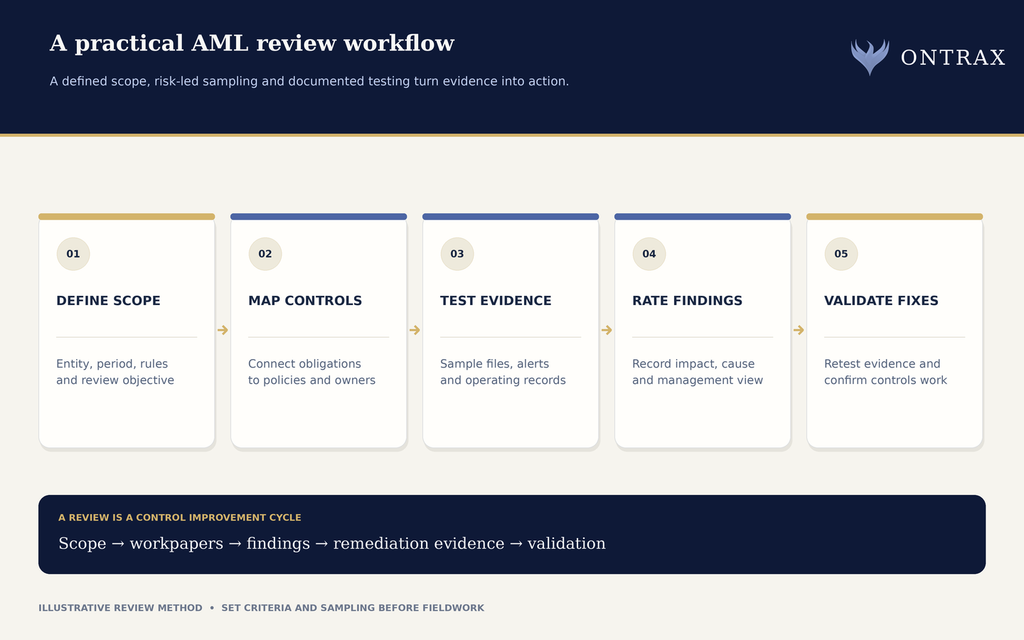
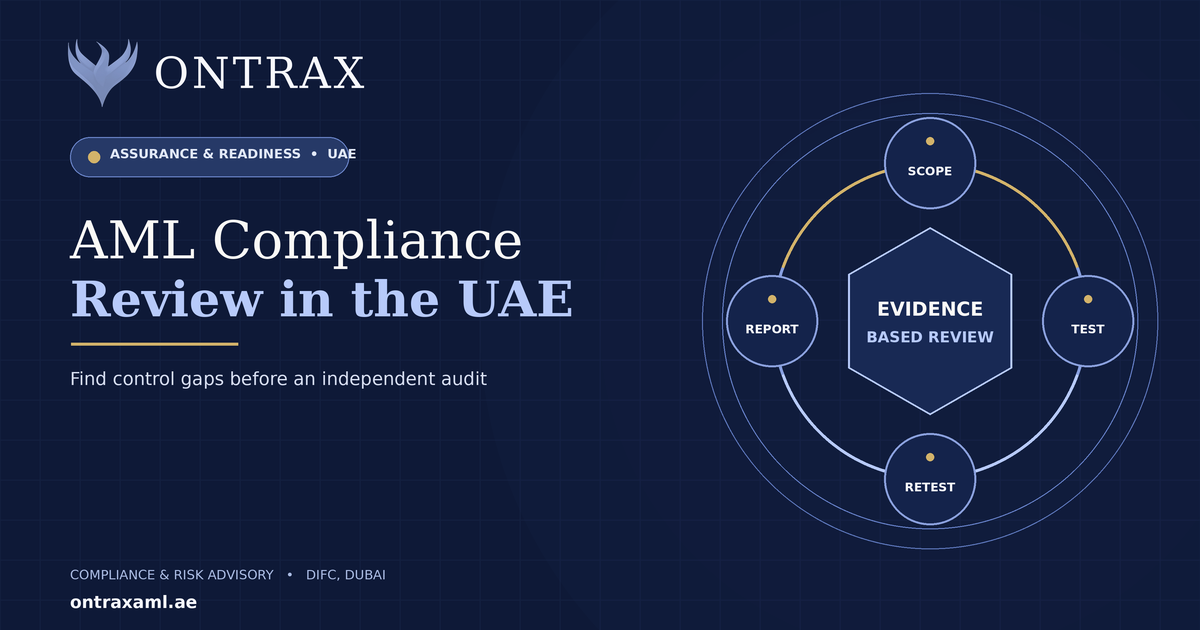
Figure 1. Define scope, map controls, test evidence, rate findings and validate remediation.
Managers may look for an AML gap analysis UAE provider or an internal AML review UAE before an independent audit. Whichever label is used, a well-scoped review should improve AML audit readiness UAE, record a clear compliance gap assessment UAE, and connect each accepted finding to an AML remediation plan UAE with an owner, deadline and verification evidence.
1. Define the purpose and perimeter
Start by stating why the review is being conducted. Possible reasons include an annual control check, a new product, a material change in customer or geographic risk, a regulatory finding, a system migration, an upcoming independent audit or a concern about alert handling. The purpose affects the scope, reviewers, sample and timeline. A review that tries to answer every possible question may become too broad to complete well.
Map the legal entities, licences, regulated activities, supervisors, branches and group services in scope. A business may have different obligations in mainland UAE, DIFC or ADGM. Federal requirements apply alongside the relevant local rules. The review plan should identify which requirements are being tested and which are outside scope. Do not describe every good practice as a legal requirement. Mark each criterion as a law, rule, regulator guidance, internal policy or control-design expectation.
Agree the period being reviewed, evidence cutoff, sampling approach, responsible contacts, access route, confidentiality rules and reporting audience. Confirm whether there are open regulatory communications, audit findings, internal investigations or other work that changes the review risk. If a potential serious control failure is discovered, define how it will be escalated during fieldwork rather than waiting until the final report.
Set the review standard. For example, a review may test whether customer files include required identity and beneficial ownership information, whether risk ratings are supported, whether screening matches are escalated and whether monitoring alerts are resolved with a documented rationale. Each criterion should be testable through documents, system evidence, interviews, observation or data analysis. A criterion such as “AML is effective” is not specific enough to test.
2. Separate the compliance review from the independent audit
An AML compliance review is usually a diagnostic or readiness exercise. It identifies weaknesses so the firm can correct them. It can be performed by compliance staff, internal reviewers or an adviser, subject to the firm’s policies and any applicable independence requirements. The reviewer may help design remediation or update procedures if the scope and conflicts are clear.
An independent AML audit provides assurance with an independence standard. The applicable law or rulebook may define who can perform it, what independence requires, how often it must occur or what it must cover. A firm should check the current requirements for its entity. If the same provider designed or operates a control, using that provider to independently certify the control can create a self-review concern. The firm should assess whether a separate independent party is required.
The two exercises can complement each other. A readiness review may test specific files and identify issues before the independent audit. The audit may then assess the overall framework according to its own scope and independence criteria. The firm should not label a readiness review “independent audit” simply because an external consultant performed it. The title should reflect the actual purpose, criteria, independence and deliverable.
Clarify how findings flow between exercises. A readiness review should record open issues and evidence of remediation. The independent auditor should receive accurate information about prior reviews and material changes, subject to the applicable process and confidentiality. Management should understand which findings remain open and what assurance the independent audit does or does not provide.
3. Build a review plan around the risk assessment
Use the firm’s current business-wide risk assessment as a starting point, then verify it against the business. Ask whether it includes current products, services, customers, jurisdictions, delivery channels, transaction types, counterparties, beneficial ownership risks, outsourcing and relevant changes. A review should not blindly accept a risk assessment because it was approved last year.
Prioritise areas where inherent risk is high, control performance is uncertain, previous findings recur, or changes have occurred. A digital customer onboarding change may warrant testing identity verification, liveness checks, beneficial ownership and risk scoring. A new payment corridor may warrant review of sanctions screening, transaction monitoring scenarios, customer expectations and data quality. A material change in leadership may warrant testing governance, escalation access and role coverage.
Create a matrix linking requirement, risk, control, evidence and test. For example: requirement to maintain a current understanding of customer risk; risk that files lack reliable ownership information; control requiring collection and verification of ownership data; evidence from sampled files, system fields and quality checks; test comparing records with procedure and validating exceptions. This structure helps reviewers explain why a gap matters.
Choose samples based on the objective. A random sample can show consistency across a population; a risk-based sample can focus on high-risk customers, complex ownership, unusual alerts or exceptions. Use both where useful. Record the sampling logic, population, period, exclusions and limitations. A reviewer should not imply that a small sample proves every file is correct.
4. Review governance and compliance ownership
Examine whether the governing body and senior management receive information that supports real oversight. Review committee terms, meeting papers, minutes, management reports, risk approvals, resourcing decisions, issue escalation and evidence of challenge. A board pack showing a green compliance status without underlying metrics may hide important weaknesses.
Check whether role responsibilities are clear. Who owns customer onboarding, beneficial ownership verification, screening, monitoring, internal reporting, policy approval, training, systems, remediation and independent testing? Determine whether business teams understand their responsibilities and whether the MLRO or compliance officer can access senior decision-makers. A job title alone does not show the person has authority, capacity or the necessary information.
Review conflicts and decision rights. If the business owner can override a risk decision, who approves the override and what evidence is recorded? If a customer is connected to an executive, is there a separate escalation path? If a compliance resource is outsourced, can the firm review its work and maintain internal accountability? The review should identify gaps in governance design and in day-to-day practice.
Test management reporting for completeness and usefulness. Reports might cover changes in risk, overdue customer reviews, alert ageing, sanctions matches, internal referrals, external reports where appropriately aggregated, training, control tests, incidents, open remediation and third-party risks. Ask managers how they use the information. A report that is produced but not understood is not effective oversight.
5. Test the policy and procedure framework
A policy should reflect the firm’s activities and regulatory perimeter. Check whether it identifies the applicable laws and rulebooks, assigns responsibilities, sets risk-based standards, describes prohibited activity, explains escalation, covers recordkeeping and is approved by the appropriate body. The review should compare the written policy with operating procedures, system configuration and actual staff behaviour.
Procedures should be usable. A frontline employee should understand how to collect customer information, identify an ownership issue, refer a potential match, document an unusual transaction and protect confidential information. A procedure that says “follow all applicable regulations” without practical steps gives little direction. Test through staff interviews, file sampling and observation of system workflows.
Review version control and change management. Confirm who owns each policy, when it was reviewed, what changes were made, which version staff can access and how affected employees were informed. If a law or supervisor updates its expectations, determine whether the firm assessed the impact and recorded a decision to update or retain its procedures.
Check that local supplements exist where a group policy spans multiple regulators. The review should look for the differences that matter to each entity: reporting channels, role approval, customer types, record expectations, screening instructions, outsourcing conditions and notification requirements. One policy can support consistency, but it should not erase local variations.
6. Examine customer due diligence and beneficial ownership
Sample customer files across risk levels and business lines. Check identity information, verification sources, legal entity details, ownership and control, authorised representatives, purpose and intended nature, expected activity, risk rating, approvals and review dates. For a complex entity, see whether the file explains how the firm understood the ownership chain and resolved gaps rather than just recording names.
Test enhanced due diligence where the risk or applicable rules require it. Review whether additional information was collected, whether the source of funds or wealth was assessed where relevant, whether senior approval was obtained when required, and whether ongoing monitoring matches the assessed risk. The reviewer should assess the logic of the file, not merely count documents.
Look for stale or contradictory data. A file may contain one address in the onboarding form and another in a source document; a system may show one beneficial owner while a corporate document shows another. Determine whether staff identified and resolved differences. Check whether customer changes are captured and whether periodic reviews are completed within the firm’s risk-based schedule and legal obligations.
Review exceptions. If the firm accepted a customer before all evidence was available, restricted activity, extended a review deadline or accepted alternative documentation, identify who approved it, what legal basis or policy allowed it, what compensating control applied and when the exception expired. Repeated exceptions may point to a design flaw or commercial pressure.
7. Test sanctions screening and transaction monitoring
For sanctions screening, identify which lists and parties are in scope, how list updates enter the system, when screening occurs and what happens when a possible match is found. Test onboarding, ongoing customer screening and transaction screening as applicable. Review the match logic, escalation, decision rationale, evidence, timing and any required actions. Confirm that a false-positive decision is supported by identifying information rather than an unexplained closure code.
For transaction monitoring, test whether data is complete, scenarios reflect the business risk, thresholds have a rationale, alerts are assigned to capable reviewers and case conclusions are documented. Sample both closed and open alerts. For closed alerts, check whether the reviewer considered customer context, linked transactions, counterparties, prior activity and any external information available to the firm. For open alerts, review ageing, escalation and resourcing.
Test the boundary between monitoring and reporting. Did staff escalate concerns internally? Did the MLRO receive the information required to assess them? Were decisions recorded? Did the firm meet any applicable filing or supervisory notification requirements? The review should not second-guess a protected reporting decision without full context, but it can test whether the process was followed and documented.
Evaluate system governance. Review changes to scenarios, thresholds, watchlists, data sources, access permissions and case workflows. Confirm that changes were approved, tested and logged. If a manual process operates during an outage, check whether it is complete, time-limited, independently reviewed and reconciled when systems return.
8. Review training, reporting, recordkeeping and third parties
Training should match roles and risk. A relationship manager, payments investigator, onboarding analyst, senior executive and technology administrator do not all need the same examples. Review the training plan, content, attendance, completion follow-up and evidence of understanding. Test whether staff can explain how to report an internal suspicion and what information to include. Completion numbers alone do not establish effectiveness.
Check recordkeeping against the applicable retention and access requirements. The firm should be able to retrieve customer due diligence, risk decisions, screening outcomes, investigations, reports, policies, approvals, training and control tests. Test whether files are complete and whether sensitive records are protected. Review whether records from a provider or system can be retrieved if the contract ends.
Assess third-party arrangements that support AML controls. Review due diligence, materiality assessment, approvals or notifications, contracts, security, access, business continuity, performance monitoring, audit rights, subcontractors and exit plans. Confirm that the firm has enough internal knowledge to challenge the provider. If the provider performs a task that cannot be outsourced under the firm’s regime, escalate immediately.
Review regulatory communications and filings. Check whether returns, notifications and responses were submitted accurately and on time under the requirements applicable to the entity. Look for evidence of quality review, accountable sign-off, supporting data and correction of errors. Do not assume a filing to one authority automatically satisfies a separate obligation to another.
9. Rate findings and write a practical report
A good report connects each finding to evidence, a requirement or expected control, the risk and the action needed. Avoid vague statements such as “improve KYC.” State which files lacked what evidence, how the current process allowed the gap, which customer or business risk may result and what management should change.
Use a severity scale the firm understands. Define the criteria before fieldwork, such as potential regulatory breach, customer or financial-crime exposure, scope, duration, recurrence, control failure and remediation urgency. Severity should not be lowered because remediation is inconvenient. Where the evidence is incomplete, state the limitation rather than pretending certainty.
Each finding should have a root-cause analysis, owner, due date, interim mitigation, target evidence and validation method. Separate quick fixes from systemic remediation. If several findings point to poor data, the answer may require a data control, system change and ownership decision, not just more training. If management accepts a risk or extends a deadline, record authority, rationale, safeguards and review date.
The executive summary should identify the most important conclusions, scope, period, methods, limitations, material themes and decisions required. The detailed report should remain useful to control owners. A report that is polished but impossible to convert into actions has failed its main purpose.
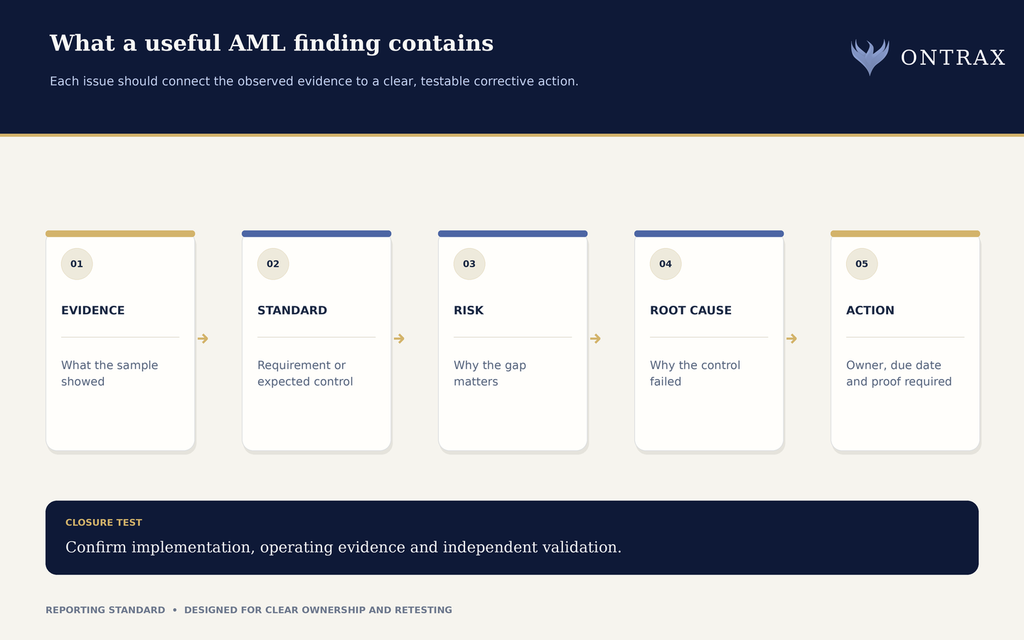
Figure 2. Link each finding to evidence, its expected standard, risk, cause and corrective action.
10. Validate remediation and plan the next review
A finding should close when evidence shows the fix is operating, not when a policy is edited. For a new customer-file process, test a fresh sample. For a system change, inspect approval, testing and production logs. For training, test staff understanding. For a governance change, inspect meeting records and escalation outcomes. Validation should be proportionate to severity.
Track recurring themes across reviews. Repeated issues may show that a previous action addressed the symptom but not the cause. Use root-cause categories such as unclear ownership, inadequate data, system limitations, insufficient staffing, weak procedures, poor training, competing incentives or ineffective oversight. Management should see where a pattern affects several entities or business lines.
Set the next review cadence based on risk, the applicable rulebook, major changes and previous findings. A material acquisition, new product, regulator communication, significant incident or major system migration may require earlier testing. The review calendar should be approved by an accountable owner and linked to the independent audit plan so that work complements rather than duplicates assurance.
Keep a single evidence pack containing the scope, criteria, samples, workpapers, findings, management responses, remediation and validation. Protect confidential customer and suspicious-activity information. A future reviewer should be able to understand the review and trace conclusions without relying on the memory of one consultant.
Making an AML compliance review UAE useful to management
An AML compliance review UAE should give management evidence it can act on: which controls were tested, what the samples showed, why a finding matters and what will demonstrate remediation. A strong AML compliance review UAE does not stop at a gap list. It connects findings to owners, deadlines, interim safeguards and independent validation where appropriate.
Frequently asked questions
What is an AML compliance review in the UAE?
It is a structured assessment of whether an entity’s AML policies, procedures, systems and controls align with its applicable obligations and business risks. It should identify evidence-based gaps and practical remediation. The scope needs to reflect the entity’s regulator, licence, business model and current federal framework.
Is an AML compliance review the same as an independent AML audit?
No. A compliance review is often a diagnostic or readiness exercise that helps the firm find and fix weaknesses. An independent AML audit provides assurance subject to independence and scope requirements applicable to the entity. A firm should not assume that an internal review or adviser-led review satisfies an independent audit obligation.
Who can conduct an AML compliance review?
The reviewer may be internal or external depending on the purpose, firm policy, independence needs and applicable rules. The person should have relevant competence and access to evidence. If the review is intended to meet a formal independent audit requirement, the firm should confirm that the reviewer satisfies the required independence and qualification criteria.
How often should an AML compliance review take place?
The frequency should reflect the applicable rules, firm risk, control changes and previous findings. A regular review cycle may be supplemented by a focused review after a product launch, incident, regulatory update, acquisition or system change. The firm should distinguish this diagnostic review from any prescribed independent audit frequency.
What should an AML gap analysis cover?
It should define the regulatory perimeter, governance, business risk assessment, customer due diligence, screening, monitoring, reporting, training, recordkeeping, third parties, testing and remediation as relevant to the firm. Each area should be tested against evidence and criteria, with limitations disclosed.
How should findings be prioritised?
Prioritise based on the applicable requirement, financial-crime exposure, breadth of impact, duration, recurrence, control failure and remediation urgency. Define the scale before testing. Each finding should have a root cause, owner, due date, interim safeguard and validation evidence.
Does a review guarantee that a regulator will not find issues?
No. A review is based on its defined scope, period, evidence and sampling. It can help management identify and address gaps, but it cannot guarantee a particular regulatory outcome or prove that every control works in every case. The report should state its limitations clearly.
Should the review use a sample of customer files?
Often, yes. Sampling can test whether procedures work in practice. The sample should be designed for the review objective and may include random and risk-based selections. Document the population, period, sample size, exclusions and limitations so readers understand what the results support.
How do you know a remediation action is complete?
Completion requires evidence that the fix has been implemented and operates as intended. A revised policy alone may not be enough. Reviewers may need to test new files, inspect system logs, interview staff or verify governance records. The test should match the finding’s severity and root cause.
Can Ontrax conduct an AML compliance review before an independent audit?
Ontrax describes its AML Audit and Compliance Review service as a proactive gap analysis against the applicable rulebook, including testing monitoring systems, policies, reporting workflows and remediation. The firm should agree the scope and determine whether it is separate from any independent audit required for its entity.
Conclusion
A useful AML compliance review UAE turns requirements and risks into evidence-based tests, clear findings and verified remediation. It helps management see what is working, where a gap exists and who must fix it. It should be scoped to the correct entity and regulator, and its purpose should remain distinct from an independent AML audit.
For service support, review Ontrax’s AML Audit and Compliance Review page. Agree the review criteria, independence boundaries, sample and deliverables before fieldwork begins.
Sources and notes
Sources checked for this draft on 22 October 2026. Regulatory references should be rechecked against the current rulebook before publication or use as legal advice.