
How virtual-asset businesses can connect customer due diligence, blockchain monitoring, Travel Rule controls and governance to the right UAE supervisory perimeter.
Introduction
Crypto AML compliance in the UAE depends on the activity, customer journey and regulator that governs the VASP. A credible programme connects business risk assessment, customer due diligence, blockchain monitoring, Travel Rule processes, escalation and evidence instead of relying on a wallet-screening tool alone.
Begin with the activity and the regulator
“Crypto business in Dubai” is not a complete regulatory description. A business must identify the legal entity, virtual-asset activities, location, customer base, products and licensing status before choosing its AML framework. VARA regulates virtual-asset activities in Dubai outside the DIFC perimeter; the DIFC has its own regulatory arrangement, while other UAE jurisdictions and financial free zones have their own competent authorities. A company group may have more than one entity and perimeter. Do not assume one regulator’s rulebook applies to every entity or service.
Create a perimeter map before designing controls: each legal entity, activity, regulator, licence condition, customer segment, asset, transfer path and third-party dependency. Check current primary rules and written supervisory directions. If a product includes payments, custody, exchange, transfer, brokerage, token issuance or fiat rails, analyse each part rather than describing the whole platform as “crypto.” The applicable obligations may vary by function. For OnTrax’s service description, see Crypto AML Compliance Services in UAE; the firm’s own compliance decisions must still be confirmed against its regulator.
Understand the federal framework and the supervisor layer
Federal AML/CFT obligations form a baseline, with regulator rulebooks and directions adding requirements for supervised entities. As of this guide’s drafting date, the UAE federal framework includes Federal Decree-Law No. 10 of 2025 and Cabinet Resolution No. 134 of 2025. Use the official legislative texts and the relevant supervisor’s current rulebook; do not rely solely on an old policy, a vendor checklist or a search result snippet. Keep a register of legal sources and changes, and record how each obligation maps to a control owner. The Ministry’s official legislation index can help confirm current federal source documents.
For a VARA-regulated VASP, the Compliance and Risk Management Rulebook and activity-specific rulebooks must be read together. VARA’s AML/CFT and Travel Rule section describes risk assessment, customer due diligence, monitoring, suspicious transaction reporting and Travel Rule expectations. A different UAE supervisor may impose a different interpretation, control detail or process. Legal and compliance teams should document which version and provisions were reviewed, who approved the interpretation and when it will be refreshed. Regulatory analysis is an ongoing operating task, particularly as products, supported assets and transfer pathways change. VARA also states that its Dubai virtual-asset jurisdiction excludes the DIFC in its federal AML/CFT laws index.
Map the virtual-asset business risk
A VASP risk assessment should understand how the service can be misused. Consider product and activity type, asset characteristics, transaction speed, custody model, customer type, source and destination of funds, geographic exposure, delivery channels, intermediaries and reliance on smart contracts or third-party infrastructure. Examine features such as privacy-enhancing assets, mixers, bridges, decentralised protocols and rapid cross-chain movement where relevant to the actual service. Their presence is a risk factor to assess, not a conclusion that every associated customer is illicit.
Connect each risk to a control and an owner. For instance, exposure to indirect transfers from a high-risk service may trigger enhanced blockchain analysis, additional source-of-funds evidence or compliance review before assets become available. Document inherent risk, control design, residual risk, thresholds and the rationale for accepting or restricting a risk. VARA’s rulebook currently requires risk assessment to reflect the nature, size and complexity of the business and to feed policies, procedures, systems, controls and resources; verify the live rulebook before publication. The assessment should be updated when the business or risk environment changes and at any required interval.
Design onboarding around customer and beneficial-owner risk
VASP customer onboarding should identify who is using the service, who owns or controls the customer, the purpose of the relationship and expected activity. For individuals, establish identity and relevant verification. For companies, understand legal existence, ownership, controlling persons, authorised representatives and the reason for the relationship. Establish a risk profile that reflects jurisdiction, product, transaction behaviour, funding source, customer type and access channel. The onboarding record should be usable by monitoring teams after the first deposit or trade.
Avoid treating wallet ownership as a complete customer profile. A wallet address does not explain the customer’s identity, source of wealth or expected activity. Where required by applicable rules, obtain source-of-funds or source-of-wealth information and apply enhanced due diligence for elevated risk. Document what the customer says, what independent evidence supports it, what remains unresolved and who approved the relationship. Reassess if activity diverges from expectations. Connect process design to OnTrax’s KYC services and AML risk assessment services when those services fit the firm’s needs.
Screen customers, beneficial owners and relevant parties
Sanctions, targeted financial sanctions, PEP and adverse-information screening should be integrated into onboarding and ongoing monitoring according to applicable UAE rules. Screen relevant customers, beneficial owners, controllers and representatives; for transactions, determine which counterparties and originators or beneficiaries must be checked. Record list sources, screening timing, identifiers, match resolution, reviewer and decision. A fuzzy match is a prompt for analysis. A confirmed match requires the firm to follow the legal steps and competent-authority process that apply to its situation.
Crypto adds an on-chain dimension but does not remove the need for conventional party screening. An address may be associated with a sanctioned entity, a service or a cluster, while the actual counterparty can be uncertain. Treat attribution as evidence with confidence and context, not certainty by default. Define who may clear a possible match, what information they need, how restrictions apply during review and how confidential cases are protected. Test list updates, screening configurations and alert queues. Keep policy language aligned with the firm’s actual tooling, including limitations and manual workarounds.
Use blockchain analytics as one layer of monitoring
Blockchain analytics can support transaction monitoring by identifying exposure to known services, suspicious patterns, wallet clusters or high-risk categories. Its value depends on data coverage, attribution quality, supported chains, risk rules, alert thresholds and analyst judgement. A provider score should not become a black-box acceptance or rejection decision. Document what the tool can and cannot see, how often data updates and how analysts interpret indirect exposure, multiple hops, bridges, mixers and asset-specific behaviour.
Build a monitoring model around the firm’s products and flows. For a custodial exchange, the platform may have internal ledger activity as well as on-chain deposits and withdrawals. A broker may see counterparties and transaction instructions but not control settlement. A wallet provider may have a different visibility profile. Define scenarios that fit the service and customer risk, then test whether alerts are timely, explainable and actionable. Maintain case narratives with transaction hashes, relevant wallet addresses, fiat records, customer context, analyst steps, escalation and disposition. Review false positives and missed cases to tune controls without weakening coverage blindly.
Handle the UAE Travel Rule with a defined data flow
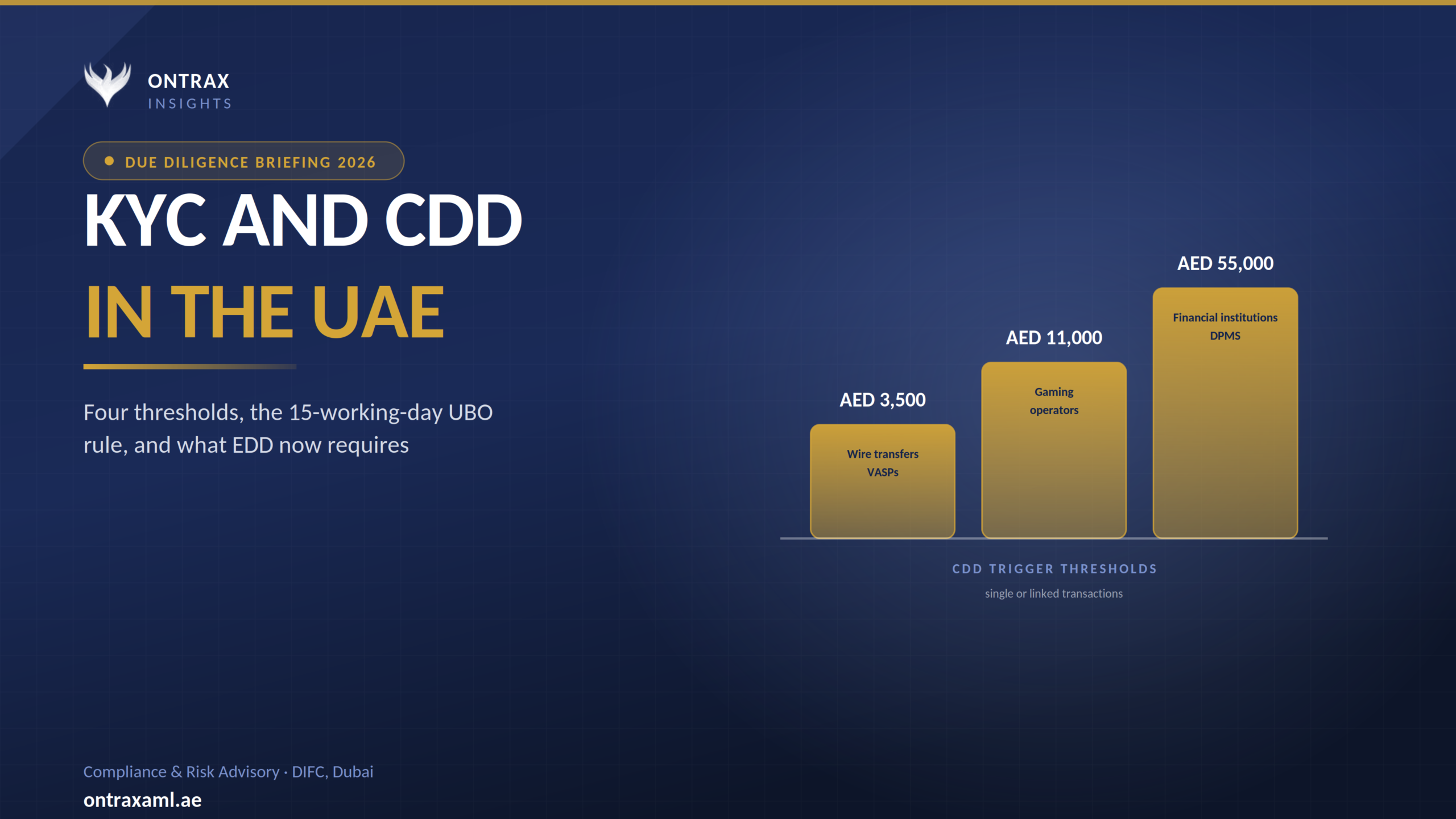
The Travel Rule requires relevant originator and beneficiary information to accompany qualifying virtual-asset transfers under the applicable regulatory framework. For a VARA-regulated VASP, VARA’s published AML/CFT and Travel Rule provisions include an AED 3,500 equivalent threshold for specified information requirements before a beneficiary VASP permits access to assets received from a transfer above that amount. Confirm the current rule wording, scope, required fields and application to the precise transfer type before configuring production logic. Other rulebooks or federal requirements may add detail or differ in application.
Map what information the sending VASP collects, validates, transmits, receives, reconciles and retains. Decide how the business handles missing or inconsistent information, failed messaging, unknown counterparty status and delayed responses. Controls should prevent a transfer from silently bypassing the process, while providing an escalation and documented exception route where legally permitted. Match data to the correct transaction and customer record, protect it in transit and restrict access. Test interoperability with counterparties and ensure operations know the manual fallback. Store evidence of message outcomes, decisions, risk analysis and any follow-up in an auditable case record.
Assess counterparty VASPs and unhosted wallets
A VASP’s risk changes depending on who controls the other end of a transfer. Determine whether a counterparty is a regulated VASP, what jurisdiction and regulator apply, what information can be exchanged and whether the institution has completed due diligence. The status of a counterparty should be periodically checked. Do not assume that every address belongs to a regulated business or that a name appearing in a directory proves current authorisation.
Transfers to or from unhosted wallets require a clear, risk-based approach consistent with current rules. The VASP should understand the customer’s relationship to the wallet and consider whether additional verification, source-of-funds analysis, blockchain screening or restrictions are appropriate. Be precise: self-hosted does not itself mean suspicious, but it can reduce the information available from an intermediary. Document what evidence is collected, how wallet control is demonstrated where required, the risk decision and any limits. VARA’s rulebook calls out risks connected with unhosted wallets and attempts to circumvent requirements; check the current provision and applicable transfer thresholds.
Build suspicious activity reporting around human review
Transaction monitoring produces alerts, not automatic findings of criminal conduct. A trained analyst should compare on-chain activity with the customer’s declared purpose, historic pattern, known counterparties and available off-chain records. Evaluate plausible explanations and document why the activity is consistent or remains suspicious. A case file might include wallet addresses, transaction hashes, flow diagrams, fiat conversions, communications and relevant KYC records, subject to confidentiality and data-protection requirements.
The policy should state how employees raise concerns internally, how the MLRO or authorised officer assesses them and how a decision to report is made under the applicable UAE process. Distinguish an internal escalation from an external report to the competent FIU channel. Preserve a decision rationale, filing reference where relevant and subsequent action. Reinforce confidentiality and anti-tipping-off controls. Establish a route for urgent cases, staff absence and system outages. Commercial teams should not be able to close an alert without an independent reasoned review, and analysts should have access to the information necessary to resolve cases.
Apply enhanced due diligence proportionately
Elevated-risk indicators can include complex ownership, higher-risk geographies, unusual source of funds, politically exposed person connections, unexplained use of privacy-related features, significant indirect exposure to high-risk services or activity inconsistent with the customer’s profile. Risk factors should be assessed together and in context. A single indicator may be explainable; a cluster of inconsistent signals may warrant more evidence, senior approval or restrictions.
Additional measures may include verifying source of funds or wealth, obtaining further customer information, increasing monitoring frequency, reviewing linked wallets, limiting transaction types or setting a senior approval requirement. The control decision should state which evidence is missing, what residual risk remains and what event would trigger re-review. Declining a relationship can be appropriate when risk cannot be understood or managed under law and the firm’s risk appetite. Avoid blanket rules that make a tool score the sole decision-maker. Record the rationale so similar cases receive consistent treatment and management can evaluate whether a threshold remains effective.
Govern the technology and third parties
VASP AML controls often depend on identity vendors, sanctions providers, chain analytics, custody partners, Travel Rule messaging providers, cloud services and outsourced case teams. Inventory those dependencies and assess data quality, resilience, security, subcontracting, incident response, audit access, retention, service availability and exit options. Confirm that relevant data can be exported in a useful form and that the firm can continue critical controls during a provider outage.
Before launch, test the end-to-end customer journey and failure paths: missing identity data, a screening match, a high-risk wallet, a rejected Travel Rule message, delayed sanctions data or an unavailable vendor. Define manual workarounds with approvals and logs. Change management should include validation when assets, chains, thresholds, vendors or monitoring rules change. A contract or vendor certificate does not prove the control works. The VASP should retain an accountable owner who can explain how the system changes decisions, review performance metrics and challenge provider claims.
Keep a complete audit trail and retention schedule
A useful audit trail connects customer identity, beneficial ownership, risk rating, wallet attribution, transactions, alerts, escalation, reporting decisions and approvals. Use stable identifiers that link on-chain data to internal customer and case records. Record the tool and rule version used, data timestamp, analyst action and rationale. If a score changes later because a provider updates an attribution, preserve the earlier result and the date of the new assessment where material.
Retention periods depend on current federal rules, supervisor requirements, record type and any legal hold. Avoid importing a generic period from another country or regulator. The schedule should identify the record, governing source, retention start point, storage owner, accessibility controls and disposal method. Test retrieval before an inspection, audit or FIU request. Restrict access to sensitive cases, protect transfer information and maintain appropriate backups. If records are held by a vendor or affiliate, the VASP should know how they can be accessed promptly and preserved when a contract ends.
Assign governance and independent challenge
Senior management should approve the risk appetite, policy, control resources and material exceptions. The MLRO or compliance function needs appropriate authority, competence, access to information and a clear escalation path. Product, operations, technology, customer support and compliance each have roles in the control chain. A responsibility matrix can show who performs, reviews, approves and receives reports for onboarding, screening, monitoring, Travel Rule handling, suspicious activity, vendor oversight and regulatory change.
Independent testing should examine design and operating effectiveness. Sample customers and transfers by asset, product, geography and risk rating. Trace a transfer from onboarding and wallet screening through Travel Rule data, alert review and record retention. Test scenarios and system configurations rather than only reading the procedure. Findings should include a root cause, risk, accountable owner, due date and retest evidence. A policy that claims review but has no testing plan is incomplete in practice. Link readers to OnTrax’s AML audit and compliance review and transaction monitoring and screening pages where suitable.
Plan an implementation sequence
A practical first phase is perimeter and risk: confirm entity, activity, regulator, licence conditions, customer types, assets, chains, counterparties and current control inventory. Identify the largest gaps and any immediate restriction or compensating control required. A second phase maps customer and transaction journeys, then defines onboarding, screening, Travel Rule, monitoring, escalation, records and vendor dependencies. The policy and procedures should be drafted from this design, not in isolation from it.
A pilot should cover ordinary and difficult scenarios. Include missing data, false-positive names, indirect wallet exposure, an unhosted wallet, a failed message, a late alert and a system outage. Train the relevant teams, collect feedback and adjust controls before broader rollout. After go-live, measure alert quality, resolution time, unresolved exceptions, training completion, high-risk review timeliness, vendor incidents and audit findings. Targets should be set internally based on risk and capacity rather than copied from an unrelated institution. Reassess after material product or regulatory change.
Choose a content strategy that supports the service page
This educational page should answer detailed questions about crypto AML compliance and link to the service landing page when a reader wants help. The service page should hold the primary commercial messaging, service scope, delivery process, proof points and enquiry route. Keep this article’s title, H1 and search intent distinct from that page so both URLs have a clear purpose. Use contextual internal links to risk assessment, KYC, audit and transaction monitoring pages where they help the reader continue.
Add useful original detail before publishing: a reviewer-approved workflow illustration, anonymised case pattern, sample control matrix or carefully sourced UAE-specific explanation. Confirm every legal statement against the regulator’s current official materials and date the review. Avoid publishing lists of repeated near-identical crypto keywords or multiple city variants. Google identifies unnatural repetition as keyword stuffing and says content created at scale primarily to manipulate results can be spam in its spam policies; see also its SEO Starter Guide for guidance on useful content. A well-researched page is a starting point; technical indexing, internal authority, site quality and competition also influence rankings, so do not promise a position or timeline.
Frequently asked questions
What does crypto AML compliance in the UAE include?
It typically includes a documented regulatory perimeter, business risk assessment, customer and beneficial-owner due diligence, sanctions and PEP screening, ongoing transaction monitoring, blockchain analytics, Travel Rule processes where applicable, suspicious activity escalation and reporting, recordkeeping, governance, training, vendor oversight and independent testing. The exact requirements depend on the VASP’s activity and supervisor.
Does VARA regulate every crypto company in Dubai?
VARA regulates virtual-asset activities in Dubai outside the DIFC perimeter. DIFC has its own regulatory framework, and other UAE jurisdictions and financial free zones have their own competent authorities. Confirm the entity, activity, location and licensing status against current official sources before deciding which rulebook applies.
What is the Travel Rule threshold for a VARA VASP?
VARA’s published rulebook includes an AED 3,500 equivalent threshold for specified originator and beneficiary information requirements on certain transfers before the beneficiary VASP permits access to the assets. Confirm the current rule text, scope, exceptions and fields before configuring controls; other requirements may also apply.
Are transfers involving unhosted wallets prohibited?
Do not assume a blanket prohibition. Unhosted-wallet transfers require risk assessment and handling under the applicable rulebook. A VASP should understand the customer’s relationship to the wallet and consider verification, source-of-funds information, blockchain analysis, monitoring or restrictions as required by its rules and risk assessment.
Is blockchain analytics enough for AML compliance?
No. Analytics can provide useful on-chain signals, but it does not replace customer identification, beneficial-ownership checks, sanctions screening, off-chain context, analyst judgement, governance or reporting decisions. Validate the coverage and limitations of each tool and keep a clear human review trail.
How frequently should a VASP update its risk assessment?
Follow the current rulebook for the relevant supervisor. VARA’s published risk-assessment requirements include update expectations tied to intervals and significant changes; verify the live text and apply it to the exact entity and activity. Reassess sooner when products, customers, geographies, assets, technology or control failures materially change risk.
What happens when a Travel Rule message is missing or inconsistent?
The firm should use a documented process to validate the data, assess the counterparty and transaction risk, escalate exceptions, and decide whether to hold, reject, restrict or otherwise handle the transfer under applicable rules. Record the evidence, reviewer, decision and any follow-up. Do not let a missing message silently bypass the control.
Should every high-risk crypto customer be rejected?
Not necessarily. The firm should assess whether the risk can be understood and managed within the law, licence conditions and approved risk appetite. Enhanced due diligence, senior approval and closer monitoring may be appropriate. Decline or exit when required information cannot be obtained or the risk cannot be managed, and document the decision.
How long should crypto AML records be retained in the UAE?
The correct retention period depends on the current federal law, regulator rulebook and record type. Use a source-based schedule confirmed for the VASP’s jurisdiction, and ensure on-chain transaction identifiers, customer files, alert decisions and reporting records can be retrieved. Avoid relying on a generic period from a different market.
Will publishing a 3,000-word crypto AML blog guarantee page-one rankings?
No. Word count alone cannot guarantee a ranking. The page must satisfy a distinct search need, be accurate and original, fit site architecture, earn relevant internal and external authority, and meet technical requirements. Google treats unnatural keyword repetition as spam, so use variations naturally and monitor actual impressions and queries in Search Console.
Conclusion
Effective crypto AML compliance in the UAE is a connected operating model: the right regulator map, risk-based customer controls, blockchain and off-chain monitoring, applicable Travel Rule data flows, reasoned reporting decisions and retrievable evidence. Validate every threshold and obligation against the current rulebook for the specific entity. For service details, visit OnTrax’s crypto AML compliance page and consider related support for transaction monitoring or AML risk assessment.
Editorial notes for publishing
Primary phrase: crypto AML compliance in the UAE. Related phrases used selectively: UAE crypto AML compliance; VASP AML requirements UAE; VARA AML compliance; UAE crypto Travel Rule; virtual asset risk assessment; blockchain transaction monitoring; AML for VASPs; crypto AML services Dubai. Exact-match usage is deliberately natural and limited. Do not add keyword blocks or repetitive city modifiers. Article body word count excludes this note and the image/source appendix.
Review every legal statement against the current official text and the entity’s regulator before publication. This article is general information, not legal advice or a substitute for regulator-specific advice. Add a named author and qualified reviewer only after they have genuinely reviewed and approved the final copy.